Why AI-Simulated Users Fail: Identity Is a State, Not an Attribute

Research proves fixed personas cannot reproduce context-sensitive behavior, revealing structural flaws in synthetic population simulation.
The article introduces a study titled "Personas Are Not People: Identity as State, Not Attribute," which challenges the implicit assumption of synthetic population simulation—that identity is a stable attribute. Drawing on three decades of personality psychology and identity economics, it notes that within-person behavioral differences across situations often exceed between-person differences, and fixed personas capture only stable traits, losing context-activated identity and context itself. The paper formally proves that any fixed-profile simulation, no matter how detailed the profile or how large the model, cannot reproduce the context-specific portion of population behavior. The authors propose a "person-in-context" alternative that produced context-dependent behavior in a Reddit corpus and a clinical trial recruitment survey, but did not fully match real populations. The practical implication: context-sensitive groups are most easily misrepresented, and when using synthetic populations, the degree of contextual variability of profiles should be reported.
The Hidden Flaw in Synthetic Population Simulation: Treating Identity as a Fixed Attribute
Using large language models to simulate human behavior has become a common approach in AI evaluation, social science pre-testing, and product user research. Give the model a text description—age, gender, occupation, attitudes—and it can "play" a specific person. These descriptions are called personas, and a collection of many personas is called a synthetic population.
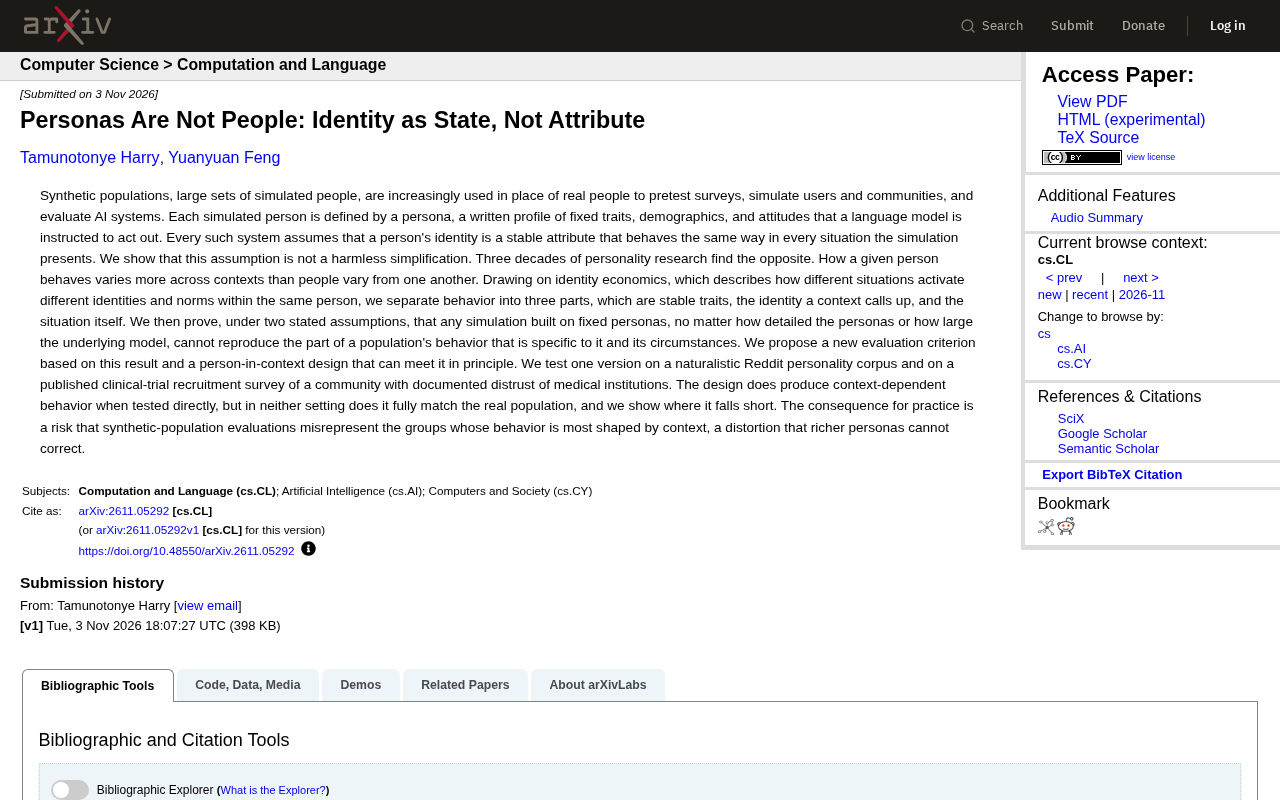
This approach rests on an unstated assumption: that a person's identity is a stable attribute that operates the same way regardless of how the simulated scenario changes. A study titled "Personas Are Not People: Identity as State, Not Attribute" directly challenges this assumption and uses a formal proof to show that any simulation based on fixed personas—no matter how detailed the profile or how powerful the underlying model—cannot reproduce the portion of population behavior that genuinely depends on context.
Why a "Human-Like" Profile Is Not the Same as "Being Human"
The researchers draw on three decades of personality psychology to reach a counterintuitive but robust conclusion: behavioral differences within the same person across different situations often exceed the average differences between people. In other words, if you only look at average performance across contexts, it is hard to pin down a person's behavior using a fixed set of traits.
More importantly, the study borrows the framework of identity economics. This framework holds that multiple identities coexist within the same individual, and different situations activate different identities and corresponding behavioral norms—one way of behaving in front of a doctor, another in a group of friends. Behavior can therefore be decomposed into three parts: stable traits, context-activated identity, and the context itself. Fixed personas capture only the first part, compressing the latter two into a static description.
Identity economics was proposed by economists George Akerlof and Rachel Kranton around 2000, with the core claim of introducing "identity" into the analytical framework of economic behavior. Traditional economic models typically assume that individual preferences are fixed and independent of social position, whereas identity economics holds that each person simultaneously belongs to multiple social categories (such as occupation, ethnicity, and gender roles), each carrying a set of behavioral norms; when an identity is activated by context, the individual acts according to the norms associated with that identity and derives utility or incurs psychological cost from doing so. This means that the "rational choices" of the same person in different social settings can differ systematically, not just randomly. The framework was initially used to explain phenomena such as racial segregation, educational investment, and gender division of labor, and was later widely borrowed into organizational behavior and market research.
The person–situation debate in personality psychology began with Walter Mischel's 1968 book, in which he pointed out that cross-situational behavioral correlations are typically only 0.2–0.3, questioning the predictive power of traditional trait theory. Decades of subsequent research formed a compromise consensus: traits do exist and are stable over time, but behavioral variance within a single situation is largely explained by situational factors; the claim that "differences within the same person across situations exceed differences between people" is a typical conclusion of this research tradition. It is often summarized as "traits predict the average, situations predict the specific moment." For simulation research, this empirical regularity means that inferring how someone will react in a specific scenario using only a static trait profile has an inherent methodological ceiling.
Formal Proof: Fixed Profiles Cannot Reproduce Context-Specific Behavior
The paper provides a proof under two explicitly stated assumptions. The core argument is that if synthetic population simulation takes fixed personas as its atomic unit, it cannot reproduce the behavior a group produces in its specific circumstances. This conclusion does not depend on how fine-grained the profiles are, nor on model scale—larger models or thicker persona text cannot fix a structural flaw.
This has direct practical implications. When the simulated group's behavior is highly context-dependent—for example, a community with a historical distrust of the medical system—synthetic population evaluation may systematically distort its true responses. And it is precisely these groups that are most likely to be misrepresented by fixed profiles.
The term formal proof here means that the authors did not rely on empirical data or case studies, but instead used a mathematical model to define "fixed persona simulation" as a mapping function, then derived the expressive capacity limit of that function family under explicit assumptions. The value of such proofs lies in the universality of the conclusion—it does not target a specific model or a particular way of writing profiles, but rather points out that any simulation architecture satisfying the premises has an irreducible error term. Readers should note its boundaries: the strength of the conclusion depends entirely on whether the two assumptions hold, and if real-world applications deviate from the assumptions, the proof's constraining force weakens accordingly. This is also why the authors provide empirical tests alongside the proof: the formal conclusion delineates impossibility, while experiments test how close alternative designs come to feasibility.
An Alternative Design and Its Boundaries
The authors do not stop at criticism but propose new evaluation criteria and a "person-in-context" design. This design attempts to let behavior vary with context rather than being derived from a static profile.
The researchers tested one version of this design in two scenarios: a naturalistic Reddit personality corpus, and a published clinical trial recruitment survey—the latter involving a community with documented distrust of medical institutions. The results showed that the design did produce context-varying behavior in direct tests. But in both scenarios, it did not fully match the real population, and the paper honestly points out where the mismatch occurred.
This shows that recognizing that "identity is a state rather than an attribute" is a necessary step, but there is still considerable distance to translating this insight into a reliable simulation method.
Implications for AI Evaluation and User Simulation
The value of this work lies not in rejecting synthetic populations but in delineating their applicable boundaries. Pre-testing, user simulation, AI system evaluation—if these scenarios involve context-sensitive behavior (trust, risk preferences, institutional attitudes), the results of fixed-persona simulation need to be treated with caution.
A practical recommendation is: when using synthetic populations, explicitly report the extent to which personas are allowed to vary with context, and shift the evaluation focus from "whether the profile is realistic" to "whether behavior correctly switches with context." After all, the differences in how a person behaves in different settings are precisely the most authentic part of identity.
One-line Summary
Research proves that fixed personas cannot reproduce context-sensitive behavior, and synthetic population simulation has structural flaws.
Paragraph Summary
The article introduces a study titled "Personas Are Not People: Identity as State, Not Attribute," which challenges the implicit assumption of synthetic population simulation—that identity is a stable attribute. Drawing on three decades of personality psychology and the framework of identity economics, the authors point out that behavioral differences within the same person across situations often exceed average differences between people, and that fixed personas capture only stable traits while losing context-activated identity and the context itself. The paper formally proves under two assumptions that any simulation based on fixed profiles—no matter how detailed the profile or how large the model—cannot reproduce the context-specific portion of population behavior. The authors propose a "person-in-context" alternative design, which produced context-dependent behavior in a Reddit corpus and a clinical trial recruitment survey, but did not fully match real populations in either case. The practical implication is: context-sensitive groups are most easily misrepresented, and when using synthetic populations, the degree of contextual variability of profiles should be reported.
Related articles
 Tech Frontiers
Sherlock: An Open-Source Tool for Tracking Usernames Across Social Networks
Sherlock is an open-source Python tool that tracks social accounts across networks by username. This article covers its core features, why developers love it, typical use cases, and privacy compliance considerations.
 Tech Frontiers
GitHub Daily·Nov 07: Agent-Ready and Context Compression
GitHub Trending Nov 07: meta's agent-ready design system astryx, billion-context's 5x context compression, sherlock nearing 100k stars, plus local-first localthings and bare-metal GPU orchestration nvke.
 Tech Frontiers
Buoyant Open-Sources Kinference: An Inference Control Plane for vLLM on K8s
Buoyant open-sources Kinference, an inference control plane for vLLM on Kubernetes, with declarative routing, KV-cache-aware load balancing, and per-tenant metrics—claiming 95% lower median TTFT in official benchmarks.