Why AI Wrapper Apps Are Still Thriving: A Deep Dive into the Survival Logic of Wrappers

AI wrapper apps thrive by excelling at scenario-specific prompt engineering, RAG, and UX polish.
Despite criticisms of having no moat, AI wrapper apps built on top of foundation models like GPT-4 and Claude continue to thrive. This article explains why through three key dimensions: scenario-specific prompt engineering, RAG-powered private data integration, and deep product experience polish. Drawing parallels to the cloud computing era, it argues that commoditized AI infrastructure actually empowers the application layer, and offers practical advice for AI entrepreneurs.
A Tweet That Sparked a Debate
A recent conversation circulating on Twitter has caught widespread attention in the industry. The exchange was brief:
Me: You stopped using ChatGPT and switched to duramata? User: Yes, it gives me better answers.
The poster then added a thought-provoking comment: "The era of wrappers is not over yet."
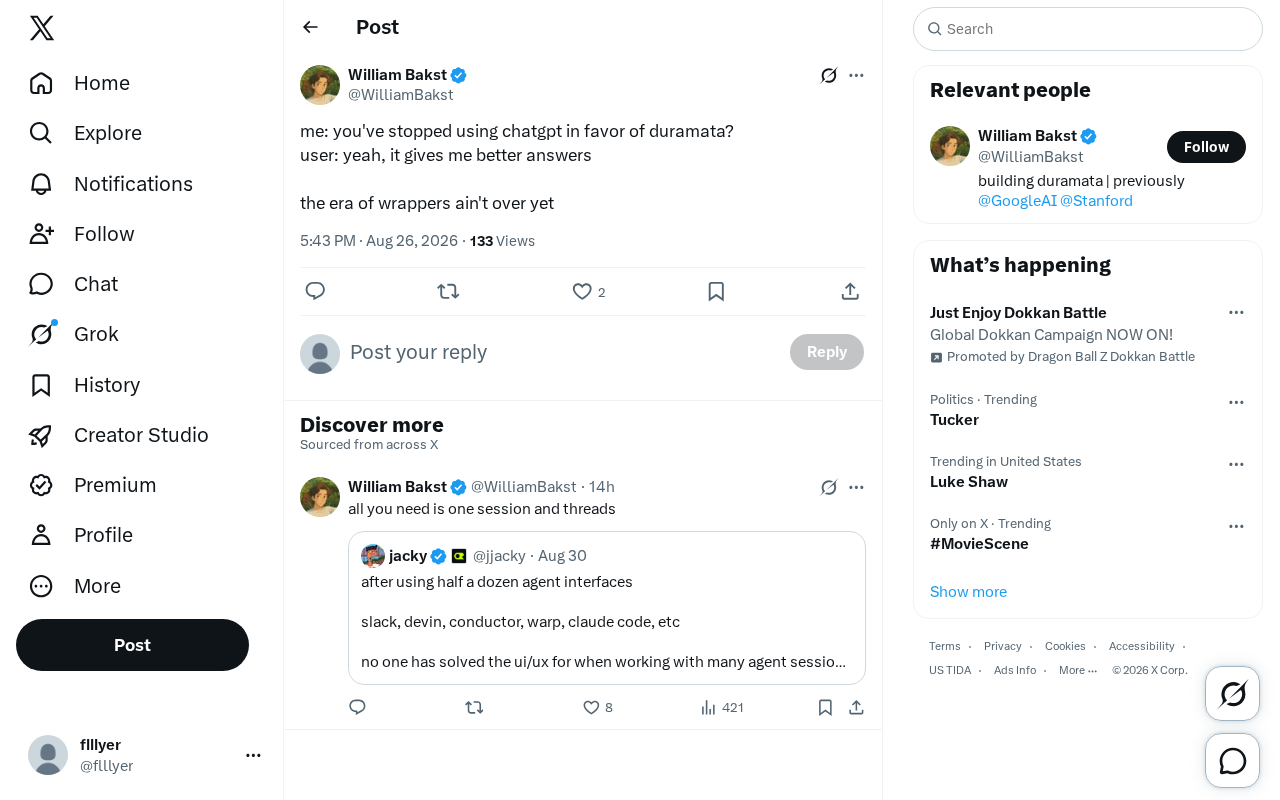
This seemingly simple conversation touches on a core and highly debated topic in today's AI application ecosystem: In an era of increasingly powerful foundation models, do "wrapper apps" — applications built on top of underlying models — still have room to survive? The market is rewriting the answer.
What Are AI Wrapper Apps?
In the AI industry, a "wrapper" typically refers to an application that doesn't train its own foundation model but instead calls APIs from providers like OpenAI, Anthropic, or Google, building a product experience on top of them. Specifically, these apps send user inputs to model providers' cloud servers via HTTP requests, receive the model's inference results, process them through their own business logic, and then present them to users in a customized way. Developers typically pay model providers based on the number of API calls or tokens consumed, meaning the marginal cost of wrapper apps is directly tied to the pricing strategy of the underlying model. According to a 2024 report by a16z, over 70% of the AI applications they tracked rely on at least one third-party LLM API at the foundational level — indicating that "wrapping" is not a fringe phenomenon but the mainstream form of AI entrepreneurship today.
These products are often criticized for having "no moat" — since their core capabilities come from third-party models, they could be instantly crushed the moment the underlying provider launches a competing feature.
Where Does the "Wrappers Are Useless" Argument Come From?
Over the past two years, as general-purpose assistants like ChatGPT and Claude have continuously improved, the industry was permeated with the narrative that "wrappers are dead." Critics mainly had three arguments:
- Foundation model providers hold advantages in compute, data, and technology, and will continuously absorb value from the application layer;
- Wrapper products lack technical barriers and are easy to replicate;
- Users will ultimately return to a "super assistant" that solves all problems through a single entry point.
This logic is quite compelling in theory and has made many investors cautious about pure application-layer startups. This concern has a professional term in the venture capital world — Platform Risk — meaning that when your business heavily depends on a platform, that platform can erode your survival space at any time through feature integration, policy changes, or direct competition. History is full of precedents: after Facebook tightened its Open Graph API in 2012, a wave of third-party apps that depended on its social data instantly lost their lifeline; Twitter's repeated API policy changes left numerous third-party client developers with devastating losses. However, history also proves that platform risk is not unmanageable — Salesforce was built on AWS, and Shopify grew on top of internet infrastructure. Both proved that the application layer can withstand platform risk through sufficiently deep value creation.
Why AI Wrapper Apps Are Still Thriving
Yet the real user feedback in the tweet above reveals another reality: For specific use cases, purpose-built wrapper apps often deliver better answers than general-purpose models.
The logic behind this isn't complicated. General-purpose assistants like ChatGPT aim to "do everything," but "doing everything" often means "excelling at nothing in particular." Vertical wrapper apps can establish differentiated advantages in the following ways:
Scenario-Specific Prompt Engineering
Carefully designed system prompts and workflows tailored to specific domains (such as law, healthcare, coding, or writing) can guide models to produce results that better meet professional needs. This represents long-tail demand that general-purpose assistants struggle to cover, and it's one of the most critical competitive advantages of wrapper apps.
Prompt Engineering refers to the technique of carefully constructing text instructions fed to LLMs to control and optimize output quality. It's far more nuanced than simply "writing a sentence for the AI to answer." In professional wrapper apps, prompt engineering typically involves multiple layers: First, the System Prompt presets the model's role, behavioral boundaries, and output format before the conversation even begins — for example, a legal consultation app might instruct the model: "You are a senior attorney well-versed in Chinese contract law. All answers must cite specific legal provisions and indicate risk levels." Second, Few-shot Examples embed several sets of high-quality Q&A samples in the prompt, helping the model understand the expected response style and depth. More advanced techniques include Chain-of-Thought Prompting, which guides the model to reason step by step rather than jumping straight to conclusions, dramatically improving accuracy on complex questions. A top-tier vertical app may have iterated through hundreds of versions of its system prompt — this accumulated know-how itself constitutes a hidden competitive barrier.
Connecting Private Data and Domain Knowledge via RAG
Through RAG (Retrieval-Augmented Generation) technology, wrapper apps can integrate industry knowledge bases, personal user documents, or real-time data, providing contextual information that general-purpose models cannot access, and thus delivering more accurate and relevant answers. This data-level uniqueness forms a hard-to-replicate competitive moat.
RAG (Retrieval-Augmented Generation) is one of the most important architectural patterns in today's AI applications. Its core idea is this: an LLM's knowledge comes from training data, which has a knowledge cutoff date and coverage blind spots. RAG compensates for these shortcomings by dynamically retrieving external knowledge at inference time. The workflow typically has three steps: The first step is Index Construction — splitting enterprise documents, industry reports, user data, and other unstructured information into small chunks, transforming them into high-dimensional vectors via an Embedding Model, and storing them in a vector database (such as Pinecone, Weaviate, Milvus, etc.). The second step is Semantic Retrieval — when a user asks a question, the system converts the question into a vector as well and finds the most semantically similar document fragments in the vector database. The third step is Augmented Generation — the retrieved relevant document fragments are concatenated as context along with the user's question and fed into the LLM, which generates answers based on this "evidence." This means a medical wrapper app can integrate the latest clinical guidelines and drug documentation, and a financial assistant can query real-time market data and research reports — none of which generic ChatGPT can do. This is the most robust data moat for wrapper apps.
Deep Polish on Product Experience
From interface design and interaction flows to how results are presented, products focused on a single scenario can push user experience to the extreme. This "last mile" of polish is precisely the territory that foundation model providers have no bandwidth to address.
In AI products, the significance of user experience goes far beyond traditional software. In traditional software, interaction logic is deterministic — clicking button A always produces result B. But AI product output is inherently probabilistic; the same question may yield answers of varying quality. This makes how to guide users to ask good questions, how to present uncertainty, and how to handle model errors critically important design challenges. For example, Cursor (an AI coding assistant) didn't simply embed a chat window in an editor — instead, it deeply integrated AI capabilities into code completion, diff comparison, multi-file editing, and other daily workflows of programmers. Perplexity (an AI search engine) innovatively attaches traceable citation sources to every answer, building user trust through transparency. These experience-level design decisions require an extremely deep understanding of the target user group's workflows and mental models — something foundation model providers simply cannot replicate across hundreds of vertical scenarios.
The Value Division Between Model Layer and Application Layer
The deeper insight here is that the AI ecosystem is forming a clear value stratification. Foundation model providers are responsible for delivering increasingly powerful "intelligence engines," while the application layer is responsible for transforming this general intelligence into products that solve specific problems.
This closely mirrors the evolution of the cloud computing era — AWS provided powerful underlying infrastructure but didn't eliminate the countless startups building SaaS products on top of it. On the contrary, powerful infrastructure lowered the barrier to application innovation and gave rise to an even more prosperous ecosystem. Looking back, when AWS launched S3 and EC2 in 2006, some questioned, "If AWS can do everything, who needs to build products on top of it?" But the reality is that AWS gave birth to a series of hundred-billion-dollar companies including Slack, Airbnb, and Netflix. The reason is that the standardization and commoditization of infrastructure actually unleashed innovation energy at the application layer — developers no longer needed to worry about server procurement and operations, and could devote all their effort to understanding user needs and polishing product experiences. The AI era is replaying this script: when the capabilities of GPT-4, Claude 3.5, Gemini, and other models become universally accessible "utilities," the decisive competitive factor is no longer "whose model is stronger" but "who better understands the user's specific problem."
It's worth noting that this value stratification is giving rise to a new middle layer — AI middleware and orchestration tools (such as LangChain, LlamaIndex, Flowise, etc.) — that help application developers more efficiently manage prompts, orchestrate multi-step AI workflows, and integrate capabilities from multiple models. This further lowers the technical barrier for wrapper apps, while also meaning that the center of competition will shift even more firmly toward scenario understanding and data assets.
In other words, improvements in foundation model capabilities haven't killed wrapper apps — they've actually raised the capability floor for all application-layer products. When every developer can easily access GPT-4-level intelligence, the competitive focus shifts to scenario understanding, data integration, and experience refinement.
Three Practical Tips for AI Application-Layer Entrepreneurs
The value of that tweet lies in how a single real user choice punctured the myth that "wrappers have no value." For teams currently building or planning to build at the application layer, several points are worth deep reflection:
- Don't put blind faith in "technical moat" as the only dimension. In the AI era, deep understanding of specific scenarios, unique data assets, and exceptional user experience can all constitute powerful competitive barriers. Warren Buffett's concept of a "moat" is essentially about sustainable competitive advantage — it was never limited to technology alone. Brand recognition, user habits, network effects, and data flywheels are all legitimate and powerful forms of moats.
- Focus beats omnipotence. Rather than trying to build the next ChatGPT, strive to perfect answer quality in a niche domain, making your product indispensable for users' specific needs. This aligns with classic strategic thinking: building absolute dominance in an "inch-wide, mile-deep" area often has more staying power than dabbling an "mile-wide, inch-deep" across the board.
- Embrace improvements in foundation models. Every upgrade to the underlying model is a free capability boost for the application layer. Smart product teams quickly convert these dividends into user value. In practice, this means your application architecture should adopt a model-agnostic design — don't deeply couple your product logic with any single specific model. Instead, maintain the flexibility to switch underlying models, so when a better and cheaper model emerges, you can pass that improvement to your users immediately.
Conclusion: User Value Is the Ultimate Standard
"It gives me better answers" — this simple piece of user feedback may be more persuasive than any industry analysis. Technological sophistication must ultimately be grounded in user value, and in the process of converting general intelligence into concrete value, wrapper apps play an irreplaceable role.
As that conclusion states: the era of wrapper apps is far from over. The real question has never been "should we build a wrapper" — it's "how to build an application that truly solves problems and becomes indispensable to users."
Related articles

Workbuddy for Absolute Beginners: How a Desktop AI Agent Fits Into Real Workflows
A beginner's guide to the Workbuddy desktop AI agent: installation, claiming credits, file management, and building automated workflows—compared with CodeX for fit and cost, helping professionals shift from AI question-askers to AI managers.

OpenAI's New Agent Stack: Computer Use, Decisions API, and Ultra-Fast Workflows
OpenAI Dev Day unveiled a new agent stack: Computer Use outperforms humans, Decisions API delivers ultra-low-latency classification via Luna, Agents API opens the same Computer Use capabilities, and GPT-6.1 Sol costs only one-seventh of Astra. Core updates, benchmark data, and developer insights.

Liang Wenfeng Open-Sources DeepInfo Inference Framework, Takes On U.S. Ban
DeepSeek open-sources its DeepInfo inference framework after its models, featuring GPU/CPU cross-pipelining, small-model prediction with large-model verification, and full Huawei Ascend and NVIDIA chip support—facing the U.S. federal ban head-on. This article analyzes its significance for AI deployment and open-source strategy.