Why an 'AI First' Company Hit the Brakes on AI: The Dual Crisis of Cost and Capability

A Fortune 500 company's AI First strategy collapsed under the weight of legacy system failures and runaway API costs.
A Fortune 500 developer's Reddit post reveals how his company's ambitious AI First strategy unraveled. Despite company-wide training and full tool deployment, AI failed to rewrite a legacy system, generated dangerous SQL code that dropped database constraints, and racked up costs that forced leadership to revoke Claude access entirely. The case exposes three systemic issues: AI's hard capability boundaries with complex systems, underestimated hidden costs, and unit economics that don't yet add up at enterprise scale.
The Strategic Reversal of an 'AI First' Company
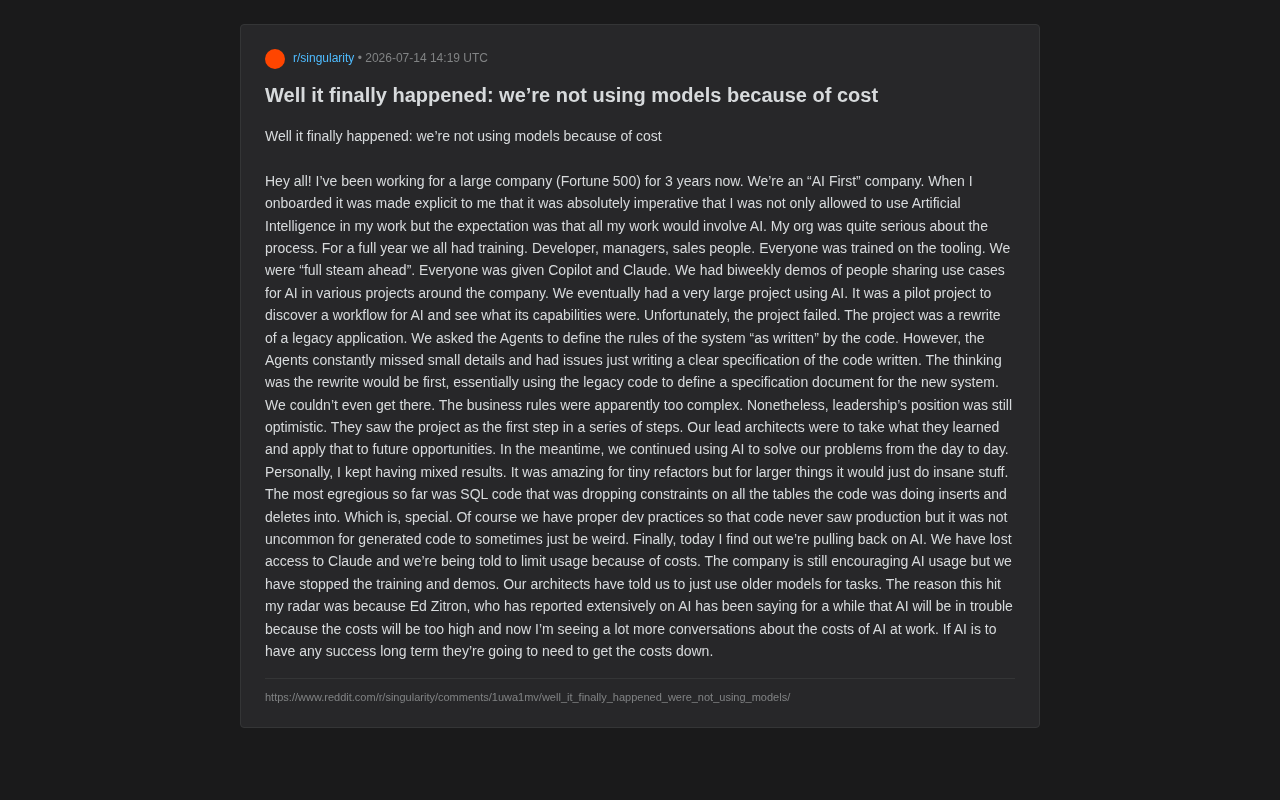
Recently, a developer with three years at a Fortune 500 company shared a remarkably telling story on Reddit that sparked widespread discussion. His company had been a committed "AI First" advocate — from day one, employees were expected to use artificial intelligence in their work, with "AI should be involved in everything" essentially a hard requirement.
Yet the ending was surprising: the company began scaling back its AI strategy, employees lost access to Claude, and were told to limit usage due to cost concerns. The post resonated so widely because it reflects the real struggles many enterprises are facing during AI adoption — the vast gap between technological enthusiasm and economic reality.
All In: A Large-Scale AI Transformation
The company's investment in AI transformation was substantial. According to the developer, the company ran company-wide training for an entire year, covering developers, managers, and even sales staff — everyone had to learn how to use AI tools.
From Tool Deployment to Cultural Adoption
The company equipped every employee with GitHub Copilot and Claude, and held biweekly demo sessions encouraging teams across departments to share real-world AI use cases. This top-down approach reflects a classic enterprise AI transformation playbook: first build cultural buy-in, then enable through tools, then drive adoption into specific business workflows.
It's worth noting a significant practical difference between this kind of Mandated Adoption versus Organic Adoption. While mechanisms like biweekly demos help spread best practices, they also tend to create "Showcase Bias" — teams naturally highlight successes while failures get systematically filtered out, leading management to develop an overly optimistic view of AI capabilities. From the perspective of the Technology Adoption Lifecycle, aggressive leaps by enterprises often skip the critical "pilot validation" and "capability boundary assessment" phases, jumping straight to "full rollout" — and this institutional shortcut is the root cause of these kinds of strategic reversals.
By any measure, this was not a tentative experiment — it was a genuine, committed, strategic-level deployment. Which makes the subsequent "emergency brake" all the more instructive.
The Key Failure: AI Couldn't Handle Complex Legacy Systems
The company launched a flagship pilot project: rewriting a legacy application system. The team's approach was clever in concept — have an AI Agent read the existing codebase, distill the "code-as-rules" business logic into a specification document, then rebuild the new system based on that spec.
Stuck at Step One: Couldn't Even Produce the Spec
The project stalled at the very first step. The AI Agent "kept missing small details and couldn't even clearly write out the existing code as a specification," the complexity of the business rules exceeded what the model could handle, and the team "couldn't even get past the spec document stage."
This failure point is worth examining closely. Modern LLMs (Large Language Models) use the Transformer architecture, and while context windows have expanded from the early 4K tokens to hundreds of thousands of tokens, attention degradation on earlier content still occurs as context length grows. Legacy systems often contain hundreds of thousands to millions of lines of code — far beyond single-pass processing capacity — and embed decades of accumulated business logic that often exists nowhere except in edge cases and exception-handling branches, completely undocumented. On top of this, the "spaghetti code" common in legacy systems creates extremely complex inter-module dependencies, making it easy for AI to miss implicit cross-module constraints when attempting to extract specifications.
Today's leading LLMs perform well on isolated, clearly bounded, small tasks, but when facing highly coupled systems with massive context and heavy implicit business constraints, they reveal their weaknesses: incomplete understanding and lost details. Legacy systems are full of "only the code knows" hidden rules — and that's exactly where AI is most likely to fall short.
Everyday Use: The 'Schrödinger's Code Quality' Problem
Even outside the pilot project, the developer's day-to-day experience was mixed. He acknowledged that AI performance on small refactoring tasks was "impressive," but as tasks scaled up, it would "do crazy things."
A Genuinely Alarming Real-World Example
In the most extreme case, AI-generated SQL code for insert and delete operations actually DROPped all constraints on the relevant tables. He described it with dark humor as "special."
This case strikes at the core of database integrity. Database constraints — including primary keys, foreign keys, unique constraints, and check constraints — are the foundation of data consistency in relational databases. Foreign key constraints are especially critical: they automatically validate cross-table references during INSERT or DELETE operations, preventing orphaned data. The reason AI generates code that drops constraints is typically because the model treats "bypassing the constraint to complete the operation" as the shortest path to resolving the current error, without considering the long-term damage to the entire data model's integrity. This illustrates a classic LLM failure mode: optimizing for a local objective (making the code run) while lacking deep understanding of global system state and business risk.
Fortunately, the company had solid development processes and code review mechanisms in place, so this dangerous code never reached production. But the case exposes a core issue: the reliability of AI-generated code fluctuates unpredictably. It might work great 90% of the time, but that 10% of "wild outputs," if it slips through, can be catastrophic. This also means enterprises can't cut human review costs — the efficiency gains from AI are partially offset by the ongoing investment in oversight.
Costs Break the Camel's Back: From Full Speed to Rationed Usage
After the project failure, company leadership initially remained optimistic, framing it as "a first step in an exploratory process." But what ultimately triggered the strategic reversal wasn't the capability problem — it was the cost problem.
Strategic Exit: Switch to Cheaper, Older Models
Today, the company has stopped AI training and demo activities, revoked access to Claude, and architects have been told to "use cheaper, older models for everyday tasks." The company nominally still encourages AI use, but has in practice retreated from "strategic priority" to "limited use under cost constraints."
It's worth understanding the structural cost pressure of enterprise AI inference. Top-tier models like Claude and GPT-4 are typically priced per million tokens, with input and output tokens priced separately, and costs significantly higher than earlier models as capabilities have improved. For high-frequency, long-context enterprise scenarios (such as code review and document processing), actual bills can grow exponentially. More critically, when enterprises evaluate AI benefits, they typically only count "saved labor hours" while ignoring the ongoing cost of maintaining human review workflows, the remediation costs of handling AI errors, and the project delay risk from unstable AI output quality. This systematic underestimation of costs is the structural reason why AI project ROI figures are so consistently inflated across the industry.
The developer drew a connection to tech commentator Ed Zitron's long-standing warning that AI's high costs would eventually become a stumbling block. And now, this developer has witnessed that prediction play out firsthand at his own company — and notices that conversations about "AI costs" in the workplace are becoming noticeably more common.
What This Case Reveals About Deeper Issues
This real-world frontline account provides a sober counterpoint to the current AI hype cycle. It exposes at least three layers of problems:
First, capability boundaries remain very real. AI excels at small, well-defined tasks, but remains unreliable in complex business logic and large-scale system refactoring scenarios. Enterprises that blindly expect AI to "rewrite legacy systems at the push of a button" are likely to hit a wall.
Second, hidden costs are systematically underestimated. The unpredictability of AI-generated code requires enterprises to maintain or even strengthen human review — an investment that's often left out of ROI calculations, inflating expected returns.
Third, the unit economics haven't been proven out. When even a Fortune 500 company starts pulling back because of the bill, it suggests that the current pricing of top-tier models may still be "too expensive to justify" for large-scale, high-frequency enterprise applications.
As the developer concluded: "If AI wants to achieve long-term success, it has to bring costs down." As model capabilities continue to improve, the real question may be whether inference costs can drop dramatically enough to make the economics of enterprise AI actually work — and that may be the single most decisive variable in determining whether this wave of AI adoption truly succeeds.
It should be noted that this is a single, anonymous personal account from Reddit, and the specific details cannot be independently verified. However, the two core themes it reflects — capability gaps and cost pressure — are increasingly echoed in broader industry discussions.
Key Takeaways
Related articles

Felix Rieseberg Personal Homepage
Felix Rieseberg's personal homepage sparks attention on Hacker News. This article covers the Slack engineer's technical background, the rise and fall of nativefier, and the value of a developer homepage as a tech calling card.

@ai-sdk/vue 3.0.306 Patch Release Syncs with [email protected] Update
@ai-sdk/vue 3.0.306 released, synced with [email protected]. A routine patch release for the Vercel AI SDK ecosystem with no public API changes; the Vue adapter layer stays version-aligned with the core package.

Gemini 4 Argon API Launches: The Era of Million-Token Output Begins
Google launches Gemini 4 Argon with sparse MoE architecture, up to 1M output tokens, and a 68.90% Vals Index score, available across API, AI Studio, and the Gemini app.