Why an Open Ecosystem Is the Key to AI Safety

Open or closed? Exploring the deep tension between AI ecosystem transparency and safety.
This article analyzes the claim that "only an open ecosystem can guarantee AI safety." Proponents argue that transparency enables independent auditing (akin to open-source software's 'many eyes' effect) and that decentralizing AI capabilities are prerequisites for genuine safety. Opponents worry that openly releasing powerful models makes them accessible to malicious actors. The article frames this as a balance between auditable transparency and controlled non-proliferation, raising deeper questions about democratic governance of AI safety decisions and ultimately characterizing the debate as a fundamental dispute over who controls AI and what governance philosophy should guide it.
Core Argument: The Link Between Open Ecosystems and AI Safety
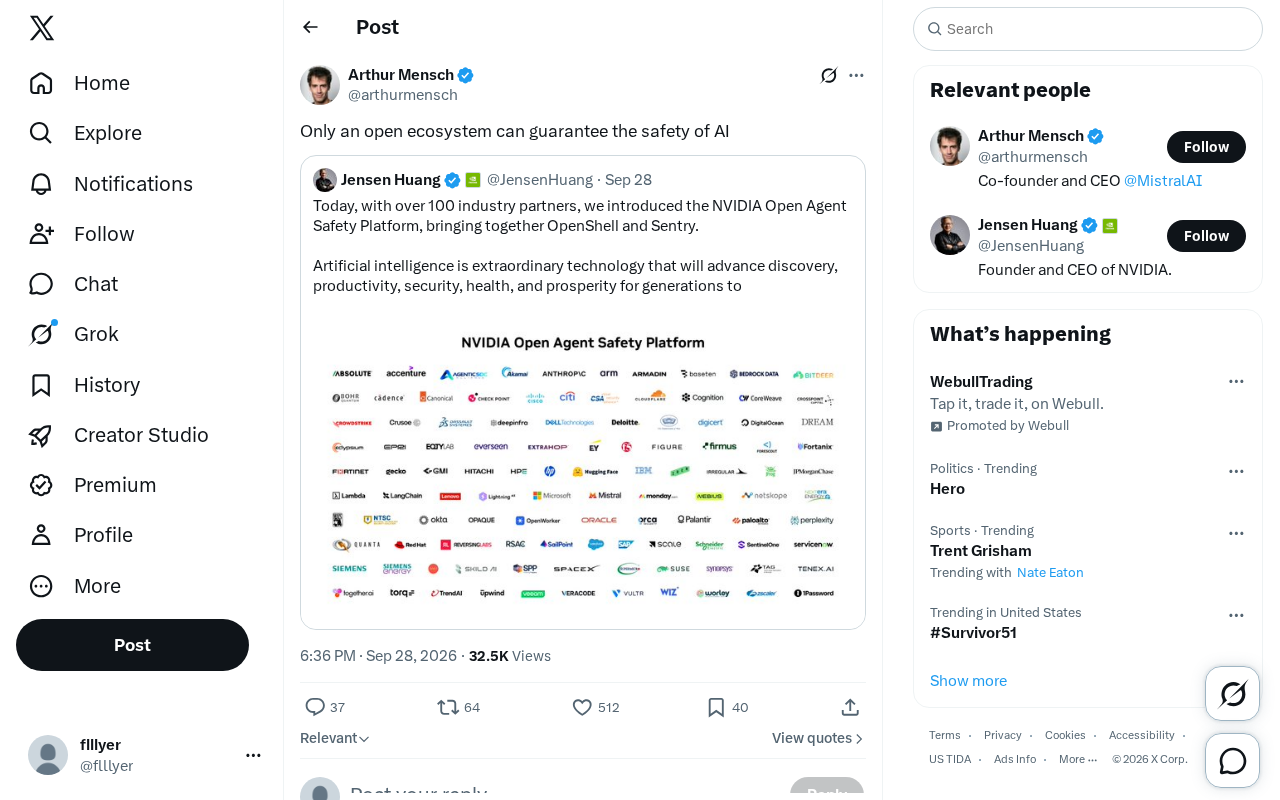
A perspective that has sparked debate on social media asserts: "Only an open ecosystem can guarantee the safety of AI." Though concise, this statement cuts to one of the most contentious issues in AI development today — whether AI systems should move toward closed, proprietary models or open, transparent ones.
Behind this claim lies a fundamental judgment about how AI safety governance should work. It argues that safety is not achieved by locking technology inside a handful of companies, but through broad participation, public scrutiny, and community collaboration.
The Safety Logic of Open Ecosystems
Transparency Enables Auditability
The core advantage of an open ecosystem is transparency. When model architectures, training methods, and even weights are made publicly available, a broader community of researchers can independently audit systems, identify vulnerabilities, and propose fixes. This "many eyes" mechanism has already been shown to improve security in traditional open-source software — potential flaws are more likely to be caught early by the community, rather than lurking inside closed systems until they are exploited maliciously.
The clearest expression of this logic in the AI domain is Red Teaming — where researchers adopt an attacker's perspective to proactively uncover security vulnerabilities and harmful output tendencies in models. Open-source models allow independent security researchers to conduct this kind of work without requiring permission from the vendor. Take Meta's LLaMA series as an example: after its weights were released publicly, the academic community documented a large number of jailbreak techniques in a short period, pressuring the entire industry to take alignment research more seriously. By contrast, security testing of closed-source models typically relies on the company's internal teams, and external researchers can only conduct limited black-box testing through APIs. This information asymmetry makes it much harder to detect systemic vulnerabilities in a timely manner.
Preventing Concentration of Power
Another important argument for open ecosystems is the prevention of AI capabilities from becoming overly concentrated in a small number of institutions. If the most advanced AI technology is controlled by only a handful of companies, it risks not only creating a technology monopoly, but also centralizing the authority to set safety standards. By distributing technical capabilities, open ecosystems reduce the risk of single points of failure and the abuse of power.
From an AI governance perspective, the concentration of technical capability carries a risk structure similar to that of political power concentration. A few companies controlling frontier models effectively grants them "private legislative authority over safety standards" — the direction of value alignment, content filtering boundaries, and access restriction rules are all decided unilaterally by commercial entities, with no democratic accountability mechanism. Scholars who support open ecosystems (such as some researchers at Stanford's HAI institute) therefore argue that AI infrastructure should be governed like public infrastructure, and that openness is the structural prerequisite for introducing multi-party oversight and preventing any single actor from abusing power. This perspective elevates "openness" from a technical choice to a question of political economy and governance.
Dissenting Views
It's worth noting that "openness guarantees safety" is far from an industry consensus. Critics argue that fully open, powerful AI models can equally be exploited by malicious actors for generating disinformation, conducting cyberattacks, or other harmful purposes. Proponents of closed models contend that controlled deployment and access restrictions are better at preventing capabilities from reaching irresponsible users.
At its core, this debate is about finding a balance between "auditable transparency" and "controlled non-proliferation." Both positions have merit, and real-world AI governance often requires trade-offs between the two rather than an either/or choice.
In academic circles, this tension is framed as the "Openness Dilemma": openness improves the efficiency of research and security auditing, while simultaneously lowering the barrier for harmful use. In 2023, a group of AI safety researchers co-signed articles in journals including Science, warning that openly releasing models capable of enhancing biochemical knowledge could create irreversible proliferation risks — a security problem analogous to nuclear proliferation. On the other side, open-source communities represented by EleutherAI and Hugging Face emphasize that "Security through Obscurity" has historically been a fragile strategy from an information security standpoint, and that genuine security must be built on verifiable transparency. Neither position currently has sufficient empirical support, and the debate continues.
Implications for the Industry
Regardless of which model ultimately prevails, this perspective reminds the industry to focus on several critical questions: Should decision-making authority over safety governance be democratized? To what extent does technical transparency help rather than harm security? And how can effective mechanisms be established to balance open collaboration with the prevention of misuse?
As AI capabilities continue to advance, the debate around open versus closed systems will only intensify. Whether an open ecosystem can truly "guarantee" safety still requires more real-world validation — but the principles it champions, transparency, collaboration, and decentralization, undoubtedly offer an important dimension for thinking about AI safety governance.
Conclusion
A single, concise assertion reflects the deep tensions underlying the choices being made about AI's development path. What an open ecosystem represents is not merely a technical decision, but a fundamental dispute over the governance philosophy of who controls AI and how its safety is ensured. On this issue, keeping the conversation itself open may well be the first step toward a safer AI future.
Related articles

Chain of Thought Isn't Just for AI: How Humans Can Use CoT to Improve Thinking Quality
Chain of Thought isn't just a prompt trick for large models. Starting from a Hacker News discussion, this article analyzes why CoT works for human thinking too, breaks down actionable ways to transfer it, and highlights the key differences between human CoT and machine CoT.
Cloudflare Teams Up with OpenAI: Closi…
Cloudflare Teams Up with OpenAI: Closing the Loop from Vulnerability Discovery to Defense with AI
Cloudflare uses OpenAI Daybreak to investigate security vulnerabilities and generate reviewable remediation plans, while developers use Codex to boost coding efficiency and quality.

Orca Multi-Agent Orchestration in Practice: A Guide to Parallel Collaboration with Claude and Codex
Orca is Stable AI's free open-source agent workbench supporting 34 agents like Claude Code and Codex in parallel. Learn its Git worktree isolation, multi-model orchestration, and mobile management.