Why Are Brutalist Fast Food Restaurant Designs Sparking Debate?
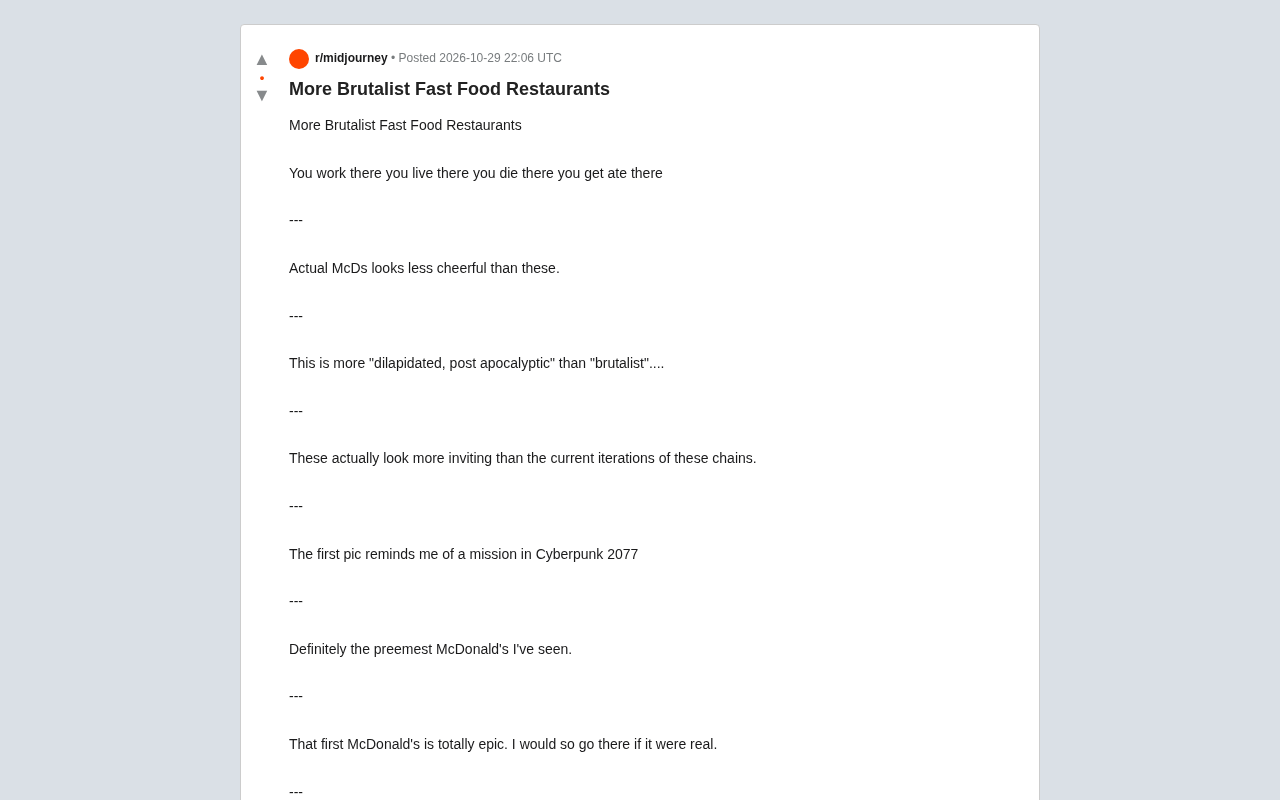
Brutalist fast food concept designs on Reddit spark debate, reflecting the clash of architecture and consumer culture.
The article discusses a Reddit post featuring Brutalist-style fast food restaurant designs that reimagine McDonald's and KFC with exposed concrete and heavy geometry, subverting the bright, cheerful image of fast food. Netizens react diversely, drawing comparisons to Cyberpunk 2077 or post-apocalyptic wastelands, with some finding them more appealing than actual chain stores. It also cites a real converted KFC in Manila and analyzes why these designs resonate: the novelty of contrast, a critique of consumerist spectacle, and the popularity of cyberpunk and wasteland aesthetics.
Why Are Brutalist Fast Food Restaurant Designs Sparking Debate?
What would McDonald's, KFC, and other fast food giants look like if they traded their usual facades for Brutalist architecture? A recent Reddit post, "More Brutalist Fast Food Restaurants," has ignited lively discussion online. The post showcases a series of fast food restaurant designs reimagined in the Brutalist style—characterized by exposed concrete, heavy geometric volumes, and stark lines—completely upending the conventional image of bright, cheerful fast food outlets.
The Collision of Brutalism and Fast Food Culture
Brutalist architecture flourished from the 1950s to the 1970s, emphasizing material honesty and structural exposure. It often employed raw, unfinished concrete (béton brut), creating a visual experience that is heavy, rugged, and even somewhat oppressive. Fast food culture, by contrast, is typically associated with vibrant colors, warm lighting, and a family-friendly atmosphere. The combination of the two produces a striking contrast and a sense of drama.
The designs featured in the post are not real buildings but conceptual renderings. These images incorporate iconic elements of fast food brands—such as the Golden Arches and Colonel Sanders—into the language of Brutalist architecture, evoking a feeling that is both familiar and alien. For instance, one McDonald's design features massive concrete arches and enclosed volumes, entirely devoid of the glass curtain walls and bright interiors typical of a conventional McDonald's.
Background on Brutalism The term "Brutalism" derives from the French "béton brut," meaning "raw concrete," and was first used by architectural critic Reyner Banham in 1955 to describe Le Corbusier's Unité d'Habitation in Marseille. The movement peaked in the 1950s–70s, with key figures including Le Corbusier, Paul Rudolph, and the British duo Alison and Peter Smithson. Its core tenet is the honest expression of materials and structure, rejecting ornamentation, and it often manifests through massive concrete volumes, coarse surface textures, and monumental scale. Brutalist buildings were frequently used for public institutions such as universities, libraries, and city halls, and thus carry associations of authority, permanence, and even austerity. The style fell out of favor after the 1980s, deemed cold and ugly, but in recent years it has experienced an aesthetic revival on social media, becoming a symbol of nostalgia and rebellion in popular culture.
Netizen Reactions: From Cyberpunk to Post-Apocalyptic Wasteland
Reddit users responded to these designs in a variety of ways. One commented, "The first image reminds me of a mission in Cyberpunk 2077." This association is no coincidence—the starkness of Brutalism shares a natural affinity with the high contrast, megastructures, and dystopian atmosphere of cyberpunk aesthetics.
Another user pointed out, "This feels more 'derelict, post-apocalyptic' than 'Brutalist'..." This view represents a segment of opinion: while Brutalism is rugged, it is not derelict—it is a deliberate aesthetic choice. Some designs in the post may appear more desolate due to rendering effects or environmental settings.
Interestingly, some also remarked, "These look more appealing than the current chain store versions." This may reflect a kind of aesthetic fatigue with the cookie-cutter glass-box style of today's fast food outlets, and a turn toward appreciating more distinctive and textured architectural expressions.
Cyberpunk vs. Post-Apocalyptic Aesthetics Cyberpunk is a sci-fi subculture that emerged in the 1980s, with Neuromancer and Blade Runner as its landmark texts. It emphasizes "high tech, low life"—megacorporations rule, cities are dense and vertical, and neon intermingles with shadows. Its visual aesthetic often includes massive concrete structures, dense pipes and signage, and dark, damp streets, which naturally align with the monumental volumes and stark textures of Brutalism. Post-apocalyptic aesthetics, on the other hand, focus on ruins and residual structures after the collapse of civilization, emphasizing decay, rust, and nature reclaiming the built environment. The difference between these and Brutalism lies in intent: Brutalism is a conscious design choice pursuing order and power, while cyberpunk and wasteland aesthetics emphasize chaos, decay, and dystopian atmosphere. The debate among netizens stems precisely from this confusion between "style" and "mood."
Real-World Brutalist Fast Food Buildings
While most designs in the post are conceptual works, Brutalist-style or industrial-feeling fast food buildings do exist in reality. One user shared a photo of a KFC building in Manila, Philippines, along with a Reddit link. The building, converted from an industrial structure, exhibits Brutalist characteristics: heavy concrete structure, exposed framework, and simple geometric forms.
This real-world example shows that Brutalism and commercial architecture are not entirely incompatible. Under certain conditions, brands may choose this style to create a unique landmark effect, or repurpose existing industrial buildings to reduce costs while achieving a distinctive spatial experience.
Why Do Brutalist Fast Food Designs Resonate?
There are several deeper reasons why this set of conceptual designs has sparked such heated discussion.
The novelty of contrast. Fast food restaurant design typically pursues approachability and efficiency, while Brutalism emphasizes power and permanence. This contrast breaks the inherent expectations of brand image and creates a strong visual impact.
A reflection on the spectacle of consumerism. Brutalism is often associated with public and institutional buildings; when applied to commercial fast food, it seems to imply a critique or parody of consumer culture. One user even joked, "You work there, you live there, you die there, you get eaten there." This dark humor reveals a complex emotional response to fast food culture.
The popularity of cyberpunk and post-apocalyptic aesthetics. In contemporary popular culture, cyberpunk and wasteland aesthetics have a large following. Brutalist fast food designs happen to fit this aesthetic preference, evoking scenes from a future dystopian society.
The Spectacle of Consumerism The concept of the "spectacle of consumerism" can be traced back to Guy Debord's The Society of the Spectacle, which argues that in a consumer society, images and displays replace authentic experience and become the dominant social relations. Fast food restaurants, as typical consumer spaces, embody this "spectacle" through their bright colors, standardized stores, and brand logos. Brutalist fast food designs carry a critical edge because they wrap the most commercial brand symbols in a heavy, non-commercial architectural language, creating a defamiliarizing effect that makes viewers realize that their taken-for-granted consumer environment is actually a carefully designed spectacle. This contrast prompts reflection on the relationship between brand image, spatial power, and everyday consumption—one of the deeper reasons the topic resonates widely on platforms like Reddit.
Thoughts Behind the Design Concepts
These conceptual designs are more than a simple transplant of architectural style; they are a form of cultural commentary. They prompt us to consider: Must brand image be uniform? Can commercial spaces carry more artistic expression? How does architectural style affect people's perception of place?
Of course, realizing these designs in the real world faces numerous challenges, including cost, brand consistency, and consumer acceptance. But as creative explorations, they undoubtedly expand the imaginative boundaries of fast food restaurant design.
Conclusion
The conceptual designs of Brutalist fast food restaurants have sparked heated discussion on Reddit, serving as both an exploration of architectural aesthetics and a reflection on fast food culture and consumer society. From cyberpunk associations to real-world examples, this debate demonstrates how design can ignite public imagination. Perhaps one day, we will indeed see a Brutalist McDonald's or KFC, becoming a distinctive sight in the city.
One-line Summary
Brutalist fast food restaurant concept designs on Reddit spark debate, reflecting the collision of architectural aesthetics and consumer culture.
Paragraph Summary
The article introduces a Reddit post showcasing conceptual Brutalist-style fast food restaurant designs. These reimagined McDonald's, KFC, and other brand images—built from exposed concrete and heavy geometric volumes—completely overturn the traditional perception of bright, cheerful fast food outlets. Netizen reactions vary: some are reminded of Cyberpunk 2077, others question whether the designs are closer to post-apocalyptic wasteland than Brutalism, and some find them more appealing than real chain stores. The article also mentions a real-world example of a KFC converted from an industrial building in Manila, Philippines, and analyzes the deeper reasons behind the popularity of such designs: the novelty of contrast, a reflection on the spectacle of consumerism, and the popularity of cyberpunk and post-apocalyptic aesthetics. Finally, it points out the value of these conceptual designs as cultural commentary and the challenges of realizing them.
Related articles

Agentic Coding with Small Models: 100x Lower Cost, Double the Success Rate
Explore how to build efficient agentic coding workflows with small language models, balancing cost, privacy, and latency. Learn about model types, local running advantages, evaluation methods, and practical tips to achieve 100x lower cost and double the success rate.
Jetpack AppState: Taking Compose State Beyond the UI Layer
Jetpack AppState extends Compose snapshot state into the data and domain layers: transform uses headless composition to derive state, and State Store enables cross-component sharing and persistence, solving Flow orchestration and process-death pain points.

Android Developer Verification: Four Paths and Global Rollout Timeline
Android Developer Verification explained: Google unveils four verification paths—Play developers, independent distributors, students/hobbyists, and power users—plus developer console API automation, 24-hour safety delay, and global phased enforcement timeline.