Why Are Open Source Communities Banning AI-Generated Code Contributions?

Open source projects are increasingly restricting AI-generated code contributions, reflecting multiple tensions around copyright, trust, and review responsibility.
A Hacker News discussion about open source projects banning AI-generated contributions has drawn attention, reflecting that this phenomenon is evolving from isolated actions into a community governance issue. The article outlines three concerns behind the bans: unclear copyright ownership and license compatibility of AI-generated code; AI patches lacking genuine understanding of project context, diluting trust and spawning "contribution farming"; and maintainers facing responsibility attribution and extra review burdens. Community responses diverge, with blanket bans coexisting alongside requirements to disclose AI involvement. For developers, reading contribution guidelines and confirming AI usage policies before submitting is becoming a new basic etiquette.
A New Controversy in Open Source: Should AI-Generated Contributions Be Rejected?
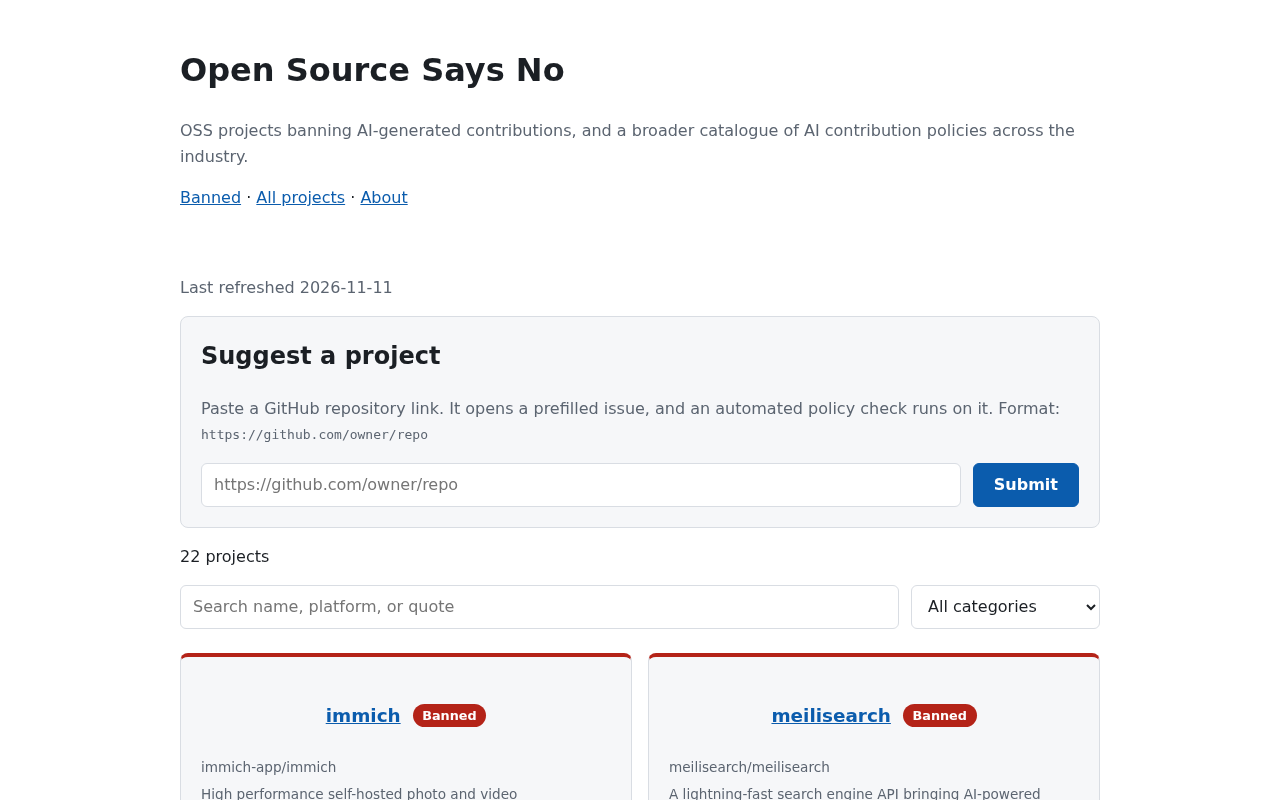
A Hacker News discussion titled "OSS projects banning AI-generated contributions" has drawn widespread attention, earning 45 points and 54 comments. The core of the debate is clear: more and more open source projects are explicitly prohibiting or restricting code contributions generated by AI. This is not an isolated action by a few projects but a community governance phenomenon that is spreading, involving multiple tensions around copyright, trust, and collaborative ethics.
Three Concerns Behind the Bans
The Gray Area of Copyright and Licensing
The legal foundation of open source projects is licensing, yet there is still no unified answer on the copyright ownership of AI-generated code. When a piece of code is produced by a large model, whether it is protected by copyright and whether it can be incorporated as-is into projects using MIT or GPL licenses remain uncertain. Maintainers worry that accepting AI-generated contributions could introduce untraceable rights defects into the entire codebase, planting hidden risks for future commercial use or redistribution.
The copyright dispute over AI-generated code stems from the legal relationship between training data and output. Large models are typically trained on massive amounts of public code, which may include snippets under different licenses such as GPL and Apache; whether model output constitutes a derivative or reproduction of the original code has yet to form unified judicial precedent across countries. The U.S. Copyright Office has explicitly stated that content purely generated by machines, lacking creative human authorship, is not protected by copyright—meaning AI-generated code may enter the public domain, or at least have an unclear rights status. For projects using "viral" licenses like GPL, if AI output is found to contain GPL-constrained snippets, it could force the entire project to be released under GPL, conflicting with the project's original license. Thus, maintainers' concerns are not unfounded but involve real legal risks around license compatibility review.
Contributor Trust and the "Contribution Farming" Problem
Open source collaboration has long relied on trust between people: submitters understand every line of code they write, and reviewers judge quality accordingly. AI-generated patches may look reasonable but lack genuine understanding of the project context and may even contain subtle errors. Maintainers find it hard to distinguish "submissions made after careful thought" from "submissions batch-generated with tools," which raises review costs and dilutes the foundation of community mutual trust.
The term "contribution farming" originates from discussions in open source communities about contribution motives. On platforms like GitHub, commit records and PR counts are often used as quantitative indicators for employment, promotion, or project influence, giving rise to the behavior of submitting low-quality patches for quantity's sake. AI tools have greatly lowered the threshold for generating seemingly reasonable code, making batch submissions easier and further amplifying this problem. Related to this is the phenomenon of "AI laundering": submitters use AI to generate code without disclosure, while reviewers mistakenly believe it is the result of human deliberation. Open source review is essentially trust-based peer review, where reviewers assume submitters have taken responsibility for the code; once this assumption is broken, reviewers must assume every submission may contain unverified AI output, systematically raising review costs.
Review Burden and Responsibility Attribution
Even if a project does not oppose AI assistance, maintainers face a new problem: when AI-generated contributions go wrong, who bears responsibility? Does the submitter truly understand and take responsibility for the code? Without a clear disclosure mechanism, reviewers must spend extra effort to screen submissions, a real burden for open source projects that already rely on volunteer time.
Community Responses and Divergence
The discussion reveals that different projects have different attitudes. Some choose a blanket ban, explicitly requiring in their contribution guidelines that submitters declare they have not used AI-generated content; others take a gentler approach, requiring disclosure of the extent of AI involvement and leaving case-by-case judgment to maintainers. Still others argue that bans are difficult to enforce and may inadvertently harm legitimate AI-assisted scenarios, such as using AI for code completion or documentation drafts.
The focus of disagreement is: are bans a necessary means of protecting the community, or an unenforceable gesture? Supporters emphasize that rules first can reduce subsequent disputes, while opponents worry that excessive restrictions will alienate newcomers willing to contribute.
Governance tools for AI contributions in open source projects are gradually taking shape. Common practices include: adding AI usage disclosure clauses to CONTRIBUTING.md, requiring submitters to state in PR descriptions whether and how AI was used; introducing extended signing items for the Developer Certificate of Origin (DCO), letting submitters declare they hold legal rights to their contributions; and some projects attempting to use AI text detection tools for screening, though such tools have far lower accuracy for code than for natural language, with higher risk of misjudgment. The Linux kernel community has discussed AI-generated patches, with the core disagreement being whether submitters should bear the same understanding and responsibility as human authors. Meanwhile, some foundations have begun issuing policy guidance attempting to draw boundaries between encouraging AI assistance and maintaining code quality, but no cross-community consensus standard exists yet.
Practical Impact on Developers
For ordinary developers, this trend means greater caution is needed when using AI coding tools. Before submitting code to an open source project, reading the project's contribution guidelines and confirming whether there are explicit requirements for AI-generated content is becoming a new basic etiquette. For enterprise teams whose workflows rely heavily on AI-generated code, participating in open source contributions may require establishing internal disclosure and review processes.
Conclusion
The resistance of open source communities to AI-generated contributions is essentially redefining the meaning of "contribution": it is not just the delivery of code but the transmission of understanding, responsibility, and trust. Whether bans will become mainstream remains to be seen, but this discussion has forced communities to confront an unavoidable question—when code can be generated by machines, how should the trust mechanism of open source collaboration be rebuilt?
One-line Summary
Open source projects are increasingly restricting AI-generated code contributions, reflecting multiple tensions around copyright, trust, and review responsibility.
Paragraph Summary
A Hacker News discussion about open source projects banning AI-generated contributions has drawn attention, reflecting that this phenomenon is evolving from isolated actions into a community governance issue. The article outlines three concerns behind the bans: unclear copyright ownership and license compatibility of AI-generated code may introduce rights defects into codebases; AI patches lack genuine understanding of project context, diluting trust among contributors and spawning "contribution farming"; and maintainers face responsibility attribution and extra review burdens when AI contributions go wrong. Community responses diverge, with blanket bans coexisting alongside requirements to disclose the extent of AI involvement. For developers, reading contribution guidelines and confirming AI usage policies before submitting is becoming a new basic etiquette.
Related articles

From 0 to 1: Vibe Coding an AI Knowledge Base — A Practical Retrospective and Tech Stack Breakdown
A retrospective on building the AI knowledge base OilBook from scratch with Vibe Coding: Next.js+Neon stack, Oil Dev Skill workflow, Stripe paywall security, interview-style writing, AI-flavor control, and Vercel deployment.

GLM-5.4 Hands-On: Native Vision Meets a New Vibe Coding Workflow
Hands-on with Zhipu GLM-5.4: native vision tested across a 3D product demo, pure-code video generation, and remote-control Vibe Coding, compared with GPT-6.2 and Gemini Neon.

AI and Humans Claim to Prove the Riemann Hypothesis: Machine-Verified, Yet Nobody Can Understand It
Anthropic mathematician and AI Claude claim to prove the Riemann Hypothesis with 17 million lines of Lean code, machine-verified but unreadable by humans. This article analyzes the event, the zero proportion record from 41.6% to 67.2%, and the gap between machine verification and human understanding.