Why C Is So Hard to Replace: The Deep Reasons Behind the Struggles of Rust, Zig, and Other Alternatives
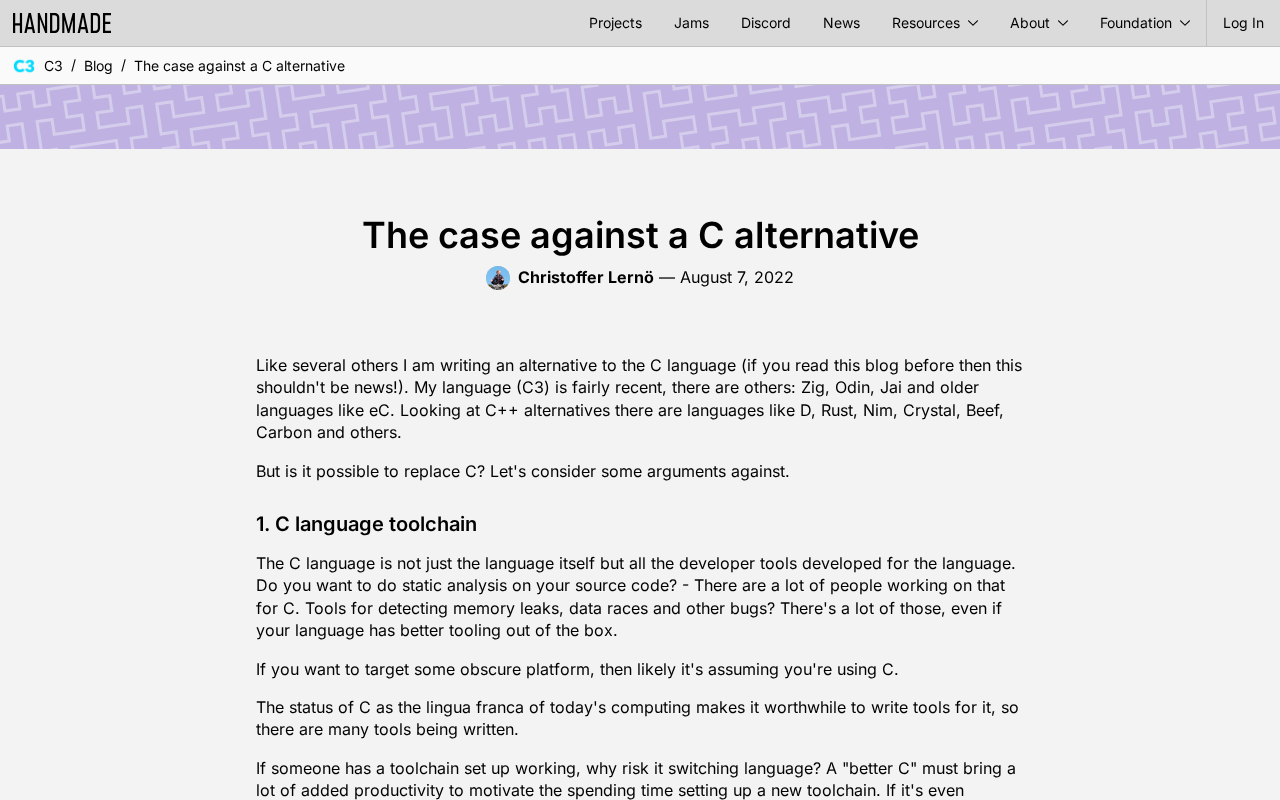
Why C remains irreplaceable despite technically superior alternatives like Rust and Zig
Despite decades of attempts by languages like Rust, Zig, and Go to replace C, it remains dominant in systems programming due to its vast ecosystem, stable ABI serving as a universal cross-language bridge, predictable behavior, and mature toolchains. New languages face prohibitive migration costs and talent gaps. Rather than replacement, the realistic trend is complementary coexistence where each language excels in specific domains while acknowledging C's foundational role.
Introduction: A Decades-Long Battle for Replacement
Since C was born in 1972, discussions about "replacing C" have never ceased. Developed by Dennis Ritchie at Bell Labs, C was originally created to rewrite the Unix operating system. Before that, operating systems were almost entirely written in assembly language, making portability extremely poor. C's revolutionary nature lay in providing both low-level control close to assembly (direct pointer and memory manipulation) and high-level structured programming features (functions, structs, control flow). The 1978 book "The C Programming Language" (commonly known as K&R) by Brian Kernighan and Dennis Ritchie became one of the most influential works in programming history, establishing C's status as an industry standard.
From Pascal and Ada to recent contenders like Rust, Zig, and Go, generation after generation of systems programming languages have attempted to challenge C's dominance. Yet despite these new languages' innovations in memory safety, type systems, and concurrency models, C still sits firmly at the top of the systems programming domain.
This technical topic, which sparked extensive discussion on Hacker News, raises a thought-provoking argument: why might the very proposition of "C replacement" be fundamentally problematic? This article combines community discussions to analyze the deep reasons why C is so difficult to replace.
How Deep Is C's Moat?
The Ubiquitous Ecosystem Foundation
C's greatest advantage isn't the language design itself, but the massive ecosystem it has built. Nearly all mainstream operating system kernels (Linux, Windows, the foundation of macOS) are written in C. Countless libraries, drivers, and embedded firmware center around C. This means any new language attempting to "replace" C must face a brutal reality: it needs seamless interoperability with vast amounts of existing C code.
This is precisely where C's "network effect" manifests—a language's value lies not just in itself, but in the entire infrastructure built around it. A new language that exists in isolation, unable to call C libraries, has almost no chance of gaining traction in systems programming.
Stable ABI and Cross-Language Communication Capabilities
C has a de facto standard Application Binary Interface (ABI). The ABI defines low-level specifications for how compiled binary code interacts at the operating system level, including function calling conventions (how parameters are passed through registers or the stack), memory layout and alignment of data types, and mechanisms for system calls. C has a de facto standard ABI because the system call interfaces of mainstream operating systems are designed according to C calling conventions—Linux's syscall interface and Windows' Win32 API both follow C's ABI. In contrast, C++ still lacks a standardized ABI; binary code generated by different compilers (GCC, MSVC, Clang) may be incompatible with each other, which is one key reason why C++ cannot replace C as a cross-language glue layer.
This makes C the "universal language" for cross-language communication—when Python, Rust, Go, and other languages want to call low-level functionality, they often do so through C's FFI (Foreign Function Interface). FFI is a mechanism that allows one programming language to call functions written in another language, and in practice, it almost always uses C as the bridge. For example, Python calls C dynamic libraries through ctypes or cffi modules, Rust interoperates with C code through extern "C" declarations, and Java calls C/C++ code through JNI (Java Native Interface). FFI implementation requires solving complex issues like type mapping, memory management boundaries, and callback function handling. The ubiquity of FFI reflects a deeper reality: C's function calling protocol has become the "greatest common denominator" of computer software stacks. In other words, C is not just a programming language, but a "glue protocol" connecting different technology stacks.
Additionally, C's behavior is highly predictable. Developers can clearly infer what machine instructions the code will generate, which is crucial for operating systems, real-time systems, and embedded development.
Core Challenges Facing C Alternatives
"Better" Doesn't Necessarily Mean "Can Replace"
One core point of the discussion is: many C alternatives are indeed more "advanced" technically, but technical superiority doesn't equal replacement capability. Rust provides memory safety guarantees, Zig simplifies compilation and memory management, but for them to truly replace C, they must overcome barriers far beyond technical aspects:
- High migration costs: Rewriting tens of millions of lines of mature C code into a new language carries unacceptable risks and costs.
- Talent pool issues: There are millions of C programmers worldwide, while new language developer communities are limited in scale.
- Toolchain maturity: C has compilers like GCC and Clang that have been refined over decades, along with comprehensive debugging and analysis toolchains. GCC began in 1987 as a core component of the GNU project, and after nearly 40 years of development supports dozens of processor architectures. The Clang/LLVM project started in the early 2000s, and its modular design and friendlier error messages quickly made it a strong competitor to GCC. The maturity of these two major compilers is reflected in multiple dimensions: optimization capabilities (hundreds of optimization passes accumulated over decades), platform coverage (from x86 to ARM to RISC-V to various embedded microcontrollers), and correctness verified by massive amounts of real-world code. For new language compilers to reach equivalent levels often requires over a decade of sustained investment. Notably, both Rust and Zig currently rely on LLVM as their backend, which itself illustrates how difficult it is to build a mature code generator from scratch.
Simplicity Is Actually Core Competitiveness in Systems Programming
C is often criticized as "too primitive"—lacking memory safety, modern type systems, and being error-prone. But this simplicity is precisely one reason for its enduring success. C's language specification is relatively concise, with a clear overall mental model. In contrast, some alternatives introduce extremely complex type systems and syntax rules in pursuit of safety and expressiveness, which paradoxically increases the difficulty of mastery.
Take Rust as an example: it achieves compile-time memory safety guarantees through its innovative Ownership System, without requiring a garbage collector. Its core rules include: each value has one and only one owner; when the owner goes out of scope, the value is automatically released; values can be "borrowed" (referenced), but mutable and immutable references cannot coexist. These rules fundamentally eliminate memory errors common in C like dangling pointers, double-free, and data races. However, the cost of this safety is a significant learning curve—developers need to repeatedly negotiate with the "borrow checker," and sometimes reasonable program logic gets rejected by the compiler, requiring workarounds through unsafe blocks.
In systems programming, "you can fully understand what the code is doing" is sometimes more valued by senior engineers than "the compiler helps you avoid errors."
Rust, Go, Zig's Positioning: Complement Rather Than Replace
Each Language's Differentiated Value
Here's a detail: this discussion doesn't deny the value of all new languages, but questions the "replacement" framework itself. A more realistic picture is: new languages complement C in specific domains rather than completely replacing it.
- Rust is making headway in new projects requiring high security (like browser components, some Linux kernel modules);
- Go shines in network services and cloud-native domains;
- Zig finds its positioning in scenarios pursuing simplicity and C interoperability. Zig, started by Andrew Kelley in 2016, has one standout feature: it can directly import and compile C header files without writing any binding code—unique among all C alternatives. Zig's compiler includes a complete C compiler (based on Clang/LLVM), allowing mixed compilation of C and Zig code in the same build process. Additionally, Zig pursues "no hidden control flow," avoiding function overloading, operator overloading, or implicit type conversions, allowing developers to understand Zig code's execution semantics as directly as reading C code.
These languages' success often builds on acknowledging C's existence—they provide excellent C interoperability rather than trying to completely erase C.
C's Own Gradual Evolution
Another noteworthy trend is C's own evolution. The C standard is maintained by the ISO/IEC JTC1/SC22/WG14 working group, which continuously updates the language specification. C11 (released in 2011) introduced multi-threading support (_Thread_local, atomic operations), generic selection expressions (_Generic), anonymous structs and unions, and other features. C17 (2018) was mainly a defect fix release. The latest C23 (officially released in 2024) brings more substantial updates: typeof operator, nullptr constant (a type-safe version replacing NULL), constexpr support, binary literals (0b prefix), [[]] attribute syntax, etc. C23 also removes some legacy unsafe features. This cautious yet continuous evolution strategy reflects the C standards committee's core principles: backward compatibility first, standardizing new features only after extensive community validation.
Meanwhile, static analysis tools and memory detectors largely mitigate C's security vulnerabilities. Valgrind is an open-source dynamic analysis framework, with its most commonly used Memcheck tool detecting memory leaks, out-of-bounds access, use of uninitialized memory, etc., by simulating program execution on a virtual CPU, at the cost of 10-50x slower runtime. AddressSanitizer (ASan), developed by Google, works by inserting detection code at compile time, with only about 2x runtime overhead, detecting heap-stack buffer overflows, use-after-free, etc. There are also ThreadSanitizer (detecting data races), UndefinedBehaviorSanitizer (detecting undefined behavior), and other tools. Static analysis tools like Coverity and Cppcheck can find potential defects without running the program. These tools collectively form a "safety net," allowing experienced C development teams to significantly improve code quality without changing languages. This "reform rather than revolution" path further weakens the urgency of alternatives.
Conclusion: A Rational View of Programming Language Evolution
This discussion about "C alternatives" offers insights far beyond language wars. It reminds us: technological ecosystem evolution is rarely simple replacement, but more often layered accumulation and coexistence.
C's status doesn't stem from being the "best" language, but from the enormous inertia formed by half a century of accumulated ecosystem, toolchains, and talent networks. For developers and users of new languages, rather than obsessing over "defeating C," it's better to think about finding their unique value positioning in the world C has built.
A truly mature technical perspective accepts the reality that C will exist long-term, while boldly adopting more modern tools in appropriate scenarios—letting each language shine in its area of expertise.
Related articles
OpenAI Partners with International Organizations to Support Independent Journalism in Ukraine
OpenAI partners with AIRPPU and WAN-IFRA on an AI initiative to boost Ukrainian news organizations' innovation, resilience, and editorial independence amid conflict.
Vercel AI Gateway: A Unified Gateway Connecting 300+ Models and Coding Agents with One Command
Deep dive into Vercel AI Gateway core capabilities: auto-configure 8 coding agents with one command, zero-markup access to 300+ models from 30+ providers, with zero data retention and compliance inference support.
NIXI Policy Changes Spark a Trust Crisis for .in Domains: How Developers Should Respond
NIXI policy changes spark a trust crisis for .in domains. This article analyzes ccTLD governance risks, ownership disputes, and offers practical advice for developers on domain selection and risk mitigation.