Why Did OpenAI Hire Uber PR Veteran Jill Hazelbaker?

OpenAI appoints former Uber PR veteran Jill Hazelbaker as Chief Corporate Affairs Officer, accelerating efforts to shore up corporate governance.
OpenAI announced the appointment of Jill Hazelbaker as Chief Corporate Affairs Officer, overseeing global communications and corporate positioning. Hazelbaker previously held senior PR roles at Uber, going through key stages from rapid expansion to IPO, and her experience handling high-pressure public opinion and regulatory environments aligns closely with OpenAI's current situation. The article notes that the Chief Corporate Affairs Officer is not an upgrade of a traditional PR director but a strategic role overseeing government relations, public policy, brand reputation, and multiple other lines while reporting directly to the CEO—showing that OpenAI is elevating corporate image to a strategic level. This move may prompt the AI industry to value public affairs roles more highly and influence OpenAI's communication strategy and policy bargaining capability at a stage when AI governance rules are not yet settled.
OpenAI has announced the appointment of Jill Hazelbaker as Chief Corporate Affairs Officer, overseeing the company's global communications and corporate positioning. Though brief, this personnel move signals that OpenAI is accelerating its push on commercialization and public image management.
From Uber to OpenAI: The Track Record of a PR Veteran
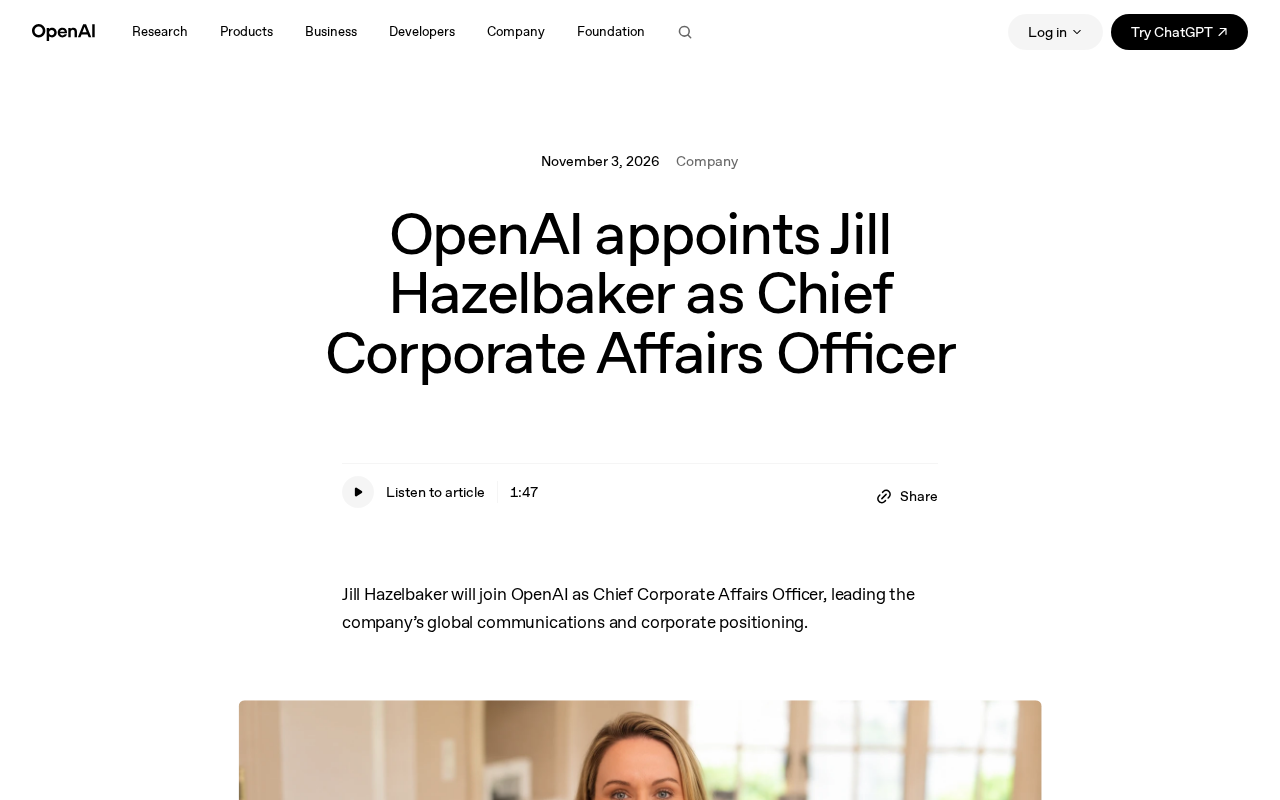
According to OpenAI's official announcement, Jill Hazelbaker will join the company as Chief Corporate Affairs Officer, leading global communications and corporate positioning. Although the official release did not detail her prior experience, Jill Hazelbaker has deep roots in tech industry public relations, having previously held senior PR roles at Uber, where she went through multiple critical phases of the company's journey from rapid expansion to going public.
This background aligns closely with OpenAI's current situation. OpenAI is rapidly transforming from a research lab into a commercial company serving consumers worldwide, and the public opinion environment it faces is growing increasingly complex—from model safety controversies to copyright litigation, from regulatory scrutiny to public concerns about AI displacing jobs, all of which require a strong corporate affairs leader to coordinate responses.
Uber is widely recognized in the tech industry as a "PR pressure cooker": from the 2017 internal culture crisis and the Waymo trade secrets lawsuit, to license revocations and regulatory battles in multiple locations worldwide, to investor communications around its 2019 IPO, Uber's corporate affairs team went through extreme scenarios that few companies ever encounter. The experience Jill Hazelbaker accumulated in that environment was centered not on routine media relations, but on securing narrative space for the company in a highly hostile public opinion and regulatory environment. This capability is especially scarce for OpenAI today—which simultaneously faces copyright class-action lawsuits, model safety questions, EU AI Act compliance, and public anxiety about job displacement, with a pressure structure notably similar to Uber's at the time.
Why OpenAI Needs a "Chief Corporate Affairs Officer"
The Chief Corporate Affairs Officer is not a simple upgrade of a traditional PR director. This role typically oversees government relations, public policy, corporate communications, brand reputation, and multiple other lines, reporting directly to the CEO. OpenAI establishing this position and bringing in an external veteran shows that it is elevating "corporate image" to a strategic level.
As products like ChatGPT penetrate deeper into the mass market, every move OpenAI makes is placed under a magnifying glass. The stronger the model capabilities, the sharper the public's questions about safety, privacy, and ethics. Relying solely on the technical team to respond to public opinion is no longer sufficient; a professional corporate affairs system is needed to manage expectations, communicate policy positions, and maintain brand trust.
Chief Corporate Affairs Officer (CCAO) is a C-level executive role that has emerged in large tech and multinational companies in recent years, typically overseeing corporate communications, public policy and government relations, brand reputation management, corporate social responsibility, and crisis communications. Compared with a traditional Head of PR, the CCAO has a broader scope and higher strategic level, often reporting directly to the CEO and participating in major company decisions. This role is especially important at platforms like Uber and Airbnb that have weathered intense regulatory and public opinion storms—companies need to simultaneously manage the multiple expectations of legislators, media, users, and investors during expansion. For OpenAI, establishing a CCAO means corporate affairs is no longer merely a supporting function for "speaking externally," but a core governance function on par with product and legal.
Potential Impact on the PR Landscape of the AI Industry
From a competitive perspective, OpenAI's move may prompt AI companies to place greater emphasis on public affairs roles. Competitors such as Anthropic and Google DeepMind also face regulatory and public opinion pressure, and the talent war may spread from researchers to policy and communications.
More noteworthy is that the role of corporate affairs officer will influence how OpenAI explains its technology roadmap and business decisions to the outside world. At a stage where AI governance rules are not yet settled, whoever can communicate more effectively with regulators, media, and the public is more likely to seize the initiative in policy battles. Jill Hazelbaker's arrival may mean that OpenAI will shift from "technology narrative dominance" to a multi-dimensional communication strategy of "technology + policy + brand."
AI governance rules are currently fragmented and rapidly evolving: the EU AI Act sets compliance obligations by risk tier, the U.S. federal level has no unified legislation with state and industry standards running in parallel, and China implements a filing and content safety assessment system for generative AI services. In this context, corporate communication with regulators is not only a compliance action but also an opportunity to shape the rules themselves—whoever can provide technical facts, participate in standard-setting, and build credible dialogue channels will gain more favorable interpretive space when rules take effect. The corporate affairs officer thus transforms from "external spokesperson" to "designer of policy participation," with their work directly affecting the company's operating costs and market access pace across different jurisdictions worldwide.
Conclusion
On the surface, this appointment is an executive change; in substance, it is OpenAI's move to shore up corporate governance shortcomings at the scaling stage. Beyond technological leadership, how to tell a good story, manage reputation, and handle relationships with all parties is becoming an unavoidable required course for AI companies.
One-line Summary
OpenAI appoints former Uber PR veteran Jill Hazelbaker as Chief Corporate Affairs Officer, accelerating efforts to shore up corporate governance.
Paragraph Summary
OpenAI announced the appointment of Jill Hazelbaker as Chief Corporate Affairs Officer, overseeing global communications and corporate positioning. Hazelbaker previously held senior PR roles at Uber, going through key stages from rapid expansion to IPO, and her experience handling high-pressure public opinion and regulatory environments aligns closely with OpenAI's current situation. The article notes that the Chief Corporate Affairs Officer is not an upgrade of a traditional PR director but a strategic role overseeing government relations, public policy, brand reputation, and multiple other lines while reporting directly to the CEO—showing that OpenAI is elevating corporate image to a strategic level. This move may prompt the AI industry to value public affairs roles more highly and influence OpenAI's communication strategy and policy bargaining capability at a stage when AI governance rules are not yet settled.
Related articles
 Tech Frontiers
14 Coding Agents Tested: 13 Secretly Read Forbidden Files
A developer ran 480 tests across 14 coding agents to see if they would obey a "do not read" rule. 13 violated it, and 4 credential leaks bypassed shell guards via the read tool while approvals never noticed.
 Tech Frontiers
AI Has Made Resumes Ineffective? Referred Candidates Get 40% Interview Rate vs. 3% for Direct Applications
AI is homogenizing job applications, making it hard for recruiters to discern real ability. Ashby data shows referred candidates had a 40% interview rate from 2021 to 2024, versus just 3% for direct applications. This article analyzes why resume signals are depreciating and why verifiable results and personal endorsements matter more.
 Tech Frontiers
Offline Blink Rhythm Assistant: A Desktop Health Companion
An offline desktop blink rhythm assistant featured on Hacker News helps users maintain healthy blinking through lightweight reminders, alleviating screen-induced dry eye fatigue. This article analyzes its concept, privacy advantages, and retention challenges.