Why Directional Ablation Fails? Centered Ablation Offers a Closed-Form Solution
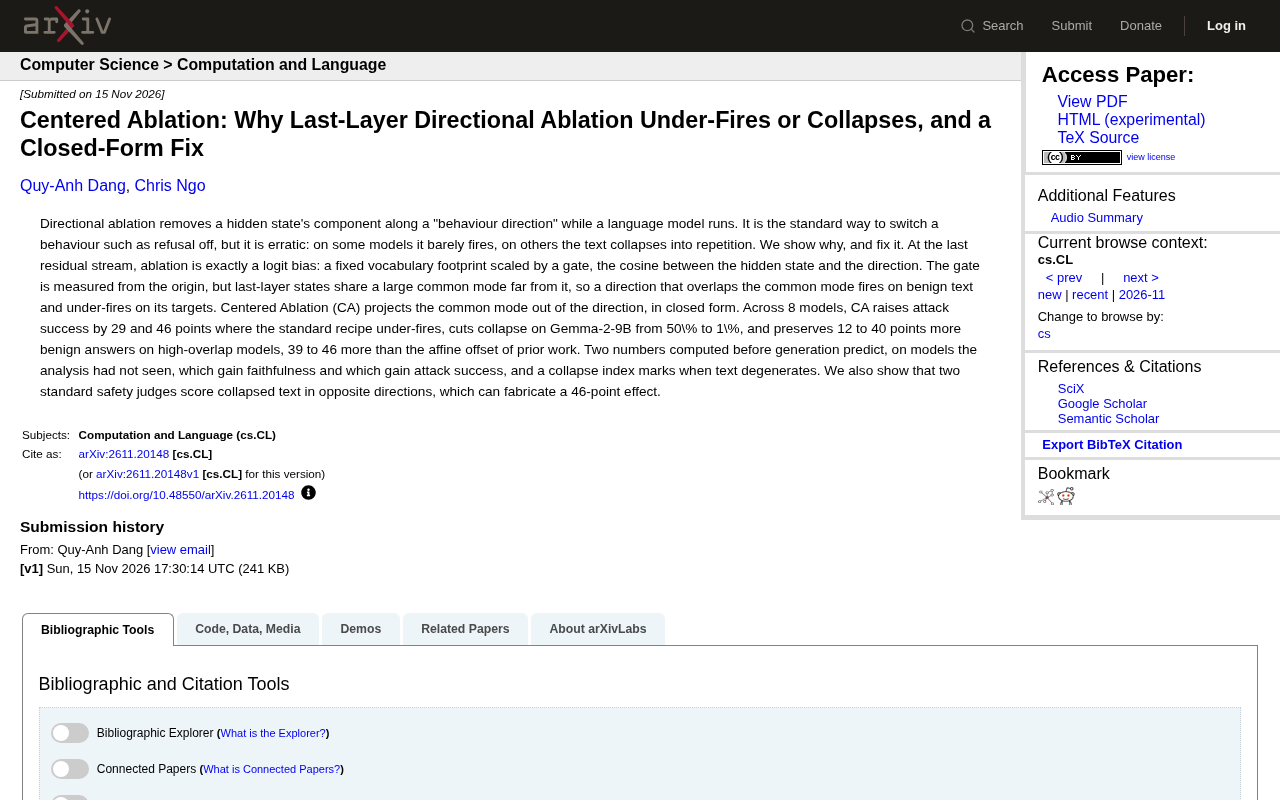
Reveals the last-layer common mode as the root cause of directional ablation instability and proposes a closed-form fix via centered ablation.
This article investigates the instability of inference-time directional ablation in language models. The research finds that on the last-layer residual stream, ablation amounts to a logit bias disturbed by a common mode, causing misfires on benign text and under-triggering on targets. The authors propose Centered Ablation (CA), which projects out the common mode via a closed-form solution. Experiments on 8 models show CA boosts attack success rate by 29 and 46 percentage points, cuts Gemma-2-9B's collapse rate from 50% to 1%, and preserves 12 to 40 more points of benign responses. Two pre-generation numbers predict gains, a collapse index flags degradation, and two judges score collapsed text oppositely, possibly inflating effects by 46 points.
The Promise and Pitfalls of Directional Ablation
Directional Ablation is a technique for removing the "behavior direction" component from hidden states at inference time in language models, often used to disable behaviors such as refusal to answer. Its appeal lies in requiring no fine-tuning—only inference-time intervention. However, its actual effectiveness is unstable: according to the original observations, ablation barely triggers on some models, while on others it causes text to collapse into repetition. This uncertainty hinders the reliable application of the technique.
The Nature of Last-Layer Ablation: Gating and Common Mode
The research points out that on the final-layer residual stream, ablation is equivalent to a logit bias: a fixed vocabulary footprint multiplied by a gating value, which is the cosine similarity between the hidden state and the direction. The problem is that the gate is measured from the origin, but last-layer states share a large common mode far from the origin. This causes directions overlapping with the common mode to misfire on benign text and under-trigger on target text.
Residual Stream and Last-Layer States: In Transformer architecture, the residual stream refers to the hidden state vectors formed by accumulating the outputs of each layer through skip connections. The final-layer residual stream state is directly normalized and projected to vocabulary space to produce logits. Because residual connections accumulate across layers, the last-layer state often contains a large-magnitude, roughly consistent-direction bias component (i.e., the common mode mentioned later), rather than a zero-mean distribution.
Mechanism of Logit Bias: At inference time, subtracting the component of direction vector (d) from the last-layer hidden state is equivalent to adding a bias term to the logits related to the vocabulary projection of (d). The strength of this bias is determined by the projection coefficient of the hidden state onto the direction (d), so directional ablation does not simply "delete" a behavior—it proportionally scales a fixed vocabulary offset.
Common Mode: Refers to a large-magnitude directional component shared by a large amount of text in the last-layer residual stream, far from the origin. It causes the hidden state to deviate overall from the origin, so that cosine similarity gating based on the origin is dominated by this common mode, leading to misfiring on benign inputs when the direction overlaps with the common mode.
Centered Ablation: Closed-Form Solution and Empirical Gains
Centered Ablation (CA) projects the common mode out of the direction via a closed-form solution. Experiments on 8 models show: when the standard method under-triggers, CA increases attack success rate by 29 and 46 percentage points; on Gemma-2-9B, it reduces the collapse rate from 50% to 1%; on high-overlap models, it preserves 12 to 40 more percentage points of benign responses, 39 to 46 percentage points more than the prior affine offset method.
Closed-Form Solution: Refers to the optimal solution obtained directly through analytical derivation, without iterative optimization. In centered ablation, the closed-form solution means projecting the direction vector onto a subspace orthogonal to the common mode, thereby mathematically precisely removing the influence of the common mode while preserving the behavior-relevant part of the direction. This method is computationally simple, highly interpretable, and requires no additional training.
Affine Offset Method: A previously proposed improvement that compensates for the influence of the common mode by introducing an affine transformation (i.e., linear transformation plus translation) during ablation. Unlike the projection in centered ablation, the affine offset requires estimating additional offset parameters and may not fully eliminate the interference of the common mode. Experiments show that centered ablation preserves 39 to 46 percentage points more benign responses than the affine offset.
Prediction and Evaluation: Two Numbers and a Collapse Index
The research also finds that two numbers computed before generation can predict the model's gains in faithfulness and attack success rate, and this prediction remains valid on unseen models. Additionally, a collapse index can flag the occurrence of text degradation. Interestingly, two standard safety judges score collapsed text in opposite directions, which may lead to an inflated effect of 46 percentage points.
Attack Success Rate: In safety research, refers to the proportion of successfully bypassing the model's refusal behavior and eliciting target harmful outputs through adversarial prompts or interventions. Directional ablation is often used as an attack method to evaluate the robustness of the model's refusal mechanism, so attack success rate is one of the key metrics for measuring ablation effectiveness.
Collapse Index: A quantitative metric used to detect text degradation. When ablation is excessive or the direction is poorly chosen, model outputs may degenerate into repetitive, meaningless, or grammatically collapsed text. The collapse index flags degradation during or after generation by analyzing features such as diversity, repetition rate, or perplexity of the generated text, helping researchers distinguish genuine attack success from falsely high scores caused by text collapse.
Significance and Implications
This work reveals the root cause of directional ablation's instability and provides a simple closed-form fix. For safety research relying on inference-time intervention, CA improves reliability and predictability. Meanwhile, the disagreement among judges reminds us to carefully choose metrics when evaluating ablation effects, avoiding misleading conclusions caused by text collapse.
One-line Summary
Reveals that the root cause of directional ablation's instability lies in the last-layer common mode, and proposes a closed-form fix via centered ablation.
Paragraph Summary
This article explores the instability of directional ablation at inference time in language models. The research finds that on the last-layer residual stream, ablation is equivalent to a logit bias disturbed by the common mode, causing the direction to misfire on benign text and under-trigger on target text. To address this, the authors propose Centered Ablation (CA), which projects out the common mode via a closed-form solution. Experiments on 8 models show that CA significantly improves attack success rate (by 29 and 46 percentage points), reduces the collapse rate of Gemma-2-9B from 50% to 1%, and preserves 12 to 40 more percentage points of benign responses. Additionally, two numbers computed before generation can predict gains, a collapse index can flag text degradation, and two safety judges score collapsed text in opposite directions, potentially inflating the effect by 46 percentage points.
Related articles

Hero or Luck? Technical Reflections Sparked by an Arizona Grandfather Finding a Missing Toddler in the Desert
An Arizona grandfather finding a missing toddler in the desert hits Hacker News. This article analyzes emergency search, drone thermal imaging, child location devices, and community collaboration, exploring the boundaries of technology and human effort in extreme environments, while noting the material's limitations.

Run Agentic Coding on Mac with One Command: The Localcode Open-Source Tool
Localcode is an open-source agentic coding tool for Mac that launches with a single command. This article examines its local, open-source, minimal-install positioning, who it suits, and the information gaps to consider before adoption.

Lean Formalization of Masullo Manuscript: Progress Map Sparks Discussion
A public progress map for a Lean formalization project of Alessandro Masullo's manuscript sparks Hacker News discussion on formalization costs, collaboration, and AI-assisted proving.