Why Director Rian Johnson Built His Own iPhone Camera App

Director Rian Johnson built his own camera app because the iPhone's default camera lacks the ritual of film—reflecting professional creators' demand for tool autonomy.
The article tells the story of *Knives Out* director Rian Johnson, who decided to build his own camera app because he was dissatisfied with the iPhone's default camera and existing professional apps. As a devout film photography enthusiast, Johnson seeks deliberate control over light, texture, and shooting rhythm—at odds with the digital camera's philosophy of quick capture. The article argues this case reflects the gap between general-purpose tools and professional creators' needs, and shows how low-code and AI-assisted programming are lowering the barrier to custom tools. Meanwhile, film photography's constraints—limited frames, shutter delay, irreversibility—offer lessons for mobile photography app design, while personalized tonality and style simulation point to the future of AI camera apps.
A Film Enthusiast's Digital Dilemma
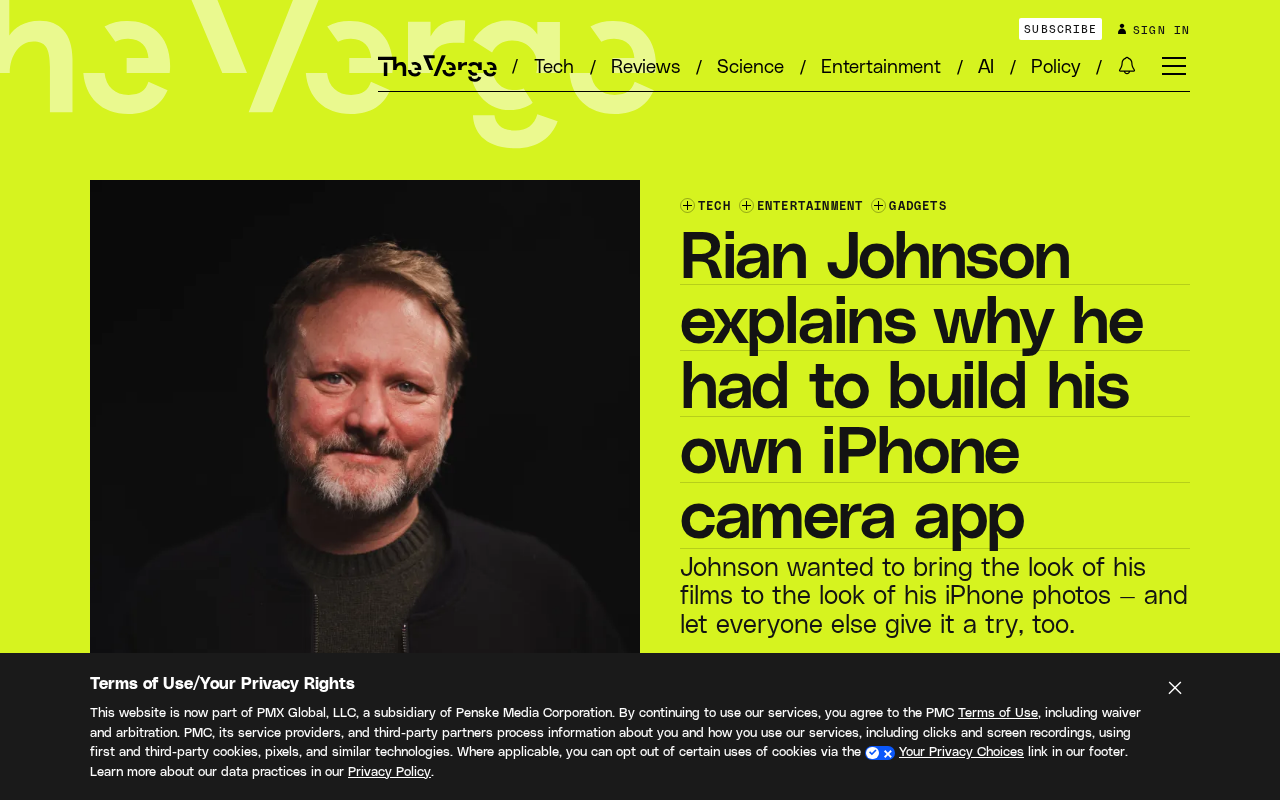
Rian Johnson, the director behind Knives Out and Star Wars: The Last Jedi, always carries a Leica M6 film camera with him on set. He's passionate about documenting the production process on film, but sometimes a phone is simply the more convenient option. The problem is that photos taken with the iPhone always feel like they're missing something. So he had an idea: why not build his own camera app?
Why Existing Apps Couldn't Satisfy Him
Johnson is a "devout believer in analog photography." He has strict aesthetic standards when it comes to light, texture, and shooting rhythm. Even though the iPhone's camera hardware has become increasingly powerful, the default camera app is designed for "quick capture" rather than "deliberate creation." For Johnson, this experience runs counter to the philosophy of film photography.
There are plenty of professional camera apps on the market, but most are either overly complex or lack the specific control logic he wanted. Johnson didn't disclose the technical details, but from his creative background we can infer: he needed a tool that could simulate the ritual of film shooting while preserving digital convenience. Building it himself was the only way to have full control over the interaction design and image processing pipeline.
The "professional camera apps" mentioned here typically refer to third-party tools like Halide, ProCamera, and Obscura, which hand camera control back to the user through manual exposure, RAW capture, focus peaking, and other features. But the design logic of these apps still centers on "adjustable parameters"—directly porting professional concepts like aperture, shutter speed, and ISO onto a touchscreen. For creators who want to recreate the rhythm of film shooting, the problem isn't that there aren't enough parameters—it's that the interaction flow is still oriented around "quick setup, continuous shooting," lacking the psychological constraint that comes from the physical limitations of a film camera. What Johnson was looking for was a design that encodes the ritual of "one shot is one shot" into the interface, and few market apps restructure the shooting flow from that angle.
Lessons from a Custom Camera App
The significance of this goes beyond a personal hobby. A well-known director willing to invest time learning to code just to make mobile photography feel closer to the film experience speaks volumes about the gap between current mobile photography tools and the needs of professional creators.
For AI and tech professionals, this is also a case study: when general-purpose tools can't meet the needs of vertical scenarios, low-code and AI-assisted programming are lowering the barrier to building custom tools. Johnson's specific development process hasn't been made public, but his choice to "reinvent the wheel" rather than compromise reflects creators' desire for tool autonomy.
When Film Philosophy Meets Digital Tools
Johnson's attempt isn't about replacing film—it's about reclaiming that "slow down" feeling of shooting on a digital device. The appeal of film photography is that every photo has a cost, forcing the photographer to think about composition, light, and timing. The iPhone's unlimited burst shooting and instant preview encourage casualness.
By building his own app, Johnson can reintroduce those constraints—for example, simulating a limited "film count," adding delayed feedback that feels closer to a mechanical shutter, or customizing the post-processing color pipeline. These design ideas have reference value for mobile photography app developers: what professional users need isn't more features, but constraint mechanisms that align with creative psychology.
The "sense of cost" in film photography comes not only from film and developing expenses but also from its physical characteristics: each roll typically holds only 24 or 36 frames, and you have to change rolls when it runs out; the mechanical shutter has a slight delay, with a brief interval between pressing the button and the actual exposure; there's parallax between the rangefinder viewfinder and the lens, so composition requires experience and anticipation. Together, these constraints shape a rhythm of "think first, shoot later." If a digital camera app wants to simulate this experience, it can't just add a "remaining frames" counter—it needs to redesign the feedback loop. For example, using UI animations or sound cues to reinforce the "irreversibility" of each shutter press, or delaying the preview after shooting so users can't immediately review. These interaction details are exactly what creators like Johnson focus on.
Potential Impact on AI Camera Apps
Although Johnson's project is currently just a personal tool, it points to a trend: as on-device AI capabilities grow stronger, future camera apps may no longer pursue "shooting clearly" but rather "shooting with personality." Through style transfer, scene awareness, and personalized parameter presets, AI can help users reproduce the tonal look of specific film stocks—or even simulate the visual style of a particular director.
Johnson didn't mention whether he used AI technology, but his need—to give digital photos the "imperfection" of film—is exactly one of the hot topics in computational photography research today. From this perspective, the director's self-built app is not just a curiosity but also a question about the future direction of mobile imaging.
Style transfer and film simulation already have mature approaches in computational photography: the former is typically based on Neural Style Transfer, extracting texture and color distribution from a reference image and transferring them to the target photo; the latter relies more on physical modeling of specific film stocks, including color response curves, grain distribution, halation, and development characteristics. Film simulation apps that have emerged in recent years (such as Dehancer and FilmBox) mostly use a hybrid approach of LUTs plus grain synthesis, while academia is exploring the use of generative models to directly learn the inverse process of film development. For users like Johnson, the key isn't whether it "looks like a certain film stock" but whether these processes can be embedded into the workflow in a way that fits the shooting ritual—for example, applying the style in real time while shooting rather than as a post-processing filter.
Related articles

Baidu's ERNIE 5.5 Flash Base Goes Open Source, Images 2.6 Dual Versions Hit the API
Baidu releases ERNIE 5.5 Flash Base sparse MoE model with 280B total parameters and million-token context; OpenAI Images 2.6 Flare and Sunburst hit the API; Ascend adapts Kimi K31 Pro on day one; Google Cloud briefly shows GPT-6 and other model names.

Baidu ERNIE 5.5 Flash Base Open-Sourced: 280B Parameters with Only 14B Active, Million-Token Context
Baidu ERNIE 5.5 Flash Base is now open-sourced: 280B total parameters with only 14B active, million-token context, MLA and HCA hybrid attention. We analyze its specs, Base model positioning, comparison with DeepSeek V4.1 Flash, and hands-on experience with Baidu's free AI workbench.

How BookTok Became the Antidote to Reading in the Digital Age
The Vergecast talks with BookTok creator Morgan Book about the BookTok community ecosystem, why romance novels are thriving, whether audiobooks count as reading, and the trade-offs behind Kindle's premium feel and price hikes.