Why Do AI-Generated Food Images Keep Failing? Analyzing Technical Limitations and Commercial Dilemmas

Why AI-generated food images keep failing: technical limits, business pressures, and their impact
AI-generated food images are flooding marketing materials with bizarre results—donut shrimp, worm noodles, and plastic-like ice cream. This failure stems from fundamental AI limitations: models mimic patterns without understanding physical properties or compositional logic. Despite poor quality, businesses adopt AI images to cut costs, risking brand credibility and legal issues. This phenomenon reveals generative AI's capability boundaries and the growing threat of low-quality AI content polluting the internet.
When Food Marketing Meets AI: A Visual Disaster
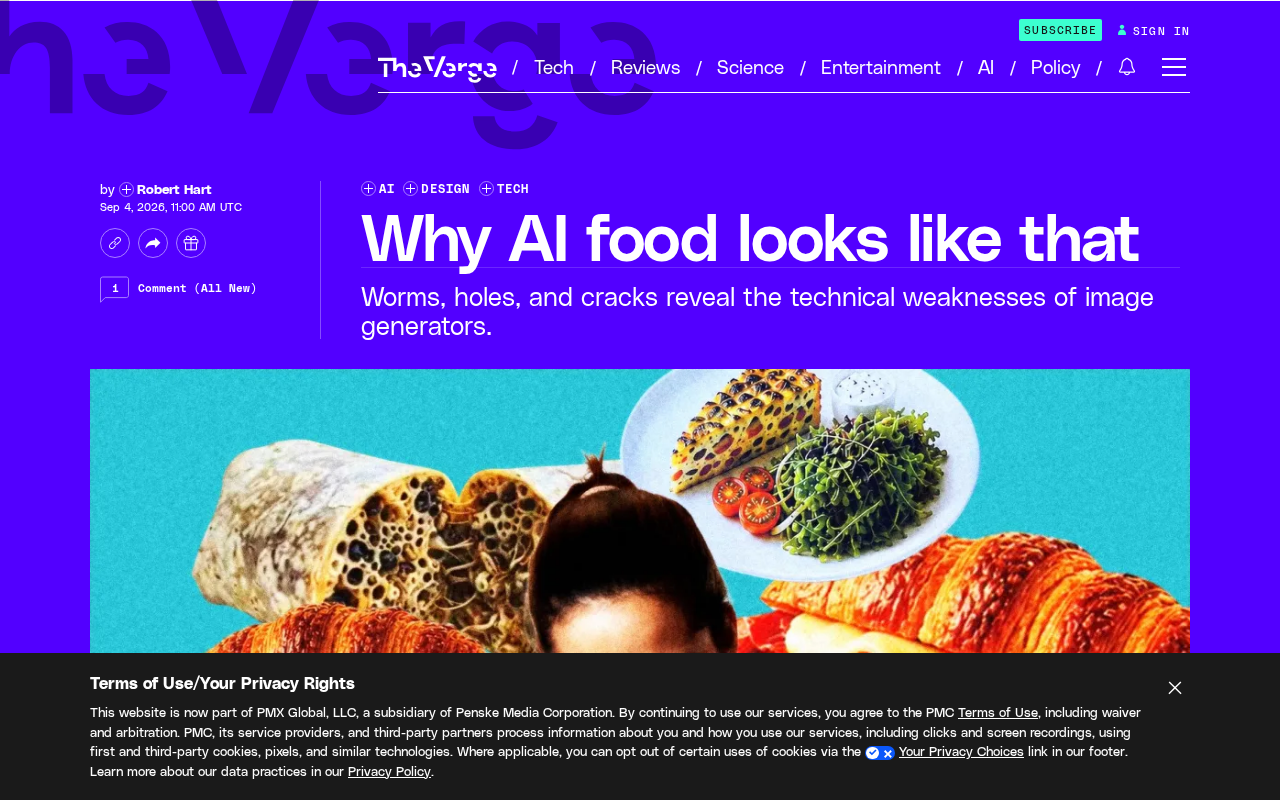
Nowadays, an increasing number of restaurants, cafés, and brands are turning to AI to generate promotional food images, yet the results often kill appetite rather than stimulate it. From "donut shrimp" to "deep-sea Reuben sandwiches," from worm-like noodles to noodle-shaped pastries, to gooey chicken—these AI-generated food images are flooding social media and commercial promotion pages in bizarrely unsettling ways.
Even more absurd are "building materials masquerading as ice cream" and "ice cream masquerading as other things." These images not only fail to inspire purchasing desire but create a unique "AI uncanny valley" effect—they look like food, yet are obviously not real food. The concept of the "Uncanny Valley" was first proposed by Japanese roboticist Masahiro Mori in 1970 to describe the strong discomfort humans feel toward robots that are "close to but not quite human." When an object's similarity to reality reaches a certain threshold yet deviates noticeably in certain details, the human brain triggers an instinctive rejection response. This effect has now extended from robotics to AI-generated images: those AI food images that "look almost right, but something's off" fall precisely into this uncanny valley of visual perception, triggering discomfort even more intense than completely abstract patterns that don't resemble food at all.
Why Does AI Always Fail at Drawing Food?
To understand why AI-generated food images frequently fail, we need to start with how image generation models work. Current mainstream text-to-image models (like Stable Diffusion, DALL-E, etc.) essentially learn "what pixel combinations correspond to what concepts" from massive training datasets.
Specifically, diffusion models like Stable Diffusion employ a "noise-then-denoise" generation strategy: during training, the model learns how to progressively restore an original image from one that has been gradually corrupted with Gaussian noise until it becomes pure noise; during generation, the model starts from random noise and, guided by text prompts, gradually "denoises" to ultimately produce an image matching the description. Text prompts are converted into semantic vectors through text encoders like CLIP, and these vectors guide the denoising direction in latent space. However, semantic representations in latent space are highly compressed and abstract—the representations of "shrimp" and "donut" in this space may have unexpected proximity due to shape features (circular, curved), which plants seeds for conceptual confusion during generation.
Food is an extremely complex visual object: delicate textures, translucent qualities, intricate glossy reflections, and morphological features humans are intimately familiar with. Precisely because we're so familiar with what food should look like, any minute distortion is immediately noticeable. This differs fundamentally from AI drawing landscapes or abstract patterns—even with flaws in the latter, the human eye doesn't easily detect them. Cognitive psychology research shows that the human visual system possesses extremely refined internal models for "things we encounter daily," with food, faces, and text being the three most typical categories. This is why AI is most prone to "exposure" when generating these three types of content—our brain's judgment precision for them far exceeds that for landscapes or abstract graphics.
Typical Failure Patterns in AI Food Images
Collapse of Structure and Logic
AI models lack genuine understanding of the physical world and food composition. They don't know that noodles should be soft strands that can be picked up with chopsticks, nor can they distinguish the fundamental difference between donuts and shrimp. When features from training data are incorrectly mixed, bizarre hybrid products like "donut shrimp" emerge.
Noodles drawn as worms, pastries drawn as noodle-shaped objects—these are results of the model's confusion over "shape similarity." AI merely assembles similar visual patterns in a statistical sense rather than truly understanding the physical properties and preparation logic of each food. This problem is technically called "concept bleeding" or "attribute leakage"—when prompts contain multiple objects, the model tends to "leak" visual attributes from one object to another. For example, with the input "a plate of shrimp next to donuts," the model may interfere the curved morphology of shrimp with the ring shape of donuts in latent space, ultimately generating shrimp-shaped donuts or donut-shaped shrimp. This is fundamentally because current text-to-image models lack compositional reasoning ability—they cannot decompose scenes into independent objects and assign correct attributes to each like humans do.
Severe Misalignment of Materials and Realism
Another major challenge in food images is material representation. Ice cream should have a dense, moist, slightly melting texture, but AI often generates solid objects that look like plastic, plaster, or even building materials. Conversely, some objects that should be hard are given ice cream-like soft appearances.
This material misalignment stems from AI's lack of physical property modeling capability—it can only mimic visual appearance without understanding physical concepts like "melting," "crispy," or "juicy" that are closely tied to real experience. One frontier direction in current AI research is endowing models with understanding of the physical world. So-called "world models" attempt to enable AI not only to recognize and generate images but also to understand physical properties, causal relationships, and temporal evolution of objects. For example, Meta's V-JEPA model and Google DeepMind's Genie project explore how to enable AI to establish internal simulations of the physical world. When OpenAI released the Sora video generation model, they emphasized that Sora implicitly learned partial physical laws (such as fluid motion and object collision) during coherent video generation. However, these capabilities remain at a very rudimentary stage—models may have learned the appearance of "water flows" but don't truly understand molecular-level phase changes. For food, knowledge like "melted ice cream becomes liquid cream" or "fried food surfaces should have irregular crispy textures" requires not just visual statistics but cross-modal physical common-sense reasoning—precisely the core challenge that current multimodal large models (like GPT-4V, Gemini, etc.) are striving to break through but are far from solving.
Despite Poor Results, Why Do Businesses Still Use AI Food Images?
Despite frequent failures, more and more businesses still choose AI-generated images, driven by obvious economic motivations.
Professional food photography is costly: it requires professional photographers, food stylists, lighting equipment, and even carefully prepared real food samples. A set of high-quality food photos can easily cost thousands of yuan. In fact, professional food photography is a highly specialized niche industry. The work of food stylists is far more complex than most people imagine: to make food appear at its best before the camera, they use numerous "industry secrets"—for example, using white glue instead of milk to shoot cereal advertisements (because real milk quickly softens cereal), using shoe polish to color roast chicken for perfect caramelization, fixing burger layers with toothpicks and glue, and even stuffing steamed cotton balls behind food to create a steaming effect. A senior food stylist's daily rate typically ranges from several thousand to tens of thousands of yuan, and a complete commercial food shoot (including photographer, stylist, prop master, post-production retouching) can cost tens of thousands of yuan and take several days. It's precisely these high time and financial costs that deter many small and medium businesses, turning them toward near-zero-cost AI-generated images.
In contrast, AI-generated images are nearly cost-free and instantly available. For small restaurants and cafés with limited budgets, this temptation is indeed hard to resist.
However, this "cost-saving" strategy is backfiring. When consumers see obviously distorted AI images, not only are they not attracted, they may question the brand's professionalism and authenticity. False visual promises may also trigger complaints about product misrepresentation, seriously damaging brand reputation in the long run. Notably, in some regions, using AI-generated food images for marketing has begun to touch legal boundaries—if AI images differ too greatly from actual products, it may constitute false advertising or consumer fraud.
What Does This AI Food Disaster Reveal?
Technical Capability Boundaries of Generative AI
The widespread failure of AI food images exposes a fundamental limitation of current generative AI: it excels at mimicking patterns but doesn't truly understand the world. In domains where humans have strong intuition and rich experience—like the food we encounter daily—AI's "disguise" is most easily exposed.
This also reminds us that generative AI is not a universal tool. In scenarios requiring high realism, professionalism, and emotional resonance, human professional skills remain irreplaceable. From a technical development perspective, current image generation models are in a "high-fidelity, low-understanding" phase—they can generate pixel-level extremely detailed images but lack deep cognition of the physical reality represented by image content. This echoes the "parrot mimicry" criticism faced by large language models (LLMs): models can generate fluent text or realistic images, but whether this constitutes genuine "understanding" or advanced "pattern matching" remains one of the core issues fiercely debated in the AI academic community.
Concerns Facing the Content Ecosystem
From a more macro perspective, this "AI slop" is polluting our visual environment. The term "AI slop" rapidly gained popularity in 2024, used to refer to low-quality, mass-produced network content generated by AI that lacks creative value. The word's inspiration comes from "slop" (swill, pig feed), vividly conveying people's disgust toward such content. Statistics show that the proportion of AI-generated content on social media platforms is growing exponentially—Amazon is flooded with low-quality e-books with AI-generated covers, Facebook feeds feature AI-generated "clickbait" images garnering massive engagement, and Google search results increasingly contain AI-generated spam pages. This "content flood" not only dilutes the visibility of genuine creators but is fundamentally eroding the credibility of the internet as an information medium. Major platforms have begun taking countermeasures, such as Meta requiring AI-generated content labeling and Google adjusting search algorithms to reduce the weight of AI spam pages, but this "arms race" has obviously just begun.
Low-quality, mass-produced AI images flooding the internet not only lower overall content quality but also make authentic, quality creations harder to discover.
For brands, short-term cost savings may result in long-term trust erosion. In this era where visuals are first impressions, an "eye-burning" AI food image may be worse than no image at all.
Conclusion
Bizarre AI-generated food images are a vivid microcosm of the collision between technological enthusiasm and practical limitations. They reflect both the capability shortcomings of generative AI in specific domains and the commercial world's blind pursuit of new technology under cost pressure.
Perhaps with continued model evolution, future AI will draw more realistic food. But until that day arrives, businesses should seriously consider: when AI can't even draw a bowl of noodles properly, is it really worth using it to replace authentic food imagery? Rather than pinning hopes on AI's rapid iteration, making wiser choices in the present is better—even a real food photo taken carefully with a smartphone conveys sincerity and trustworthiness far surpassing a refined yet uncanny AI-generated image.
Related articles

Workbuddy for Absolute Beginners: How a Desktop AI Agent Fits Into Real Workflows
A beginner's guide to the Workbuddy desktop AI agent: installation, claiming credits, file management, and building automated workflows—compared with CodeX for fit and cost, helping professionals shift from AI question-askers to AI managers.

OpenAI's New Agent Stack: Computer Use, Decisions API, and Ultra-Fast Workflows
OpenAI Dev Day unveiled a new agent stack: Computer Use outperforms humans, Decisions API delivers ultra-low-latency classification via Luna, Agents API opens the same Computer Use capabilities, and GPT-6.1 Sol costs only one-seventh of Astra. Core updates, benchmark data, and developer insights.

Liang Wenfeng Open-Sources DeepInfo Inference Framework, Takes On U.S. Ban
DeepSeek open-sources its DeepInfo inference framework after its models, featuring GPU/CPU cross-pipelining, small-model prediction with large-model verification, and full Huawei Ascend and NVIDIA chip support—facing the U.S. federal ban head-on. This article analyzes its significance for AI deployment and open-source strategy.