Why Do Faithfulness Evaluation Criteria Disagree? A New Framework Offers a Navigation Path

The paper proposes a faithfulness functional framework to analyze sources of disagreement among evaluation criteria and argues for justifying operationalization choices in light of institutional context.
Addressing contradictory faithfulness evaluation criteria in explainable AI, this paper proposes a "faithfulness functional" framework that locates disagreement along three dimensions: claims, comparisons, and aggregation. The authors argue that faithfulness is a shared but not fully specified relation, so multiple operationalizations may coexist. Defending a specific operationalization requires explanatory, institutional, and normative considerations rather than purely technical arguments. Through an adverse action notices case, the paper shows how institutional context narrows choices and justifies some decisions, offering auditors and practitioners a method for navigating conflicting evaluations.
In the field of explainable AI, faithfulness is regarded as a core requirement of explanation quality: an explanation must accurately reflect the model's true behavior. However, a persistent practical problem for developers and auditors is that different faithfulness evaluation criteria may give contradictory judgments about the same explanation. A paper titled Navigating Disagreement Among Criteria for Evaluating Explanation Faithfulness confronts this dilemma directly and attempts to provide practitioners with an actionable path.
Where Does Disagreement in Faithfulness Evaluation Come From?
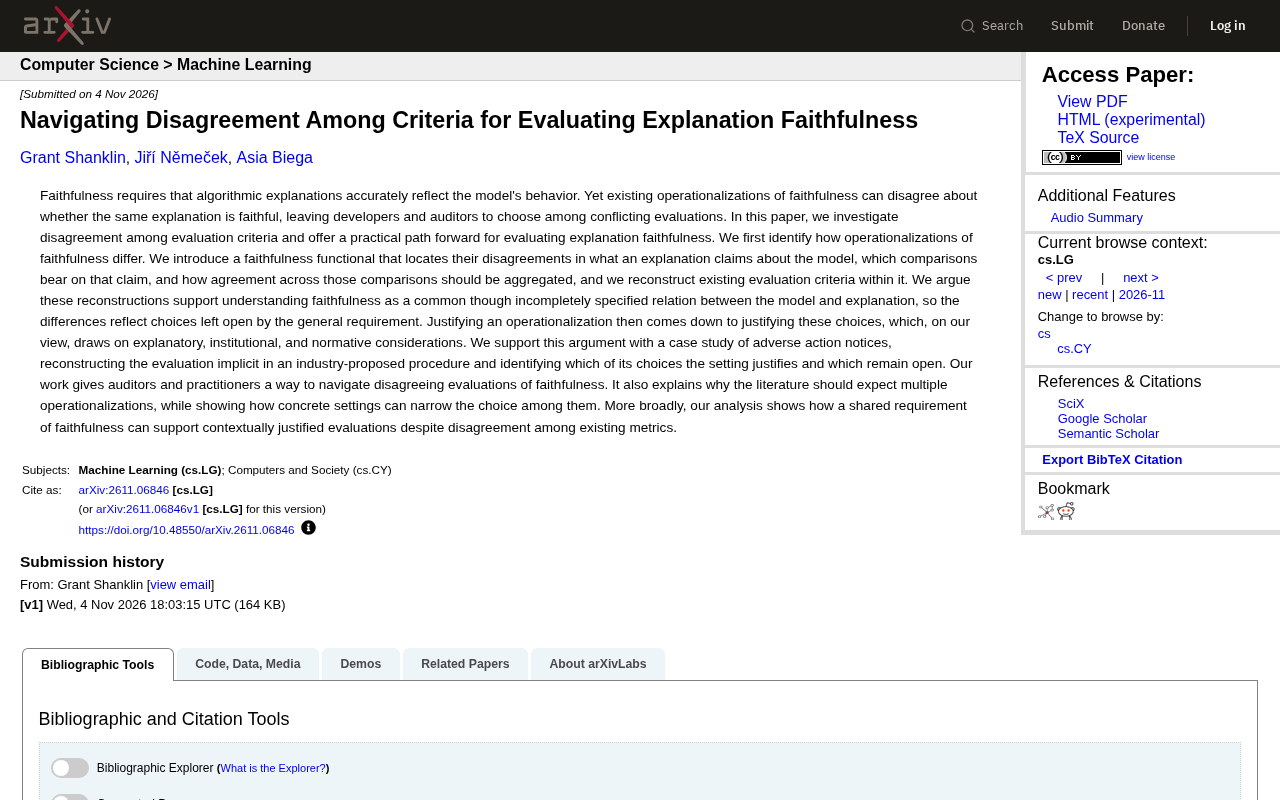
The paper first asks: at what levels do existing operationalizations of faithfulness actually differ? The authors propose a "faithfulness functional" framework that locates disagreement along three key dimensions: what claim the explanation makes about the model, which comparisons are relevant to that claim, and how consistency among those comparisons should be aggregated.
In other words, when two evaluation metrics give different conclusions about the same explanation, the disagreement is not simply a matter of "who is right and who is wrong," but stems from different choices made at these three stages. The value of this analytical framework is that it transforms seemingly chaotic metric conflicts into comparable, traceable differences in design decisions.
Faithfulness functional is the analytical tool proposed in this paper, drawing on the mathematical concept of a "function": given inputs (explanation, model, comparison set, etc.), it outputs a faithfulness score or judgment. The authors decompose existing evaluation metrics into three configurable components—claim, comparison, and aggregation—each with multiple possible choices. For example, an explanation may claim that "feature A is most important for the prediction," or that "feature A is positively correlated with the prediction"; comparisons may be based on prediction changes after deleting a feature, or on ranking changes after perturbation; aggregation may take the mean, minimum, or weighted sum. Different metrics disagree precisely because they choose different options for each component. The value of this framework lies in "parameterizing" conflicts among metrics, enabling practitioners to locate which design decision the disagreement occurs at—much like debugging code—so they can engage in targeted discussion and trade-offs.
Faithfulness Is a Shared but Not Fully Specified Relation
Building on the reconstruction of existing evaluation criteria, the authors offer an insightful view: faithfulness should be understood as a shared relation between model and explanation, but this relation is not fully specified. Differences among operationalizations reflect precisely the space of choices left open by the general requirement.
The significance of this perspective is that it explains why multiple operationalizations appear in the literature—this is not disciplinary confusion, but diversity permitted by the concept itself. Accordingly, defending a particular operationalization becomes a matter of defending these specific choices, and such defenses require explanatory, institutional, and normative considerations rather than purely technical arguments.
Operationalization refers to the process of translating an abstract concept into measurable, executable procedures. In this paper's context, faithfulness is an abstract requirement (explanations should reflect the model's true behavior), while an operationalization specifies how to concretely measure the degree of this reflection—for example, by observing prediction changes after deleting important features, or by comparing the consistency between explanation rankings and gradient rankings. Different operationalizations may all satisfy the abstract requirement of "faithfulness," but because they choose different measurement methods and comparison targets, they may give different scores for the same explanation. The authors emphasize that this diversity is not a defect, but an inevitable consequence of the concept itself being "not fully specified." Therefore, practitioners need to clearly state the operationalization they adopt and provide reasons for their choice, rather than assuming there is a single correct measurement method.
The Adverse Action Notices Case: How Institutional Context Narrows Choices
The paper supports these arguments with a case study of "adverse action notices." In scenarios such as credit, institutions must provide users with specific reasons for denial, which is essentially an act of explanation, and its faithfulness evaluation is implicit in an industry-proposed process.
The authors reconstruct the evaluation logic implicit in this process and identify which choices can be justified by the specific institutional context and which remain unresolved. This case shows that concrete scenarios can effectively narrow the range of operationalization choices—institutional requirements, regulatory frameworks, and stakeholder expectations all provide additional constraints on faithfulness evaluation.
Adverse action notices are an institutional requirement in regulated industries such as credit and insurance: when an institution denies a user's application based on automated decision-making (e.g., denying a loan or raising a premium), it must provide the user with specific reasons for the denial. In the United States, this requirement derives from the Equal Credit Opportunity Act (ECOA) and its implementing Regulation B, which require reasons to be specific and actionable rather than a vague "insufficient credit score." From an explainable AI perspective, adverse action notices are essentially explanations aimed at stakeholders, and their faithfulness evaluation is implicit in the institution's process for generating reasons. By reconstructing this process, the paper identifies which design choices (such as the granularity of reasons or whether to include counterfactual information) can be justified by the institutional context and which remain contested. This case vividly demonstrates how institutional constraints provide additional criteria for faithfulness evaluation, thereby narrowing the space of operationalization choices.
Practical Implications for Auditors and Practitioners
The practical value of this work lies in providing auditors and practitioners with a method for navigating conflicting evaluations. When two metrics give different conclusions, practitioners no longer need to simply choose one; instead, they can trace the source of disagreement and judge which choices are reasonable in the current context.
The paper also notes that the literature should expect multiple operationalizations to coexist rather than pursuing a single "correct" metric. More broadly, this analysis shows that even when existing metrics disagree, a shared faithfulness requirement can still support contextually justified evaluation practices.
For teams building explainable AI systems, this means that when evaluating faithfulness, they should clearly document the choices made and justify those choices in light of the institutional and normative constraints of the deployment scenario—which may be more pragmatic than searching for a so-called "universally optimal" metric.
One-line Summary
The paper proposes a faithfulness functional framework to analyze the sources of disagreement among evaluation criteria and argues for justifying operationalization choices in light of institutional context.
Paragraph Summary
Addressing contradictory faithfulness evaluation criteria in explainable AI, this paper proposes a "faithfulness functional" framework that locates disagreement along three dimensions: the explanation's claim about the model, relevant comparisons, and how consistency is aggregated. The authors argue that faithfulness is a shared but not fully specified relation between model and explanation, and that multiple operationalizations coexisting is permitted by the concept itself. Defending a specific operationalization requires explanatory, institutional, and normative considerations rather than purely technical arguments. Through the adverse action notices case, the paper shows how institutional context narrows the range of choices and justifies some decisions. Finally, it offers auditors and practitioners a method for navigating conflicting evaluations: trace the sources of disagreement and justify choices in light of the deployment scenario, rather than pursuing a single "correct" metric.
Related articles
 Tech Frontiers
Sherlock: An Open-Source Tool for Tracking Usernames Across Social Networks
Sherlock is an open-source Python tool that tracks social accounts across networks by username. This article covers its core features, why developers love it, typical use cases, and privacy compliance considerations.
 Tech Frontiers
GitHub Daily·Nov 07: Agent-Ready and Context Compression
GitHub Trending Nov 07: meta's agent-ready design system astryx, billion-context's 5x context compression, sherlock nearing 100k stars, plus local-first localthings and bare-metal GPU orchestration nvke.
 Tech Frontiers
Buoyant Open-Sources Kinference: An Inference Control Plane for vLLM on K8s
Buoyant open-sources Kinference, an inference control plane for vLLM on Kubernetes, with declarative routing, KV-cache-aware load balancing, and per-tenant metrics—claiming 95% lower median TTFT in official benchmarks.