Why Does Apple Keep Getting AI Wrong? A Deep Dive into the Apple Intelligence Predicament

Analyzing why Apple's privacy-first, perfectionist culture is causing it to fall behind in the generative AI race.
This article examines why Apple is struggling in the generative AI era despite its traditional strengths. From Apple Intelligence's underwhelming rollout and Siri's delayed upgrades to fundamental conflicts between Apple's privacy-first philosophy and AI development needs, the analysis explores how organizational culture, perfectionism, and path dependence have left Apple a generation behind competitors like OpenAI and Google—while noting Apple's remaining advantages in device ecosystem, on-device AI, and financial resources that could enable a comeback.
Apple's Strategic Predicament in the AI Era
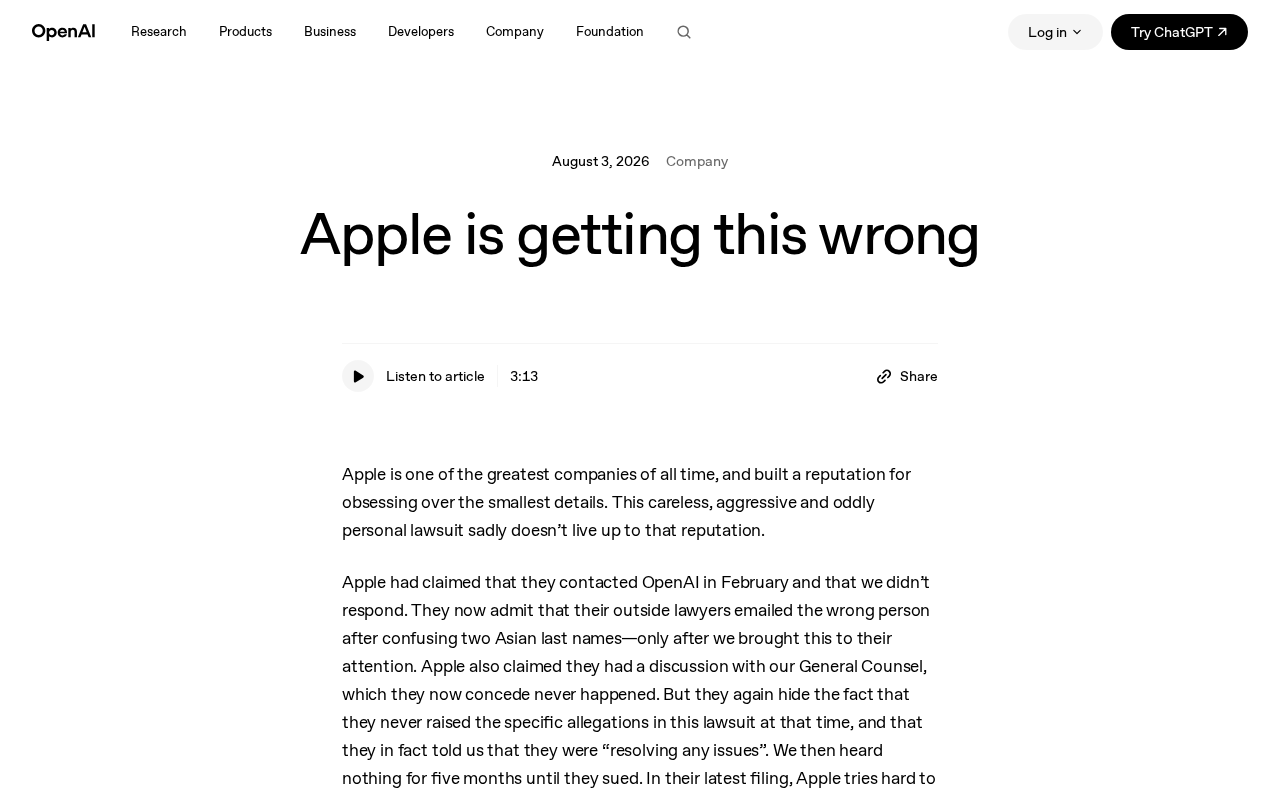
Recently, a Hacker News post titled "Apple is getting this wrong" sparked widespread attention in the tech community. Although the discussion wasn't extremely popular (24 points, 6 comments), it touched on one of the most critical topics in the tech world today: Why has Apple—once an industry leader in innovation—appeared to stumble in the generative AI wave?
Behind this discussion lies a deeper concern about Apple's AI strategy. While OpenAI, Google, Anthropic, and other companies charge full speed ahead in the large model race, Apple's moves appear conservative and sluggish. These companies share common traits: investing billions of dollars in compute resources for model training, maintaining top-tier AI research teams numbering in the hundreds, and rapidly gathering user feedback through API openness and productization. OpenAI's GPT series has been continuously iterating since ChatGPT's launch in late 2022, Google's Gemini series integrates years of DeepMind research, and Anthropic's Claude series stands out for its safety features and long-context capabilities. By comparison, Apple's absence from this arms race is particularly glaring—a contrast that makes "Is Apple getting it wrong?" a topic worthy of serious analysis.
Apple's Traditional Strengths vs. the Misalignment with the New AI Era
The Hardware-Driven Product Philosophy Hits a Bottleneck
For years, Apple's success has been built on deep hardware-software integration. From the iPhone to Apple Silicon chips, Apple has always controlled the entire stack from underlying silicon to user experience. This model proved unbeatable in the mobile internet era, enabling Apple to deliver seamless experiences competitors couldn't replicate.
However, the competitive logic of generative AI is fundamentally different from the hardware era. The core of AI capability is no longer exquisite industrial design or smooth touch interactions, but model scale, training data quality, and cloud compute deployment efficiency. Today's most advanced large language models have parameters numbering in the hundreds of billions or even trillions, requiring tens of thousands of high-end GPUs running for months per training run, at costs reaching hundreds of millions of dollars. This competition model—centered on compute and data as core moats—is precisely the domain Apple's traditional strengths don't cover. Apple excels at extreme optimization on limited hardware resources, not at amassing massive compute for large-scale distributed training.
The Privacy-First Strategy Creates a Dilemma
Apple has long positioned user privacy as a core selling point, emphasizing on-device computation and keeping data on the device. While this philosophy earns user trust, it also creates significant constraints in the AI era. Large language models typically require massive training data and powerful cloud-based inference capabilities, and Apple's commitment to privacy inherently puts it at a disadvantage in data collection and cloud AI deployment.
Specifically, competitors can continuously optimize their models through user interaction data—every user conversation with ChatGPT can become a training signal for model improvement—while Apple's privacy commitments largely sever this data feedback loop. Although Apple introduced "Private Cloud Compute" to process AI requests in the cloud while protecting user privacy, this approach is far more technically complex and costly than competitors' standard cloud deployments.
Many voices in the discussion argue that Apple needs to find a new balance between privacy and AI capability, rather than letting privacy principles become an excuse for technological lag.
How Large Is the Gap Between Apple Intelligence and Reality?
Apple Intelligence was launched with high expectations, but its actual implementation shows a clear gap from what was promised. Several announced features have been repeatedly delayed, especially the redesigned Siri, whose intelligence upgrades have fallen far short of user expectations.
By comparison, competitors' AI assistants can already handle complex multi-turn conversations, code generation, and document processing. While Apple's partnership with OpenAI brought ChatGPT capabilities to Siri, this "outsourcing" approach also exposes Apple's own model capability shortcomings. This is exactly what community discussions about "what Apple is doing wrong" point to—Apple appears to be a full generation behind in building foundational AI capabilities.
Notably, Apple isn't entirely without AI research achievements. In 2024, Apple published multiple research papers on multimodal models and efficient on-device inference, and open-sourced small language models like OpenELM. But there's a huge chasm between research output and product implementation, and Apple's AI research output still seems disproportionate relative to its trillion-dollar market cap and R&D spending.
Why Has Apple's AI Strategy Become Reactive?
Organizational Culture Clashes with AI Development Pace
Apple's secrecy culture dates back to the Jobs era, with employees strictly limited to "need-to-know" information and cross-departmental communication tightly controlled. This culture effectively protected competitive advantage in hardware product development—the secrecy around the iPhone launch is legendary in the industry. However, in AI research, this closed nature creates a serious obstacle.
AI research emphasizes open collaboration, rapid experimentation, and paper publication. Top AI researchers typically value academic reputation and community influence—Google DeepMind and Meta FAIR publish hundreds of papers at top academic conferences annually, and researchers can freely share results and gain academic recognition. Apple's closed R&D culture is incompatible with this ethos, resulting in historically low paper output. Only in the past two years has Apple begun increasing open-source efforts, but it has already lost ground in the talent war. Reports indicate that multiple senior Apple AI executives have defected to competitors in recent years, further exacerbating Apple's reactive position.
The Cost of Perfectionism in the AI Era
Apple is accustomed to polishing products to perfection before launch, but in the AI era, a "ship first, iterate later" strategy is often more effective. While Apple pursues the perfect experience, competitors have already completed multiple rounds of model optimization through extensive user feedback. OpenAI's evolution from GPT-3 to GPT-4 relied heavily on real usage data from ChatGPT's hundreds of millions of users and RLHF (Reinforcement Learning from Human Feedback) training. This "evolving through real-world use" model fundamentally conflicts with Apple's "launch once, pursue perfection" product philosophy.
This tempo mismatch may be one of the deeper reasons Apple lags in the AI race. In AI, an imperfect product that can rapidly gather user feedback often has more strategic value than a perfect product that never ships.
Does Apple Still Have a Chance to Turn Things Around?
Despite its current reactive position, Apple isn't without the means to fight back:
- Device Ecosystem Advantage: Apple has over 2 billion active devices worldwide, providing a natural distribution channel for any AI feature deployment. This means once Apple's AI features mature, they can reach hundreds of millions of high-value users in an extremely short time—a distribution capability no pure-play AI company possesses.
- On-Device AI Inference Capability: Apple Silicon has unique advantages in on-device AI inference. Take the M-series chips as an example: the M4 chip's Neural Engine delivers peak performance of 38 TOPS (trillion operations per second), capable of running language models with billions of parameters locally on-device for low-latency, privacy-preserving AI experiences. As model miniaturization technologies mature—including knowledge distillation, quantization (compressing model weights from 32-bit floating point to 4-bit integers can reduce model size by 4-8x), pruning, and other technical approaches—on-device AI could become Apple's key breakthrough. Open-source small models like Meta's LLaMA and Microsoft's Phi series have already demonstrated that carefully designed small models can approach large model performance on specific tasks.
- Financial Strength: Apple's massive cash reserves (approximately $160 billion as of late 2024) give it the ability to rapidly close technology gaps through strategic acquisitions. In fact, Apple has quietly acquired multiple AI startups in recent years, but has yet to make a landmark deal that reshapes its product landscape the way the Siri acquisition did.
The question is whether Apple is willing to break its own inertia and embrace AI transformation with a more open and faster approach.
Conclusion: Warning Signals from Apple's AI Predicament
Discussions like "Apple is getting this wrong" may be small in scale, but they reflect the tech community's keen observation of industry giants. Apple once defined the smartphone era, but in the AI era, past success may become the greatest obstacle to transformation.
Path Dependence—where organizations struggle to change direction due to past successes and existing investments—is a tragedy repeatedly played out in tech history. Nokia was disrupted by iOS and Android because it clung to its Symbian system; Kodak invented digital camera technology but delayed its digital transformation because of its massive film business profits; Microsoft missed the mobile market by clinging to the Windows ecosystem during the mobile internet era. The common thread in these cases: the more successful a giant's existing business model, the greater the internal resistance to transformation.
For Apple, the real challenge isn't technology itself, but whether it can let go of path dependence and reassess its position in the AI era. Apple's current annual iPhone revenue exceeding $300 billion and service gross margins approaching 60% create enormous internal resistance to any "self-disrupting" change. History is full of giants that declined after missing technology inflection points—whether Apple can avoid repeating their fate will be answered in the coming years.
Key Takeaways
Related articles

Altman Declares: The Cybersecurity Crisis Is Unsolvable and There Are Too Many Vulnerabilities to Patch
OpenAI CEO Sam Altman publicly admits he can't fix all security vulnerabilities and that the cybersecurity crisis will keep worsening. This article analyzes the industry reality behind this statement: exploding software complexity, the double-edged sword of AI, and the need to shift security paradigms from "zero vulnerabilities" to resilient defense.

Product Hunt Launches Visual Launch Editor, Saying Goodbye to Tedious Form Filling
Product Hunt launches a Visual Launch Editor with in-place editing for name, tagline, gallery, and maker info, auto-saved drafts, and a checklist to guide creators.

Zelensky Speaks: How We Held Kyiv Against 200,000 Russian Troops
Zelensky recalls the early Russia-Ukraine war: 200,000 Russian troops drove on Kyiv while Ukraine's main forces were in the east. He explains how mobilization grew the army from 200,000 to 800,000 and how Kyiv and Chernihiv oblasts were recaptured.