Gemini Omni and Nano Banana Model Analysis: Google's Multimodal AI Strategy

Exploring Google's dual AI strategy through Gemini Omni's full-modal power and Nano Banana's lightweight efficiency.
This article analyzes Google's Gemini Omni and Nano Banana models, representing two complementary AI directions: a full-modal flagship capable of unified text, image, audio, and video processing, and a lightweight model optimized for edge deployment. It examines their technical foundations, competitive positioning against GPT-4o, and Google's broader high-low model matrix strategy for capturing developer ecosystems.
Introduction: A Tweet That Sparked Attention
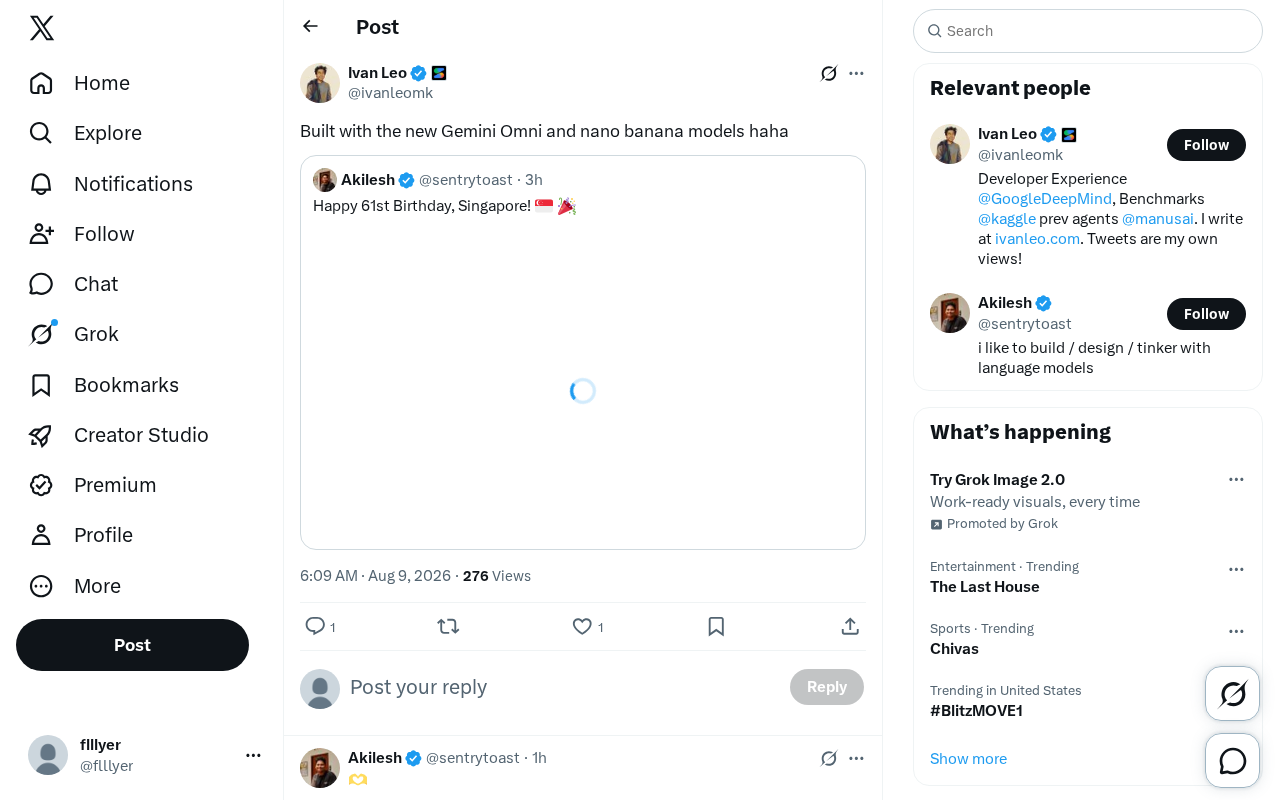
Recently, a brief social media post stirred considerable discussion in the AI community. A developer showcased a project built "using the brand-new Gemini Omni and Nano Banana models." Despite the original content being extremely brief, the two keywords mentioned—Gemini Omni and Nano Banana—are worth exploring in depth. They represent Google's latest explorations in two directions: multimodal large models and lightweight models.
This article will analyze the likely positioning, technical characteristics, and application prospects of these two models within the context of the Google Gemini model family's development trajectory. It should be noted that due to limited source material, some content represents reasonable inferences based on publicly available industry information.
Gemini Omni: Google's Ambition for Full-Modal AI
What Is an "Omni" Model
The word "Omni" derives from Latin, meaning "all, everything." In the context of AI model naming, "Omni" typically refers to models capable of uniformly processing inputs and outputs across multiple modalities including text, images, audio, and video. This aligns with the approach behind OpenAI's previously released GPT-4o (where the "o" also stands for omni).
The Gemini series itself has positioned "native multimodality" as its core selling point since inception. Unlike approaches that stitch together separate models for different modalities, Gemini integrates multiple data forms during the pre-training phase. Specifically, traditional multimodal AI solutions typically employ a "pipeline" architecture: speech is first converted to text via ASR (Automatic Speech Recognition), images are first processed through vision encoders to extract feature vectors, and then separately fed into the language model. This approach suffers from information loss—emotions and intonation in speech are lost during text conversion, and spatial relationships in images are simplified during feature compression. Native multimodal pre-training means the model learns a unified representation space directly from mixed data (interleaved text, image tokens, audio spectrograms) from the very beginning of training, enabling tighter semantic alignment across modalities and more natural cross-modal reasoning (such as interpreting visual intent based on vocal emotion). Therefore, Gemini Omni is likely Google's further strengthening in this direction—pursuing lower cross-modal latency and more natural real-time interactive experiences.
What Full-Modal Capability Means
For developers, the value of a full-modal model lies in handling complex multimedia tasks through a single unified API. For example, a user could upload a video, and the model could simultaneously understand the visual content, comprehend the dialogue, and generate a response combining both text and images. This capability would greatly simplify the development of multimodal applications, eliminating the need to integrate separate services for speech recognition, image understanding, and text generation.
If Gemini Omni indeed focuses on real-time full-modal interaction, it would directly compete with GPT-4o and its successors in scenarios such as voice assistants, real-time translation, and video analysis. It's worth recalling that GPT-4o, released by OpenAI in May 2024, was the industry's first commercial model to unify text, vision, and audio end-to-end within a single neural network. Its most significant breakthrough was reducing voice interaction latency to approximately 320 milliseconds, approaching the reaction speed of natural human conversation. Previous voice assistants required three serial processing steps: "speech-to-text → LLM inference → text-to-speech," with each step introducing latency. GPT-4o bypassed the intermediate text bottleneck by directly inputting audio tokens and outputting audio tokens, setting a new user experience standard for full-modal AI. For Gemini Omni to win in this arena, it needs not only to match such latency performance but also demonstrate differentiated advantages in multimodal understanding depth and generation quality.
Nano Banana: A Playfully Named Lightweight Model
Inferring Model Positioning from the Name
The name "Nano Banana" sounds quite playful. "Nano" is an established naming convention for the smallest-scale models in the Gemini family—Gemini Nano has long been deployed on edge devices, such as Pixel phones for offline intelligent features. From a technical implementation perspective, Gemini Nano has parameter scales of approximately 1.8 billion (Nano-1) and 3.25 billion (Nano-2). It distills capabilities from the larger Gemini Pro/Ultra models through knowledge distillation and uses 4-bit quantization to compress weights into low-precision integer representations, dramatically reducing memory usage. On the Pixel 8 Pro, Gemini Nano leverages the phone chip's NPU (Neural Processing Unit) to enable offline smart reply suggestions, recording summary generation, and other features with millisecond-level response times, keeping all data entirely on-device.
The fruit codename "Banana" is more reminiscent of temporary codenames used during internal development or testing phases. Interestingly, Google has previously used similar playful codenames in the image generation domain. Therefore, Nano Banana may be a lightweight model focused on image generation or image editing. Its lightweight positioning means it can complete specific tasks with lower computational costs and faster response speeds, suitable for deployment in resource-constrained environments.
The Strategic Significance of Lightweight Models
As the arms race among large models intensifies, the importance of lightweight models is increasingly apparent. Not all application scenarios require flagship models with staggering parameter counts. For mobile devices, edge computing, and cost-sensitive commercial applications, small but refined models often offer greater practical value.
Core technologies for lightweight models include two major directions: Quantization and Knowledge Distillation. Quantization compresses model parameters from 32-bit floating point (FP32) to lower-precision representations (such as INT8, INT4, or even INT2), theoretically shrinking model size by 4-16x while leveraging integer arithmetic units to accelerate inference. Knowledge Distillation uses the output probability distribution of a large model (teacher model) to guide a small model (student model) in learning, enabling the small model to achieve comparable performance with far fewer parameters. Additionally, there's Pruning technology, which streamlines network structure by removing neuron connections that contribute little to the output. The combined use of these techniques enables billion-parameter-scale small models to achieve 80%-90% of the effectiveness of ten-billion-parameter models on specific tasks.
The development trend of edge computing also provides natural deployment scenarios for lightweight models. Edge computing refers to processing data near its physical point of origin rather than transmitting everything back to cloud servers. This trend is driven by three forces: privacy regulations (like GDPR) requiring minimal data transmission, real-time requirements (autonomous driving's millisecond-level decisions cannot tolerate network round-trip latency), and bandwidth costs (the networking overhead of continuously uploading video streams to the cloud is extremely high). Chip manufacturers like Qualcomm, MediaTek, and Apple have all integrated dedicated AI acceleration units into their SoCs, providing the hardware foundation for on-device model execution.
By deploying the Nano series for on-device AI, Google can protect user privacy (data doesn't need to be uploaded to the cloud) while reducing inference costs. If Nano Banana is indeed a lightweight model for image tasks, it would further complete Google's on-device AI ecosystem puzzle.
The Product Logic Behind Both Models
A High-Low Model Matrix Strategy
Looking at Gemini Omni and Nano Banana together reveals Google's clear product strategy: on one end, a full-modal flagship pursuing ultimate capability; on the other, a flexible and efficient lightweight specialized model. This "high-low combination" model matrix covers the complete spectrum from complex cloud-based tasks to simple on-device tasks.
This strategy isn't unique to Google—current mainstream AI companies have all adopted similar tiered model matrices. OpenAI has the GPT-4o (flagship) and GPT-4o-mini (lightweight) series; Anthropic offers three tiers with Claude Opus (most powerful), Sonnet (balanced), and Haiku (fastest); Meta's Llama series provides open-source options across multiple parameter scales including 8B, 70B, and 405B. The business logic behind this tiered design is: flagship models showcase the technical ceiling to attract attention and high-value clients, mid-tier models cover most commercial application scenarios to achieve revenue at scale, and lightweight models attract long-tail developers and startups with low invocation costs (typically 1/10 to 1/20 of the flagship), building broad ecosystem stickiness.
Developers can flexibly choose based on actual needs: calling Omni when powerful understanding and generation capabilities are required, and selecting the Nano series when prioritizing speed and cost. This combination approach is the common choice among current mainstream AI companies.
The Battle for Developer Ecosystems
The original tweet came from a developer who was actually hands-on building an application—this itself makes a point: a model's value is ultimately realized through developer creativity. By continuously releasing models with diverse capabilities, Google is essentially competing for the developer ecosystem. Whoever provides the most usable, economical, and powerful tool combinations attracts more developers, thereby building a thriving application ecosystem.
A Rational Perspective: Thinking Under Limited Information
We must honestly acknowledge that based on a single tweet alone, we cannot confirm the exact specifications or release status of Gemini Omni and Nano Banana. They could be officially released products already available, experimental models in testing phases, or their names might even be informal designations within the developer community.
However, the trend reflected by this post is real: AI models are simultaneously evolving in two seemingly contradictory yet complementary directions—more capable and more compact. For practitioners following AI development, rather than fixating on specific parameters of individual models, it's better to grasp this overarching trajectory.
Conclusion
From Gemini Omni's full-modal ambitions to Nano Banana's lightweight exploration, Google is steadily making moves on the multimodal AI track. Although publicly available information is currently limited, it's foreseeable that as more details are disclosed, these models will bring new possibilities for developers. For everyday users and developers alike, perhaps the best approach is to stay attentive and get hands-on—just as the developer who posted the tweet did, validating new tools' true capabilities through actual projects.
Related articles

Amphibious Transforming Drone: Beyond 100x Power Savings, What Are the Real Needs?
Is the amphibious transforming drone just a gimmick? Starting from the 100x power difference of the M4 Morphobot, explore real application scenarios and thesis topic ideas, analyzing boundary conditions where pure drones and pure ground robots both fail.

Warhound Raises $200 Million: Genetically Engineered "War Dogs" Paired with Anduril Gear
Warhound raises $200M, backed by Ben Lamm and Palmer Luckey, to genetically engineer dogs for military and law enforcement use and equip them with Anduril gear. This article analyzes its technology direction, funding logic, and ethical controversy.

Claude API Comes to Google Cloud: IAM Integration and SDK Access Guide
Anthropic hosts the full Claude API on Google Cloud with IAM-controlled permissions and unified billing. This guide covers the Vertex AI and Anthropic-hosted entry points, IAM role configuration, and SDK access.