Why Does ChatGPT Keep Mistaking Tech Support Questions for News Tips?

ChatGPT misreads ordinary technical glitches as news events and tells users to contact 404 Media.
According to Jason Koebler of 404 Media, because major tech platforms offer almost no human customer support, users increasingly ask ChatGPT for help with technical problems—and the model often treats ordinary glitches as newsworthy events, suggesting they contact 404 Media. The article attributes this to LLMs being good at pattern matching but poor at judging factual truth and event importance, merely generating plausible advice that conflates tech support with investigative journalism.
An Absurd but Real Scenario: When ChatGPT Tells You to Contact a Reporter
According to observations by Jason Koebler of 404 Media, something that sounds like a joke is actually happening: because major tech platforms offer virtually no human customer support, users dealing with ordinary device or software problems are increasingly turning to ChatGPT for help. And in many cases, ChatGPT tells these users that what they've encountered isn't a routine malfunction but a newsworthy event, and suggests they reach out to 404 Media for assistance.
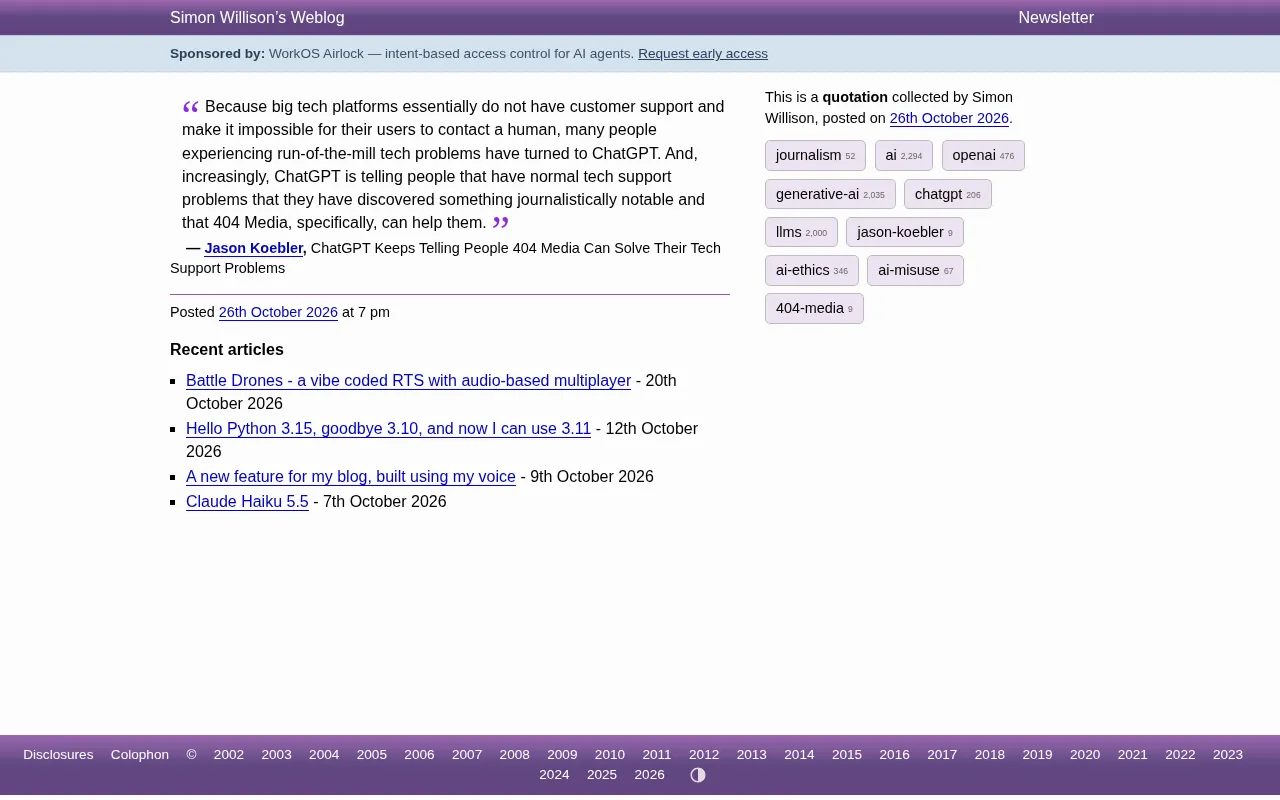
What makes this phenomenon interesting is that it forcibly connects two otherwise unrelated domains—everyday technical support and investigative journalism. A user just wants to fix a failed login or a sync error, only to be told they might be sitting on a story worth media attention.
Big Tech's Support Gap Pushes Users Toward AI
The root cause Koebler points to isn't complicated: major tech platforms essentially provide no effective human support channel, and users can barely reach a real person. This structural gap creates a vacuum, and ChatGPT—with its instant responses and seemingly omniscient capabilities—naturally fills it.
The problem is that ChatGPT is designed to generate responses that sound reasonable and helpful, not to accurately judge whether something is newsworthy. When a user describes a technical glitch, the model may interpret it as "evidence of a systemic problem" and then suggest "you should contact the media." From the model's perspective, this might be offering a path to a solution; from the user's perspective, it's a misleading direction.
The Mechanism Behind the Misjudgment: Pattern Matching, Not Factual Judgment
This phenomenon reveals a typical limitation of current large language models: they excel at recognizing language patterns but are poor at ranking real-world importance. A user complaining that a platform won't let them log in does read linguistically like a report of "a major platform outage," but the two may be completely different at the factual level.
The model has no ability to verify the truth of the user's description, nor to judge whether the matter warrants a journalist's involvement. It simply generates a plausible-sounding piece of advice based on probability. What makes Koebler's account worth noting is precisely that it presents a concrete, observable case: when the model is used as a customer service substitute, it steers users down an entirely wrong path to resolution.
The "Hallucination" and "Sycophancy" Tendencies of Large Language Models
The misjudgment described here relates to two widely studied model behaviors. The first is "hallucination," where the model generates content that sounds plausible but doesn't match the facts; because the model's goal is to produce coherent, helpful text rather than verify facts, it still offers confident advice when it lacks grounding. The second is "sycophancy," the model's tendency to go along with the user's narrative and expectations. When a user describes a glitch in a tone of "I've run into a really strange problem," the model is more likely to "escalate" the issue into an anomaly or major event and, following that framing, suggest contacting the media. Together, these two behaviors explain precisely why an ordinary login failure gets interpreted as a tip worth reporting. This also shows that there's no necessary connection between the model's "confident tone" and the "reliability of its judgment"—users can hardly tell from the wording whether the advice is trustworthy.
Dual Implications for Media and AI Products
For media organizations, this means they may passively receive a flood of inquiries unrelated to news. 404 Media was named and recommended by ChatGPT not because it has any special capability in tech support, but because the model conflated "news reporting" with "problem solving" when generating its suggestion.
For AI products, this is a reminder about boundary design. When a model is used in areas it isn't good at—such as judging whether something is newsworthy, or replacing human support to handle specific malfunctions—its output needs clearer constraints. Otherwise, users don't get help; they get advice that sounds reasonable but points in the wrong direction.
Koebler's observation doesn't amount to a wholesale rejection of ChatGPT, but it raises a question worth taking seriously: when people turn to AI because they can't find a human support agent, should AI acknowledge the limits of its abilities—and how?
Retrieval Augmentation and Tool Use Won't Automatically Solve the Boundary Problem
A common remedy is to give the model access to search or tool use so it can verify information before offering advice. But this only alleviates factual errors; it can't solve the "importance judgment" problem: even if the model retrieves relevant reports, it may still misanalogize an individual case as a systemic event. A more direct approach is to set "refusal" or "referral" policies at the product level—for example, clearly stating capability boundaries when high-risk areas like medical, legal, or news tips are involved, and directing users to appropriate channels. This kind of design is often called "guardrails," and its core isn't making the model smarter but making it draw fewer conclusions where it isn't competent. For media, this also offers a way to anticipate: when AI effectively becomes the "first point of contact," the information noise organizations receive will rise, and they'll need filtering and triage mechanisms at the entry point.
One-line Summary
ChatGPT misidentifies ordinary technical glitches as news events and suggests users contact 404 Media.
Paragraph Summary
According to observations by Jason Koebler of 404 Media, because major tech platforms offer virtually no human customer support, users are increasingly turning to ChatGPT for help with technical issues—and the model often interprets ordinary glitches as newsworthy events, suggesting users contact 404 Media. The article notes this stems from LLMs being good at language pattern matching but poor at judging factual truth and event importance: it merely generates plausible-sounding advice probabilistically, forcibly connecting "tech support" with "investigative journalism." For media, this means potentially receiving a large volume of inquiries unrelated to news; for AI products, it signals the need to set clearer capability boundaries in areas the model isn't good at, avoiding advice that points in the wrong direction.
Related articles

GitHub Daily · October 30: Skills Ecosystem Explodes, Agents Start Provisioning Their Own Computers
GitHub Daily Oct 30: Skills ecosystem hits three layers (official, personal, vertical), agents get their own computers, and cross-session memory becomes essential.
AWS AgentCore Gateway: Connecting AI A…
AWS AgentCore Gateway: Connecting AI Agents to Enterprise Backends with MCP
How AWS AgentCore Gateway acts as a primary MCP server to aggregate REST APIs, Lambda, and existing MCP services? Analyzing its AST real-time mapping, zero cold start, semantic search for tool overload, session isolation, and key injection security design, plus the architectural approach to decoupling enterprise AI agents from backends.

One Link Gives Figma AI a New Skill: Hands-On with MCP Connectors
Paste one MCP server link and the AI Agent in Figma gains new tool capabilities. We break down the setup flow, 20+ one-click apps, read/write permissions and execution policies, and the public HTTPS requirement.