Why Does Dropout Scale Activations? The Key Beyond Mean Matching
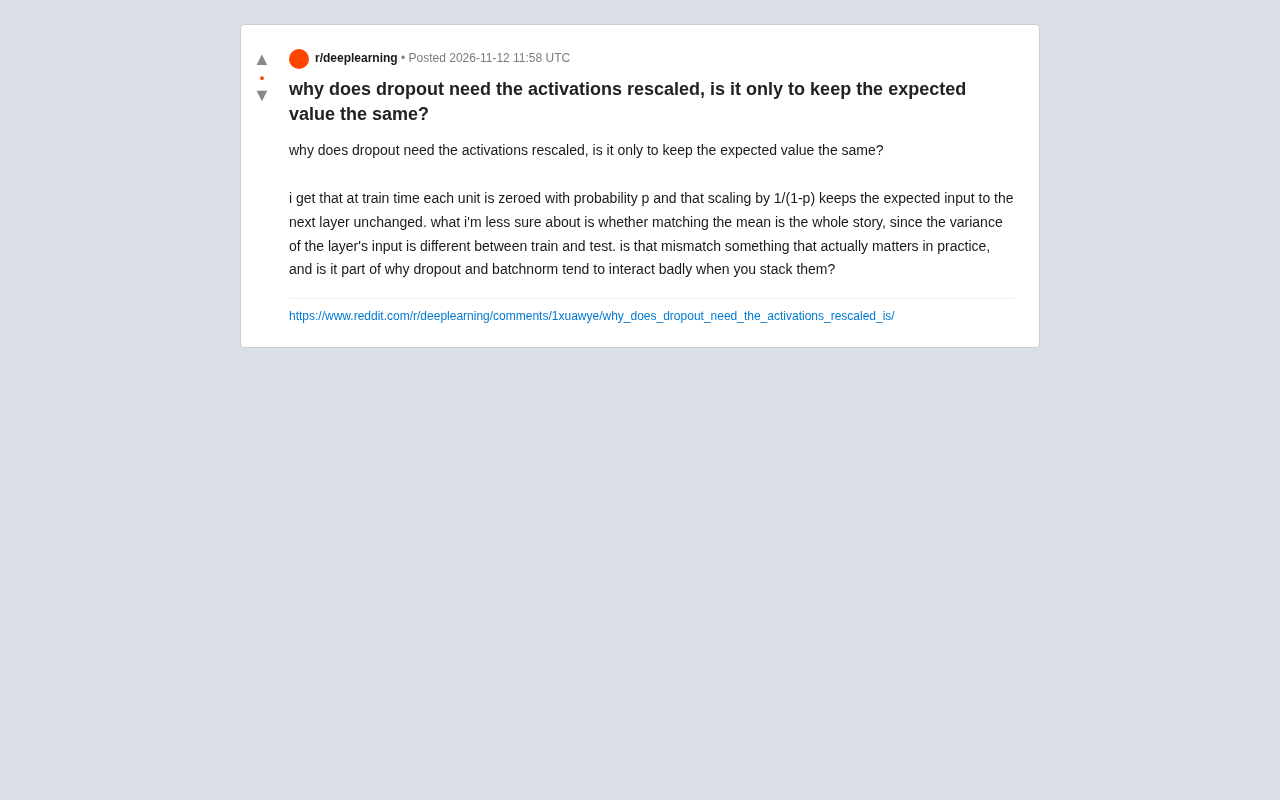
Dropout scaling does more than match the mean; variance mismatch and its statistical conflict with BatchNorm are the real keys.
Starting from a Reddit question, this article analyzes the deeper meaning of Dropout's 1/(1-p) scaling. The core purpose of scaling is to match the expected value of the next layer's input during training and inference, but the variance of retained units is amplified during training while it is zero at inference, creating a variance mismatch. This second-order effect is limited in single-layer or wide networks and may even be part of the regularization benefit; however, in deep stacking it may accumulate and affect convergence stability. The article further points out that the root of the Dropout-BatchNorm conflict is inconsistent statistical baselines: BatchNorm computes statistics on noisy distributions during training and uses moving averages at inference while Dropout is disabled, leading to normalization shift. Practical suggestions include adjusting layer order, avoiding placing Dropout directly after BatchNorm, or adopting other regularization methods.
Introduction: A Detail That Keeps Getting Asked About
In introductory deep learning courses, Dropout's scaling operation is often glossed over: during training, neurons are zeroed out with probability p, and the retained activations are multiplied by 1/(1-p) to keep the expected value of the next layer's input unchanged. But a learner's question on Reddit points to a deeper issue: Is matching the mean the whole story? Does the mismatch in variance between training and test phases really matter? Does this explain the poor interaction when Dropout is stacked with BatchNorm?
This question touches on the essence of regularization techniques and brings up some subtle trade-offs in modern network design. Based on that discussion, this article sorts out the mathematical motivation and practical implications of the scaling operation.
The Scaling Operation: Mean Matching Is Just the Starting Point
Dropout randomly drops neurons during training. Without any compensation, the total input the next layer receives would be systematically too small. The intuitive explanation for multiplying by 1/(1-p) is precisely restoring the expected value: suppose a neuron's activation is a and the drop probability is p. Then the output is a/(1-p) with probability 1-p, and 0 otherwise, so its expectation is exactly a. This ensures that the mean of the next layer's input is consistent between training and inference.
However, as the questioner points out, matching only the mean is incomplete. During training, the variance of this neuron's output is a²·p/(1-p), while during inference (no dropping) the variance is 0. This means that the input distributions during training and testing not only have the same mean but also differ in variance structure. Whether this difference is perceived by the optimization process depends on the network's sensitivity to input fluctuations.
The expectation and variance analysis here is based on a key assumption: each neuron's output is treated as a random variable, whose randomness comes from Dropout's independent Bernoulli dropping. Let the input activation be a and the drop probability be p. Then during training, the unit's output X takes a/(1-p) with probability 1-p and 0 with probability p. From this we can compute E[X]=a and Var(X)=a²·p/(1-p). During inference there is no dropping, so the output is always a and the variance is 0. This variance expression also reveals an often overlooked detail: when p approaches 1, the variance explodes sharply, because the scaling factor 1/(1-p) amplifies the values of retained units, and the dropping event itself also contributes fluctuation. Therefore, the variance mismatch under high drop rates is more significant than under low drop rates. In addition, the above analysis is performed unit by unit and does not consider correlations between dropping events of different neurons in the same layer—standard Dropout assumes independent dropping; if variants such as spatial Dropout are used, the variance structure will differ.
Variance Mismatch: How Big Is the Practical Impact?
Theoretically, the variance mismatch does exist, but its practical impact needs to be discussed case by case.
Single-Layer Perspective: Variance Changes Are Treated as Noise
For a single layer, the variance introduced by Dropout can be understood as a kind of multiplicative noise, which is one source of its regularization effect. The network learns during training to be robust to this noise; at inference the noise disappears, which may actually lead to more stable predictions. Therefore, the variance mismatch itself is not necessarily harmful and may even be part of Dropout's generalization benefit.
Deep Stacking: Variance Accumulation and Signal Attenuation
When multiple Dropout layers are stacked, the variance perturbation of each layer is passed on layer by layer. If each layer only performs mean compensation, the variance of deep inputs may accumulate a bias between training and inference. Some views in the discussion point out that this cumulative effect may affect convergence stability in very deep networks, but the specific degree depends heavily on network width, activation function, and learning rate settings.
Understanding variance accumulation requires distinguishing two cases: if the dropping events of each Dropout layer are mutually independent, then variance propagation between layers is not simple addition but interacts with each layer's weight matrix and activation function. For linear layers, the output variance is approximately proportional to the input variance times the squared Frobenius norm of the weight matrix; after nonlinearities such as ReLU, the variance is further modulated. In practice, if every layer of a very deep network uses a relatively high drop rate, the signal variance during training may be amplified or compressed layer by layer, while this modulation disappears at inference, causing the scale of deep activations to drift. This is precisely one of the motivations for introducing residual connections and normalization layers—they provide explicit anchors for signal scale. However, modern networks usually use Dropout only at a few specific positions and with low drop rates (e.g., 0.1-0.3), so in most practical configurations the cumulative effect is not a major bottleneck.
Conflict with BatchNorm: An Explanation from the Variance Perspective
The questioner keenly links the variance mismatch to the "poor interaction" between Dropout and BatchNorm, which is the most insightful part of the discussion.
The core of BatchNorm is standardizing each layer's input, that is, forcing its mean to 0 and variance to 1 (then applying a learnable scaling). During training, BatchNorm computes statistics on the activation distribution that includes Dropout noise; during inference, it uses moving average statistics while Dropout is turned off. The statistical baselines of the two are inconsistent:
- Training phase: the input variance seen by BatchNorm is amplified by Dropout (because the scaling factor 1/(1-p) acts on retained units);
- Inference phase: the input variance returns to a noise-free state, but BatchNorm still uses the statistics estimated during training.
This statistics mismatch causes the normalization result to shift at inference and thus harms performance. This is also one reason why it is often recommended in practice to avoid placing Dropout directly after BatchNorm, or to use other regularization methods instead.
BatchNorm computes the mean and variance for each mini-batch during training and maintains a running mean/variance, usually with momentum set to 0.1. At inference it uses this running average rather than the current batch's statistics. The problem is that the running average is accumulated with Dropout enabled, so it reflects the distribution of noisy activations; at inference Dropout is disabled and the actual input distribution has changed, but BatchNorm still normalizes according to the noisy statistics. This causes the normalized activations to no longer have mean 0 and variance 1, producing a systematic shift. More subtly, if Dropout is placed before BatchNorm, Dropout's multiplicative noise will also change the within-batch variance, giving BatchNorm's variance estimate itself extra fluctuation and further exacerbating the inconsistency between training and inference. Therefore, layer ordering (e.g., BatchNorm first and Dropout later) and calibration of inference-time statistics are common means of mitigating the conflict between the two.
Practical Implications: How to Properly View Scaling
From the discussion, several actionable insights can be drawn:
- The primary purpose of scaling is mean matching, which is the foundation for ensuring consistency between training and inference and is indispensable.
- Variance mismatch is a real second-order effect. Its impact is limited in shallow or wide networks, but caution is needed in deep stacking or when used together with normalization layers.
- The root of the conflict between Dropout and BatchNorm lies in inconsistent statistical baselines, not merely in the numerical difference in variance; reasonable layer ordering (e.g., BatchNorm first, Dropout later) can alleviate the problem.
- In modern architectures, Dropout is often replaced by more refined regularization (such as weight decay and Stochastic Depth), partly because its statistical coupling with normalization layers is difficult to coordinate perfectly.
Conclusion
Returning to the original question: scaling is not only for preserving the expected value, but it is indeed a design centered on mean matching and at the cost of variance mismatch. Whether the variance difference matters in practice depends on network depth, inter-layer interactions, and normalization strategy. Understanding this is more valuable than memorizing the formula 1/(1-p).
Related articles

GPT-6 Designs Proteins, Claude Creations Become Apps with One Click, DeepMind Releases New Benchmark
OpenAI says GPT-6 can design protein 3D structures, Anthropic lets Claude creations install as desktop apps, DeepMind's HIP benchmark tests stability on simple questions, Google Workspace opens agent MCP interfaces.

OpenAI Weekly Roundup: GPT-6.2 Rolls Out to ChatGPT, GPT-6 Designs Proteins
OpenAI's week: GPT-6.2 rolls out to ChatGPT, GPT-6 claims independent protein design, agent research share surges, perplexity proposed as a shared metric, and internal safety concerns surface.

Is the Crypto Industry About to "Turn Blue"? The Truth Behind Tech and Politics' Shifting Allegiances
Vergecast discusses whether the crypto industry will shift from the right to the Democrats, revealing the pragmatic nature of tech's politics and the costs of a crypto pivot.