Why Does PRM-Pruned Fragment Grafting Fail? An Empirical Analysis Across Three Reasoning Models

Rigorous experiments show PRM-Pruned Fragment Grafting is statistically equivalent to parallel CoT — because it almost always triggers at the wrong time.
This paper presents a rigorous null-result study of PRM-Pruned Fragment Grafting (PPFG) in parallel chain-of-thought reasoning. PPFG grafts high-quality reasoning prefixes from pruned chains into sibling chains still decoding, aiming to rescue struggling trajectories. Yet across three models including Qwen2.5-7B and six benchmarks, PPFG is statistically equivalent to independent parallel CoT (confirmed via TOST). The root cause: only 14% of 322 injection events actually hit chains in genuine difficulty. A compound-gate fix fails to resolve the precision-density tradeoff, and an oracle upper bound shows the ideal gain is just +0.13 percentage points. The paper's key contribution is a methodological template for establishing equivalence-based null results for inference-time mechanisms.
Parallel Chain-of-Thought (Parallel CoT) has been a promising direction for reasoning models, but it suffers from a persistent problem — diversity collapse. As multiple parallel reasoning paths gradually converge, the value of parallel sampling diminishes. To combat this, researchers have proposed various inference-time interventions. One particularly appealing design is: when a Process Reward Model (PRM) prunes a reasoning chain, it "grafts" the high-scoring prefix of that pruned chain directly into sibling chains still being decoded, serving as in-context demonstrations.
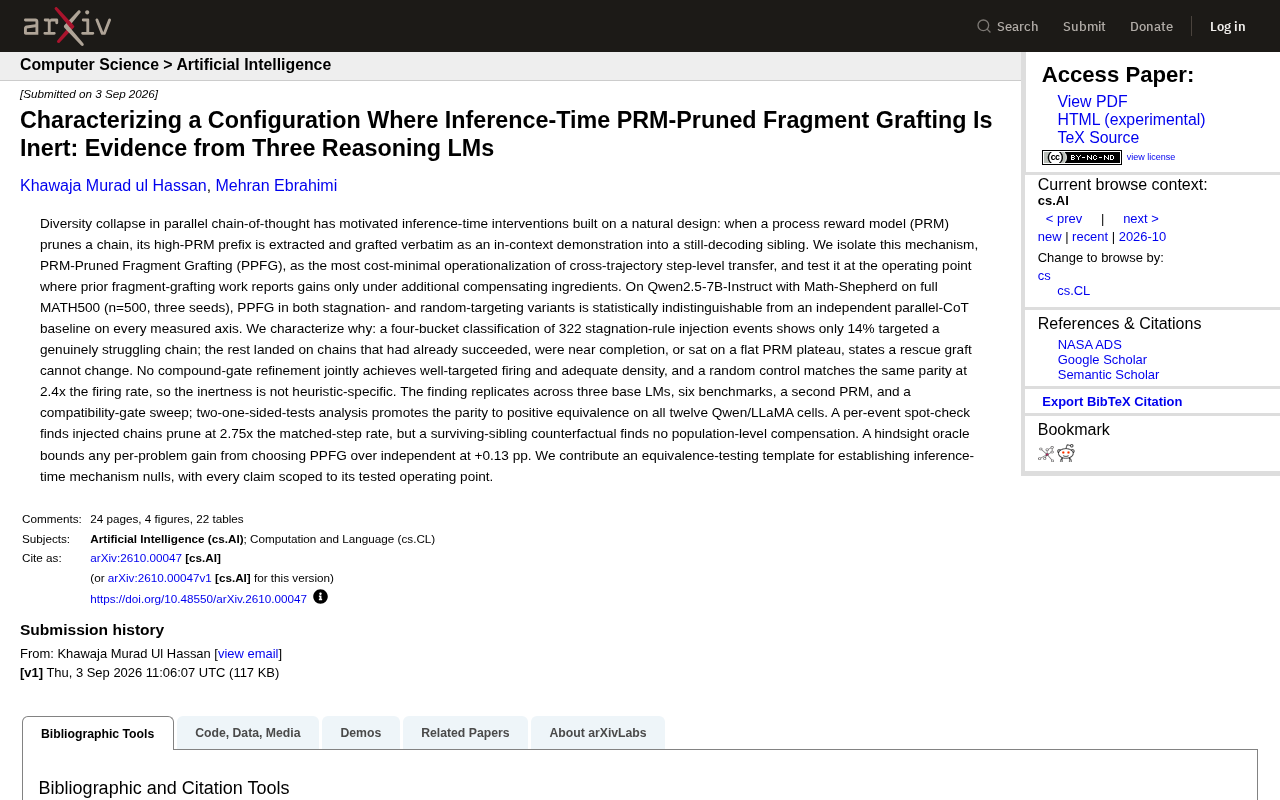
A new arXiv paper (arXiv:2610.00047v1) does something counterintuitive — rather than promoting a new method's effectiveness, it rigorously characterizes a configuration where this mechanism is completely inert, backing it up with evidence from three reasoning language models.
PPFG: The Lowest-Cost Form of Cross-Trajectory Transfer
The paper names this mechanism PRM-Pruned Fragment Grafting (PPFG), positioning it as the minimal-cost implementation of "cross-trajectory step-level transfer." The logic is straightforward: since a chain has been judged by the PRM to have a high-quality prefix, copying that prefix verbatim into another unfinished chain should provide a "rescue" or guidance effect.
What makes this worth studying is that prior work on fragment grafting has often reported positive gains — but those gains typically depended on additional "compensating ingredients." In other words, whether the bare grafting mechanism has independent value has never been cleanly isolated. This paper chooses to run controlled experiments specifically at the operating point of "grafting alone, no additional compensation."
Process Reward Models (PRMs) are a class of reward models that score each intermediate step during reasoning, as opposed to Outcome Reward Models (ORMs) that only score the final answer. PRMs can assess in real time during decoding whether a reasoning chain is heading toward the correct answer, and are widely used to guide inference-time compute strategies such as beam search and best-of-N selection. Math-Shepherd is one representative open-source PRM, designed specifically for mathematical reasoning tasks and trained via automatically constructed process-level annotations. In the context of PPFG, the PRM plays a dual role: it acts as the "pruning judge" (deciding which chain to terminate) and the "grafting source" (extracting the high-scoring prefix from the pruned chain and injecting it into other chains). This coupling means that the PRM's scoring quality and triggering timing both directly affect the grafting mechanism's effectiveness.
Statistically Indistinguishable from the Baseline
Experiments were conducted on Qwen2.5-7B-Instruct, using Math-Shepherd as the PRM, tested on the full MATH500 dataset (n=500, three random seeds). The results are unambiguous:
In both the "stagnation-targeting" and "random-targeting" variants, PPFG is statistically indistinguishable from the independent parallel CoT baseline across all measured dimensions. In other words, this seemingly reasonable grafting mechanism produces no observable gains at this operating point.
Why Does It Fail? A Four-Bucket Classification Reveals the Root Cause
The most valuable part of the paper is its characterization of why the mechanism fails, rather than simply reporting a null result.
The researchers applied a four-bucket classification to 322 "stagnation-rule" injection events, finding that only 14% of injections landed on a chain that was genuinely in difficulty. The remaining injections fell on chains that were already succeeding, nearly complete, or had PRM values on a flat plateau — states that "rescue grafting" simply cannot change.
In other words, the mechanism doesn't fail because grafting itself is useless — it fails because the triggering timing is almost always wrong. It fires repeatedly where no help is needed, and rarely hits where help is actually needed.
Further, the paper attempts to use a "compound-gate" to optimize triggering, only to find it impossible to simultaneously achieve both "precise triggering" and "sufficient trigger density." A random control group, with 2.4× the trigger rate, achieved the same balance — indicating that the failure is not a problem with any particular heuristic, but a mechanism-level issue.
The diversity collapse phenomenon described in the paper stems from the fact that, during parallel sampling, different reasoning paths in large language models tend to converge toward similar phrasing or logical frameworks in early steps. This means multiple chains effectively explore minor variations of the same solution path. As a result, the marginal returns from parallel computation diminish rapidly as the number of chains increases — adding more parallel paths doesn't effectively cover a broader solution space. The original intent of fragment grafting was to break this homogeneity: by injecting high-quality fragments from different chains, it artificially introduces heterogeneous context, forcing receiving chains to continue reasoning in different directions. However, this design presupposes that "the receiving chain genuinely needs a directional adjustment at this moment" — and the four-bucket classification shows this presupposition does not hold at most triggering moments. This reveals that the challenge of diversity intervention lies not in "how to inject" but in "when injection is truly necessary."
Multiple Replications and Equivalence Testing
To avoid the critique of "single-configuration coincidence," the paper conducts extensive robustness validation:
- Results replicated across three base language models
- Covers six benchmark tests
- Validated with a second PRM
- Compatibility-gate sweep conducted
Critically, the paper uses Two-One-Sided-Tests (TOST), elevating the conclusion from a negative "no difference found" to a positive "equivalence established" — holding across all 12 Qwen/LLaMA experimental cells. This is an important methodological distinction: proving equivalence is substantially stronger than simply saying "no difference observed."
Two One-Sided Tests (TOST) is a statistical hypothesis testing framework used to establish "equivalence" rather than "difference." Traditional null hypothesis significance testing (NHST) can only reject the null hypothesis of "no difference" — failing to reach significance only means "insufficient evidence of a difference," not "proof of no difference." TOST reverses this logic: an equivalence margin is pre-specified, and both the hypothesis that "A is lower than B by more than the margin" and "A is higher than B by more than the margin" are tested simultaneously. If both are rejected, one can positively assert that the two groups are equivalent within that margin. This method is widely used in clinical trials for generic drug equivalence testing, and has increasingly been adopted in machine learning evaluation. This paper applies TOST to evaluate inference-time intervention mechanisms, upgrading the conclusion "PPFG shows no difference from baseline" from a vague "no effect found" to a statistically supported "equivalence claim" — a key methodological rigor.
Micro-Level Evidence and Benefit Upper Bound
The paper also performed event-by-event inspection, finding that chains receiving injected fragments had a pruning rate 2.75× higher than matched steps — grafting actually makes chains more likely to be pruned. However, counterfactual analysis of "surviving sibling chains" shows no compensating gains at the population level.
Finally, a post-hoc oracle establishes the benefit upper bound: even if every problem ideally chose between PPFG and independent sampling, the resulting gain would be only +0.13 percentage points — negligible.
Methodological Contribution: Establishing "Null Results" for Inference-Time Mechanisms
Beyond the specific findings, the paper's deeper contribution lies in methodology: it provides an equivalence-testing template for rigorously establishing null conclusions about inference-time mechanisms, with every claim explicitly scoped to the operating points being tested.
In an AI research environment that broadly favors reporting positive results, this kind of work — honestly characterizing the boundaries of failure — is especially valuable. It reminds practitioners that a mechanism working in some configurations does not mean it works universally, and that clearly articulating failure conditions is just as important as proving effectiveness. For engineers designing inference-time interventions and PRM-guided sampling, this research makes one thing clear: bare fragment grafting, without addressing the "triggering timing" problem, is likely an ineffective use of compute resources.
Related articles

Chain of Thought Isn't Just for AI: How Humans Can Use CoT to Improve Thinking Quality
Chain of Thought isn't just a prompt trick for large models. Starting from a Hacker News discussion, this article analyzes why CoT works for human thinking too, breaks down actionable ways to transfer it, and highlights the key differences between human CoT and machine CoT.
Cloudflare Teams Up with OpenAI: Closi…
Cloudflare Teams Up with OpenAI: Closing the Loop from Vulnerability Discovery to Defense with AI
Cloudflare uses OpenAI Daybreak to investigate security vulnerabilities and generate reviewable remediation plans, while developers use Codex to boost coding efficiency and quality.

Orca Multi-Agent Orchestration in Practice: A Guide to Parallel Collaboration with Claude and Codex
Orca is Stable AI's free open-source agent workbench supporting 34 agents like Claude Code and Codex in parallel. Learn its Git worktree isolation, multi-model orchestration, and mobile management.