Why Does the American Right Keep Crying 'Communism'?

Anti-communist rhetoric is making a comeback in American politics, but its deterrent effect on young voters is waning.
The article traces American anti-communist discourse from the post-WWII Red Scare to contemporary label politics. The Eisenhower era bound anti-communism with Christian identity through national rituals. After the Cold War, this rhetoric was repeatedly activated to mark groups challenging traditional values. Today, democratic socialists like Bernie Sanders and AOC are frequently labeled 'communists' by Republicans, though their policies differ fundamentally from communism. The article notes that declining religious affiliation and Gen Z's rising preference for socialism may weaken the label's political efficacy, while current economic anxiety, similar to the 1930s, provides fertile ground for label politics.
The word "communism" has never truly left American political discourse. From Trump repeatedly invoking it at campaign rallies to Republicans slapping the "communist" label on their opponents, this rhetoric traces a historical thread stretching back nearly a century. But the question is: why has this tired old "monster" resurfaced today? Can it still scare voters?
From the "Red Scare" to the Culture Wars: How Anti-Communism Became Part of American Identity
The American right's fear of communism did not begin with Trump. After World War II, anti-communist sentiment rapidly rose to become a core component of national identity. At the height of the "Red Scare," thousands of American citizens were persecuted through blacklisting on suspicion of communist ties, hundreds were imprisoned, and two convicted communist spies were executed. At the time, America was increasingly defining itself as a Christian nation, and anti-communism was tightly intertwined with religious identity.

In 1954, President Eisenhower added the words "under God" to the Pledge of Allegiance, and a year later designated "In God We Trust" as the official U.S. motto and had it printed on banknotes. These moves were no accident—they were a systematic response to communist atheism, aimed at reinforcing the narrative of "Christian America" versus "atheist Soviet Union."

This entanglement of religion and politics shaped an "us vs. them" mindset: communism was not merely an enemy of economic systems but an enemy of faith and way of life. After the Cold War ended, the word was still occasionally activated to mark any group perceived as challenging traditional values.
McCarthyism was the anti-communist political movement centered on Senator Joseph McCarthy in the early 1950s. In February 1950, McCarthy delivered a speech in Wheeling, West Virginia, claiming to hold a list of 205 communists within the State Department, triggering national panic. Over the following years, the Senate Permanent Subcommittee on Investigations and the House Un-American Activities Committee (HUAC) frequently summoned government officials, Hollywood screenwriters, and university professors, demanding they disclose political affiliations and "name" others. Those summoned often ended up blacklisted and lost their jobs for refusing to cooperate. In 1954, the Army–McCarthy hearings, televised live, exposed McCarthy's brutal tactics, and in December the Senate passed a censure resolution by a vote of 67 to 22, gradually bringing McCarthyism to an end. But its political legacy—using ideological labels for political purges—profoundly influenced the discourse strategies of the American right thereafter.
The Real History of Communism in America: From the Great Depression to the Cold War
To understand how the word is used, one must first clarify what it refers to. Communism is a political-economic system in which a single party—the Communist Party—controls all political and economic decision-making of the state. But the historical American fear of communism often had little to do with the actual demands of American leftist movements.
Communism truly gained attention in America during the Great Depression of the 1930s. With the capitalist system seemingly discredited, nearly a million Americans joined the Communist Party USA and other communist-led organizations. These groups participated in labor rights advocacy and agendas for expanding government economic intervention. However, the exposure of Stalin's crimes in the late 1930s, and Stalin's pact with Hitler and invasion of Poland in 1939, completely changed the situation. For many who had placed hope in communism, this was the ultimate betrayal.

After World War II, the Cold War ushered in the most intense anti-communist period in American history—the postwar Red Scare and McCarthyism. The fear was directed not only at the government but extended to schools, the media, and any venue that could exert cultural or intellectual influence. The McCarthy era shaped anti-communism into a mainstream political movement and a fundamental creed of American life.
Who Is Being Called a "Communist" Today?
In recent years, candidates associated with left-wing groups such as the Democratic Socialists of America (DSA) have won primaries in New York, Michigan, Florida, and elsewhere, covering positions at all levels of government. Figures like Bernie Sanders, AOC, and Zohran Mamdani are frequently labeled "communists" by Republicans.
But looking at their policy positions, these people are far from communism. They advocate for universal healthcare, expanded public services, and higher taxes on the wealthy—demands fundamentally different from a system where the Communist Party controls all economic decisions. Yet this has not stopped Republicans from using the word in a religious context. Rally rhetoric often claims that opponents "will shut down churches" and "want to eliminate religion."
The effectiveness of this rhetoric is being tested by demographic change. Although the proportion of Christians in Congress is far higher than the national average, only a minority of Americans believe the U.S. should be a Christian nation.
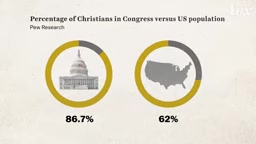
More critically, a significant proportion of America's largest voting bloc—Gen Z and Millennials—have no religious affiliation. Some polls show that Gen Z is the first generation to prefer socialism over capitalism. This means that for younger voters, the Cold War fear carried by the word "communism" may have lost its effect.
The Democratic Socialists of America (DSA) was founded in 1982 through the merger of the Democratic Socialist Organizing Committee (DSOC) and the New American Movement. It is currently the largest socialist organization in the United States, with membership surging from a few thousand to tens of thousands after Sanders' 2016 campaign. The DSA is not a Marxist-Leninist party; its platform advocates achieving "democratic socialism" through elections and union movements, with specific demands including Medicare for All, the Green New Deal, free public college, rent control, and defunding the police. DSA members elected to office are mostly city council members, state legislators, and members of Congress, such as AOC (New York's 14th District), Rashida Tlaib (Michigan), and Cori Bush (Missouri). Zohran Mamdani is a DSA-backed New York State Assembly member elected in 2024. Conflating the DSA with the "Communist Party" is a deliberate conceptual slippage in political rhetoric.
The Cycle of Economic Anxiety and Label Politics
The current economic and social conditions bear an unsettling resemblance to the 1930s: dissatisfaction with government, soaring living costs, funded wars, and income inequality. These conditions may be opening the door to new ideas that challenge the status quo—perhaps explaining why DSA-associated progressive candidates have been successful, and why their opponents are eager to portray them as "America-hating communists."
Some scholars note that since the Civil War, any group perceived as successfully challenging the status quo or reactionary politics has been labeled communist, Marxist, socialist, Bolshevik, or anarchist. The words change, but the meaning stays the same: marking the enemy.
However, the political efficacy of this label may be waning. When "communism" is used to describe moderate leftists who advocate healthcare and public services, it reveals more about the anxiety of the user than the threat of the labeled. In a country where religious affiliation continues to decline and economic anxiety continues to rise, whether the old Red Scare narrative can still work is a question worth watching.
"Red-baiting" refers to the tactic of attacking someone's political stance by accusing them of being a communist or a communist sympathizer, a common strategy in 20th-century American politics. Classic examples include: accusations against New Deal officials in the 1940s, McCarthy's pursuit of "communist infiltration" in the State Department in the 1950s, red-smearing of civil rights leaders in the 1960s, and the persecution of the Hollywood "Hollywood Ten" during the McCarthy era. The core logic of red-baiting is not to prove the target is actually a communist, but to use the fear and stigma carried by the word "communism" to politically delegitimize the accused. Academic research indicates that the effectiveness of this tactic in elections depends on the intensity of voters' perception of the "communist" threat; as Cold War memories fade and younger voters' favorability toward socialism rises, the marginal utility of red-baiting declines significantly.
One-line Summary
Anti-communist rhetoric is making a comeback in American politics, but its deterrent effect on young voters is waning.
Paragraph Summary
The article traces the historical trajectory of American anti-communist discourse from the post-WWII Red Scare to contemporary label politics. During the Eisenhower era, "under God" and "In God We Trust" were embedded into national rituals, deeply binding anti-communism with Christian identity. After the Cold War, this rhetoric was repeatedly activated to mark groups challenging traditional values. Today, democratic socialists like Bernie Sanders and AOC are frequently labeled "communists" by Republicans, yet their policy positions—universal healthcare, tax increases, expanded public services—are fundamentally different from a communist system. The article notes that declining religious affiliation and Gen Z's rising preference for socialism may weaken the political efficacy of this label; meanwhile, current economic anxiety, similar to the 1930s, provides fertile ground for the renewed activity of label politics.
Related articles
 Tech Frontiers
How Do You Stop AI Agent Emails From Sounding Like AI? One Developer's Solution
AI agent emails always sound like AI? A developer shares reright: a rewrite step that validates numbers, names, and links, preventing humanizers from tampering with key info. Test data and integration details inside.
 Tech Frontiers
Starlink Mobile: SpaceX's Carrier Ambitions and the 5G Deployment Challenge
SpaceX plans to make Starlink Mobile a mainstream carrier, deploying thousands of direct-to-cell satellites and building a terrestrial 5G network to challenge AT&T, Verizon, and T-Mobile. This article analyzes its dual-track strategy, 5G deployment challenges, and the competitive landscape.
 Tech Frontiers
OpenAI Raises Another $11 Billion, Valuation Hits $1.25 Trillion
OpenAI has raised an additional $11 billion in a new funding round at a valuation of $1.25 trillion. The deal is not yet closed and is expected to be completed in the coming weeks, further consolidating its leading position in AI.