Why Does Your AI Customer Service Keep Saying 'Please Be Patient'? Because It Never Checks Real-Time Status

Financial AI agents must combine knowledge base rules with real-time transaction data to give meaningful answers.
Most AI customer service bots fail because they only query a knowledge base and can't read real-time transaction data. Truly professional AI agents separate general policy rules (knowledge base) from live transaction status (tool calls), translate raw API fields into meaningful business conclusions, and validate data across multiple systems. When inconsistencies arise, the agent should acknowledge uncertainty rather than force a misleading answer. The core insight: professional AI combines general rules with individual case data — it's not just a faster FAQ search engine.
Why Generic Answers Are Worthless
On financial trading platforms, one of the most common customer questions is: "Why hasn't my money arrived yet?" Most AI customer service bots respond with the same tired lines — "Please be patient" or "This typically takes a few business days." These responses sound polite but are completely useless, because they have nothing to do with the actual status of that specific transaction.
The root cause is simple: most AI customer service systems only query a knowledge base, without reading real-time data. A knowledge base can tell customers that "deposits or withdrawals normally take a few business days," but it can never answer "where exactly is your money stuck right now." To answer the latter, an agent must be capable of reading live system state.
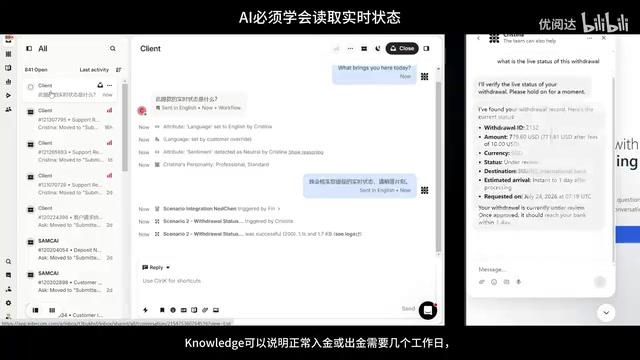
As shared by a Bilibili creator in their AI Agent practical series, the professional approach is to separate "policy timelines" from "real-time status": policy timelines are general rules that belong in the knowledge base, while real-time status must be retrieved via tool calls — fetching fields like application time, current status, last update time, channel response codes, and failure reasons.
Real-Time Status Is More Complex Than Raw API Responses
Getting the API response is just the beginning. A mature financial customer service agent needs to understand the business meaning behind each field — not simply repeat raw return values to the customer.
Two classic examples illustrate this: a platform status of "Sent" does not mean the bank has completed the final credit to the account; a payment channel status of "Success" does not mean the customer's account balance has been updated. If the agent doesn't understand these semantic differences, it will produce misleading conclusions — like telling a customer "it's already gone through successfully" when they haven't received a single cent.
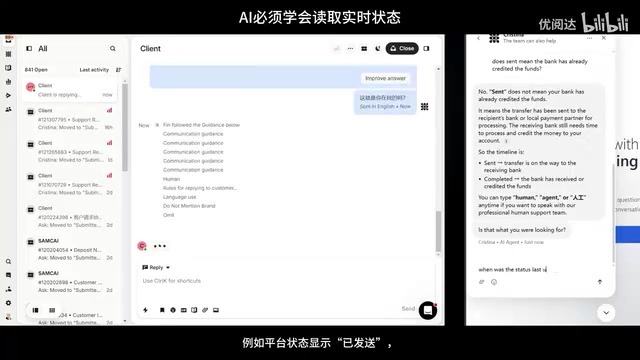
This is exactly where "professional AI" diverges from "parrot AI." The former translates interface fields into status explanations that customers can understand and that reflect the actual business reality; the latter dumps raw technical fields at the customer and creates more confusion.
This comes down to a critical conceptual distinction in finance: message status and funds settlement status often differ in both timing and meaning. Take interbank transfers as an example — the full chain typically passes through the sending bank → clearing network (such as China's CNAPS large-value payment system or small-value payment system) → receiving bank. After the sending bank dispatches the message, the platform-side status updates to "Sent" or "Processing" — but the funds are still in transit through the clearing network. Even after the clearing network returns "Success," the receiving bank may delay crediting due to account conditions, transaction limits, or other factors. For cross-border remittances, the gap between SWIFT message delivery status and final settlement can span several business days. This is why an agent must never equate "platform has issued the instruction" with "customer has received the funds" — every node in between needs to be explicitly modeled and distinguished.
Data Validation: Don't Let Bad Data Drive Bad Conclusions
Financial scenarios demand extremely high accuracy. A wrong assessment of whether funds have arrived can directly trigger customer complaints or even financial disputes. So after retrieving real-time data, the agent must perform a round of data validation.
The validation dimensions covered in the video include:
- Timestamp reasonableness: catching obviously wrong timestamps like future dates or suspiciously early times
- State transition logic: status changes should follow business logic — no reversals or unexplained jumps
- Key field completeness: missing critical fields may indicate a data synchronization failure
- Cross-system consistency: data from the platform, payment channel, bank, and other parties should corroborate each other
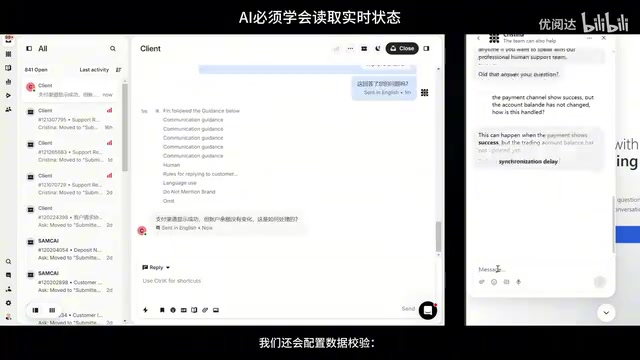
When data conflicts are detected, the right move is not to force a "definitive conclusion" but to enter an anomaly investigation workflow. In other words, when systems contradict each other, the agent should acknowledge the uncertainty and escalate for further investigation — not gamble on an answer. This kind of "knowing what you don't know" design is actually a mark of professionalism.
Cross-system data consistency validation (sometimes called "reconciliation") is a mature engineering practice in finance. A typical financial transaction is written simultaneously to multiple systems: the core transaction system, payment gateway, channel integration layer, accounting system, and notification system. These systems maintain synchronization via asynchronous messaging or batch reconciliation. When network instability, message loss, or system restarts occur, different systems may fall into temporary or even persistent inconsistency — for example, the payment channel has confirmed success, but the accounting system hasn't finished updating. The traditional approach is to catch and resolve these discrepancies after the fact through T+N reconciliation files. In the AI customer service context, if an agent detects multi-system inconsistency at query time and proactively triggers anomaly handling, it effectively moves reconciliation capability up to the user interaction layer — enabling earlier intervention and fewer complaints.
The Essence of Professional AI: Combining Rules with Real Data
The core takeaway from this content can be summed up in one sentence: Professional AI isn't about repeating FAQs faster — it's about combining general rules from knowledge with a customer's actual real-time data to deliver grounded status explanations and actionable next steps.
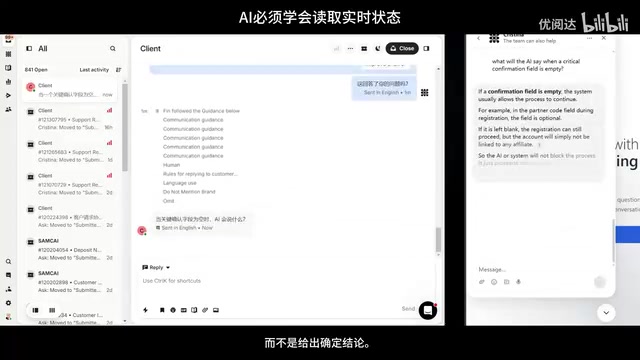
This way of thinking is instructive for any team working on AI Agent deployment. It exposes a common misconception: many teams believe that building a large knowledge base is sufficient for customer service, and end up with nothing more than a faster FAQ search engine. Real value comes from the combination of "knowledge + real-time data" — knowledge provides contextual rules, tool calls provide case-specific facts, and only together do they produce targeted answers.
Architecturally, this means agent design should follow several principles: separate knowledge from state responsibilities, explicitly model field semantics, enforce data validation, and fall back to human escalation or investigation when conflicts arise. These engineering details are often what determine whether an AI customer service system is merely "usable" or genuinely "good."
From an AI Agent architecture perspective, the design described in this article is essentially a combination of RAG (Retrieval-Augmented Generation) and Tool Use / Function Calling. RAG retrieves general policies and rules from the knowledge base to provide the model with background context; tool calls allow the model to actively query external systems during reasoning — such as transaction databases and payment channel APIs — to obtain real-time, case-specific data. The key distinction between the two lies in timeliness and specificity: knowledge base content is static, general-purpose information for all users; tool calls retrieve dynamic, transaction-specific facts for the current user. Leading agent frameworks today (such as LangChain, LlamaIndex, AutoGen, etc.) natively support both capabilities, but deciding exactly where to draw the boundary between them is something that must be explicitly designed during engineering implementation.
Lessons for AI Agent Deployment
For teams exploring AI Agent applications, this practical content offers several directly reusable takeaways:
First, ask yourself upfront: "Does answering this customer's question require general rules or case-specific data?" Then decide whether to use the knowledge base or a tool call. Don't paper over every question with a one-size-fits-all response.
Second, API return values are not business conclusions. The agent layer must perform semantic translation, clearly distinguishing concepts like "technically successful" from "funds actually credited."
Third, design explicit anomaly boundaries for your agent — when data is inconsistent, it's better to admit "this requires further investigation" than to output a definitive conclusion that could mislead the customer. In high-stakes domains like finance, caution beats fluency.
Related articles

Why Does the Tesla Roadster Need to Fly? A Deep Dive into Musk's Wild Demo
Tesla's Roadster launch showed wall-climbing, upside-down driving, and flying stunts—but The Vergecast notes the demo car may lack a battery, the Rocket version is invite-only and not street-legal, and the website terms don't guarantee delivery. After nine years of delays, why does this car still need to exist?

AI Is Not a Replacement: Human-AI Collaboration Through the Lens of Factory Root Cause Analysis
Starting from factory root cause analysis, this article explains how AI accelerates evidence chain construction rather than replacing human experts, exploring the pragmatic implementation logic and business value of 'AI supporting people rather than replacing them.'

AI Agent Decision Auditing: Building an Evidence Chain in Regulated Workflows
Starting from a Reddit discussion, this article analyzes three core issues in AI agent decision auditing within regulated workflows: what fields audit records should contain, how to handle feedback latency for erroneous decisions, and how to continuously calibrate LLM judge consistency with human judgment.