Why Has Magnetism Puzzled Scientists for a Century? Quantum Spin Finally Reveals the Answer

How quantum spin solved the century-old paradox of why magnetism exists at all.
In the early 20th century, Bohr and van Leeuwen independently proved that classical physics made magnetism theoretically impossible — exposing a fundamental gap in the theory. The answer came with quantum mechanics: the 1926 discovery of quantum spin showed that a particle's spin direction determines its magnetic field orientation, and since electrons have far stronger magnetic fields than protons, electron spin alignment determines whether a material is magnetic. Most materials are non-magnetic because electrons pair up with opposing spins and cancel out; metals like iron, nickel, and cobalt retain unpaired electrons and can be permanently magnetized. This understanding gave rise to NMR spectroscopy and MRI imaging, and underpins hard drives, motors, and wireless communications.
A Paradox That Shocked Physicists
In the early 20th century, physicists Niels Bohr and Hendrika Johanna van Leeuwen each independently arrived at a startling conclusion: according to every physical law known at the time, magnetism simply could not exist.
This conclusion clashed dramatically with reality. Humans had been navigating with magnetic compasses for thousands of years, and anyone who had ever held two magnets could feel that invisible force at work. Magnetism was obviously real — yet classical physics couldn't explain it. Bohr and van Leeuwen knew they were missing some critical piece of the puzzle; they just couldn't say what it was.
This finding, later known as the Bohr–van Leeuwen theorem, exposed a fundamental gap in classical physics. To truly understand magnetism, science would need a complete paradigm revolution.
The core argument of the Bohr–van Leeuwen theorem goes like this: within the framework of classical statistical mechanics, a system's equilibrium state is governed by the Boltzmann distribution. When a magnetic field is applied to charged particles, their orbits are deflected — but when you average statistically over all possible particle velocities and positions, the magnetic moment contributions in every direction cancel out exactly, leaving a net magnetization of zero. In other words, as long as the laws of physics remain classical, no material in thermal equilibrium can exhibit a net magnetic moment. This conclusion holds with mathematical rigor, and it directly implies that explaining magnetism requires an entirely new physical picture beyond the classical framework.
The Basic Picture of Matter — and the Questions That Remained
By the 1920s, physicists had developed a solid understanding of matter's basic structure. They knew that all materials are made of atoms, each containing a nucleus composed of protons, surrounded by orbiting electrons. Both protons and electrons carry several fundamental properties: a tiny mass, an electric charge, and a degree of magnetism.
This meant that every electron and proton is itself a miniature magnet, behaving no differently from a macroscopic one. Each has an invisible magnetic field that radiates in closed loops from one pole to the other. Magnetic poles are attracted to the dense field lines of an opposite pole on another magnet, and repelled by fields flowing in the opposite direction.
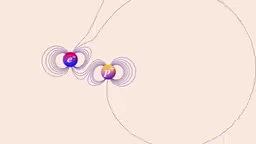
But the puzzle remained: what determines the direction of these magnetic fields? And if every atom is made of tiny magnets, why isn't all matter magnetic? Classical physics still had no answers.
Quantum Spin: The Missing Piece
The answer emerged with the birth of quantum mechanics — a new branch of physics exploring how the laws of nature operate in radically different ways at the subatomic scale.
In 1926, two Dutch physicists discovered that in addition to mass, charge, and magnetism, particles possess another fundamental property: quantum spin. The name is somewhat misleading, because nothing is actually spinning. "Spin" refers to an intrinsic directionality that influences how a particle behaves.
By the 1930s, Nobel laureate John H. van Vleck discovered that this property answered countless questions about magnetism — including the very puzzle that had stumped Bohr and van Leeuwen.
In short, the direction of a particle's spin determines the direction of its magnetic field. And since an electron's magnetic field is far stronger than a proton's, the orientation of electron spin becomes the decisive factor in whether a material is magnetic.
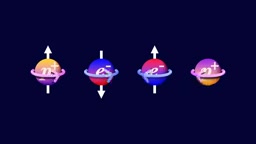
The "intrinsic directionality" of quantum spin is represented mathematically by half-integers or integers. An electron has a spin quantum number of 1/2, meaning that when measured along any given direction, the result can only be one of two values: +1/2 (commonly called "spin-up") or −1/2 ("spin-down"). This binary, either-or nature is fundamentally different from the continuously variable angular momentum of classical mechanics — it is a manifestation of the discrete character unique to the quantum world. The Pauli exclusion principle further dictates that no two electrons in the same orbital can share identical quantum states, which is the deep reason electrons tend to appear in pairs with opposite spins, and explains from first principles why most materials are not magnetic.
Why Most Materials Are Not Magnetic
If enough electrons in a material spin in the same direction, their tiny magnetic fields align, and the entire material becomes a magnet with a field pointing in that shared direction. The more electrons in alignment, the stronger the magnet.
Conversely, if the electron spins in a material compete and cancel each other out, you end up with a non-magnetic substance. In most elements, electrons come in pairs with opposing spins — and that is precisely why the vast majority of materials are not magnetic.

Iron, nickel, cobalt, and a handful of rare metals are exceptions — they tend to leave some electrons unpaired. However, being unpaired doesn't automatically make a material magnetic, because those electrons don't necessarily spin in the same direction. They need to be "nudged" into alignment through interactions with neighboring atoms.
Researchers can actively trigger this process by applying a strong magnetic field, or by heating the material in a weaker magnetic field and then cooling it. Metals treated this way retain their magnetism permanently — unless disrupted by intense heat or an extremely strong magnetic field. The magnetization process can also give almost any material a temporary magnetic state.
From NMR to MRI: How Magnetism Transformed Technology
In 1945, Felix Bloch and Edward Mills Purcell exploited this property of temporary magnetization to invent nuclear magnetic resonance spectroscopy (NMR).
The technique first uses a strong magnetic field to temporarily align the protons in a material, then uses a weaker field to knock specific molecules out of alignment. The machine then tracks the electromagnetic energy released as these disturbed protons realign, producing a map of the material's molecular structure.
This invention laid the foundation for MRI (magnetic resonance imaging) machines, which use a similar principle to map tissue by magnetizing water molecules in the human body. NMR and MRI are just two examples among the many modern technologies that depend on magnetism — hard drives, electric motors, speakers, and wireless communications are all built on an understanding of magnetic phenomena.
The reason NMR can distinguish different molecular environments lies in "chemical shift": the same type of atomic nucleus (such as a hydrogen nucleus) is shielded to varying degrees by the surrounding electron cloud depending on its chemical bonding environment, causing subtle differences in the frequency at which it responds to an applied magnetic field. By reading these frequency differences, scientists can identify molecular structures like reading a fingerprint — making NMR the gold standard for identifying unknown compounds in organic chemistry and drug development. MRI primarily uses signals from the abundant hydrogen nuclei in the body (from water and fat), applying gradient magnetic fields to spatially encode the signals and reconstruct three-dimensional images. This allows it to distinguish soft tissue differences without ionizing radiation — something X-rays and CT scans struggle to achieve.
A Century of Questions
From classical physics' paradox of "impossible magnetism" to the elegant answer provided by quantum spin, unraveling the mystery of magnetism took decades and spanned the most profound revolution in the history of physics. This journey reminds us that the most familiar phenomena often hide the most counterintuitive truths.
It's worth noting that why particles possess intrinsic properties like mass, charge, and magnetism in the first place remains an open question. The study of magnetism has never stopped — it remains one of the most captivating frontiers in physics.
Related articles

Workbuddy for Absolute Beginners: How a Desktop AI Agent Fits Into Real Workflows
A beginner's guide to the Workbuddy desktop AI agent: installation, claiming credits, file management, and building automated workflows—compared with CodeX for fit and cost, helping professionals shift from AI question-askers to AI managers.

OpenAI's New Agent Stack: Computer Use, Decisions API, and Ultra-Fast Workflows
OpenAI Dev Day unveiled a new agent stack: Computer Use outperforms humans, Decisions API delivers ultra-low-latency classification via Luna, Agents API opens the same Computer Use capabilities, and GPT-6.1 Sol costs only one-seventh of Astra. Core updates, benchmark data, and developer insights.

Liang Wenfeng Open-Sources DeepInfo Inference Framework, Takes On U.S. Ban
DeepSeek open-sources its DeepInfo inference framework after its models, featuring GPU/CPU cross-pipelining, small-model prediction with large-model verification, and full Huawei Ascend and NVIDIA chip support—facing the U.S. federal ban head-on. This article analyzes its significance for AI deployment and open-source strategy.