Why Hasan Piker Refuses to Run for Office: Independent Media Has More Political Influence Than Holding Public Office

Hasan Piker argues independent media creators wield more political leverage than elected officials.
Prominent political streamer Hasan Piker explains why he refuses to run for office, arguing that as an independent media figure he can simultaneously influence multiple elections and shape the Democratic Party's 2028 direction — leverage no single-district candidate can match. He reveals how hidden gatekeeping mechanisms and manufactured outrage from power elites actually prove his political relevance.
An Unexpected Answer
During an interview, the host relayed his mother's question: "You sound like a candidate — are you planning to run for office?" Prominent political streamer Hasan Piker's response was surprisingly blunt — no.
Hasan Piker is a Turkish-American political commentator who previously served as a producer and host at The Young Turks (TYT) network before transitioning to independent political streaming on Twitch in 2019. His channel quickly grew into one of the largest political channels on Twitch, with peak subscriber counts in the tens of thousands and single-stream viewership regularly reaching tens of thousands. His uncle, Cenk Uygur, is the founder of TYT — a family connection that embedded him deeply in the American progressive media ecosystem from the start. Piker's content style blends pop culture commentary with left-wing political analysis, attracting a large young audience, particularly Gen Z and millennial viewers that traditional political media struggles to reach.
"I'm sorry to disappoint Mama Herndon, but I will not be running for office in any capacity whatsoever." Behind this statement lies a deeper logic about contemporary political communication, the rise of independent media, and the dynamics of power. This isn't merely an influencer's personal choice about a political career — it reflects a fundamental redistribution of political influence in the digital age.

Hasan Piker's Leverage Thinking: Why Not Running Actually Maximizes Influence
Hasan's reasoning for refusing is remarkably strategic. He believes that pouring all his time and resources into a single election with uncertain outcomes would actually be an inefficient allocation of resources.
"I feel like I can have a bigger impact on every single race that I'm involved in rather than pouring all of my energy into one race that is not guaranteed to be a victory."
This is classic "leverage thinking." Originating from investment theory and systems thinking, the core logic is using limited resources to generate maximum output. In the context of platform economics, a content creator with a million-plus audience can achieve greater communication reach with a single piece of content than a member of Congress might get in media exposure over an entire term. According to Pew Research Center data, more than half of Americans aged 18-29 get their political news through social media rather than traditional television or newspapers. This means creators like Piker effectively occupy a critical position at the information gateway for young voters, wielding influence that scales across districts and issues — a structural advantage that no single-district elected official can replicate.
As an independent media figure, he can simultaneously influence multiple elections, multiple issues, and even an entire party's direction. Once you become a candidate, your influence gets compressed into one district and one term. For content creators who already command a massive audience, maintaining their "media figure" identity is actually the optimal path for maximizing political influence.
The Proven Model of Independent Channels
Hasan specifically emphasized: "This movement needs a media flank. We've already seen the success of independent channels."
This statement highlights a notable recent trend — traditional media's gatekeeping power is being diluted by independent content creators. The rise of independent media is closely tied to the democratization of platform infrastructure since Web 2.0. YouTube launched in 2005, Twitch debuted in 2011, and the podcast ecosystem exploded after 2014 — these platforms reduced the barriers to content production and distribution to near zero. Meanwhile, traditional media faces plummeting ad revenue, waves of layoffs, and a credibility crisis. According to Gallup's long-term tracking surveys, American public trust in mass media has fallen from over 70% in the 1970s to around 30% in the 2020s. In this vacuum, independent creators like Joe Rogan, Ben Shapiro, and Hasan Piker have filled audience demand, forming a decentralized yet enormously influential new media ecosystem.
Decentralized platforms — podcasts, livestreams, YouTube channels — allow individuals to bypass traditional media institutions and reach millions of viewers directly. This model hasn't just changed the path of information dissemination; it has reshaped how political agendas are set.
How the Hidden Political "Gatekeeping" Mechanism Works
When discussing why certain voices struggle to enter the mainstream, Hasan described a subtle "gatekeeping" phenomenon.
Gatekeeping theory was first proposed by social psychologist Kurt Lewin in 1947 and later applied to journalism research by communications scholar David Manning White. The theory posits that information passes through multiple layers of "gatekeepers" on its journey from event to audience — editors decide what gets published, producers decide what gets aired. In the traditional media era, this gatekeeping power was highly concentrated among a few institutions. The "social circle gatekeeping" that Piker describes is an extension of this theory into the political economy dimension: power elites don't need to issue explicit directives — merely by sharing social spaces, converging values, and intertwined interests, they form an implicit agenda-filtering mechanism.

He clarified that this gatekeeping "isn't like Blue Cross Blue Shield calling CNN and saying 'you'd better not have a Medicare for All candidate on, or we'll pull our ads' — it's not that kind of blatant conspiracy." The reality is more subtle and more mundane — "these people frequent the same cocktail bars, they know each other from events."
In other words, power's exclusion mechanism often operates not through explicit directives but through social circles, personal networks, and Washington D.C.'s famous "revolving door." The revolving door is a widely studied structural phenomenon in American politics, referring to government officials who leave office to join lobbying firms or corporations as executives, and vice versa. According to OpenSecrets data, there are more than 12,000 registered lobbyists at the federal level in the United States, over half of whom previously served in government positions. This personnel flow creates a relationship network that allows industry interests to permeate the policymaking process in unofficial, non-public ways. Typical examples include former FCC officials joining telecom giants and former Department of Defense officials sitting on defense contractor boards. The "cocktail party acquaintance relationships" that Piker describes are the everyday social manifestation of this institutional phenomenon. This structural exclusion is harder to detect and harder to resist than overt censorship.
Why a Streamer Attracts Lobbyists' Attention
Hasan pivoted to reveal an intriguing detail: some of those cocktail party conversations "are one hundred percent about how to push me out."

"No rich person, no corporate lobbyist should know who I am. In a normal world, they would say 'who is this Twitch streamer? Who cares?'"
This statement reveals a key insight: when the power establishment begins paying attention to — and even trying to marginalize — a "streamer," it proves precisely that the streamer has already accumulated political influence that cannot be ignored. Hasan views the "manufactured outrage" and backlash directed at him as inverse proof of his own influence — if he were truly insignificant, no one would bother going after him.
Manufactured outrage is a public opinion manipulation strategy that works by amplifying, distorting, or taking someone's statements out of context to provoke emotional reactions from the public, ultimately marginalizing the target. This strategy is particularly effective in the social media era because algorithms naturally favor content with high emotional arousal. Research shows that anger-inducing content is shared at rates several times higher than neutral content on Facebook. However, this strategy is a double-edged sword — if the target is skilled at leveraging controversial attention, they can actually convert it into audience growth and expanded influence. This is precisely the logic behind Piker's statement about "converting extra attention into something constructive."
Eyes on 2028: How Independent Media Shapes the Democratic Party's Direction
Hasan believes he has substantively influenced the Democratic Party's direction: "I've had a big impact on these races, and I've had a big impact on the direction that the DNC is going to be forced to go in 2028."
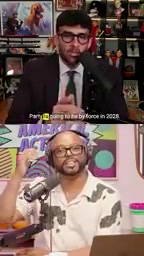
After the 2024 election, the Democratic Party faces a serious internal battle over direction. On one side, progressive forces (such as the supporter base of Bernie Sanders and Alexandria Ocasio-Cortez) advocate a more aggressive economic populist agenda including Medicare for All, free public college education, and the Green New Deal. On the other side, the establishment wing favors maintaining a centrist approach to win swing voters. The independent left-wing media force that Piker represents is attempting to tip the scales of this directional battle through opinion shaping and voter mobilization. The 2028 primaries and general election will be the critical test of whether this kind of influence can translate into actual political outcomes.
In his view, it's precisely this influence that has triggered "incredible manufactured outrage and backlash." Handling all of this requires a special kind of ability:
"It takes a real media demon to be able to turn all of that extra attention into something that is constructive — into something that highlights the positive values and policy positions of the campaign."
He predicts that more candidates capable of navigating this kind of media environment will emerge in the future. This effectively paints a picture of a new political landscape: content creation ability and media mastery are becoming core competencies for political figures.
Conclusion: Independent Media Figure or Candidate? A New Paradigm for Political Participation in the Digital Age
Hasan Piker's choice represents a new paradigm for political participation in the digital age. He clearly recognizes that in an era of attention economics and decentralized communication, an influential independent media figure doesn't necessarily need to run for office to achieve political ambitions.
By holding media ground, influencing multiple elections, and shaping party agendas, he has found a path distinct from the traditional political career. The power establishment's wariness toward him only confirms the effectiveness of this path. Regardless of whether one agrees with his positions, this ongoing experiment in "how independent media reshapes politics" deserves continued attention.
Related articles

Writing a Driver for an Old Printer with Claude Code: AI Reverse Engineering in Practice
A developer uses Claude Code to reverse engineer a native macOS CUPS driver for an HP Laser 1008a printer with no official support, from packet capture to C filter development.

AI Cyber Offense and Defense Capabilities Approaching a Critical Threshold: Should We Slow Down Model Development?
AI models' cyber capabilities are nearing critical thresholds, able to autonomously find vulnerabilities and execute attack chains. We analyze the debate between slowing development and accelerating defense.
fx: A Deep Dive into the Minimalist Op…
fx: A Deep Dive into the Minimalist Open-Source Native Coding Agent
Deep dive into fx, the open-source coding agent built on Tiny, Open, and Native principles. Exploring its unique value in controllability, privacy, and model agnosticism.