Writing a Driver for an Old Printer with Claude Code: AI Reverse Engineering in Practice

Developer uses Claude Code to reverse engineer a native macOS printer driver for an unsupported HP laser printer.
A developer leveraged Claude Code to write a native macOS CUPS driver for the HP Laser 1008a, a budget GDI printer with no official macOS support. The project involved USB data capture, proprietary protocol analysis, and C-language filter development — tasks traditionally requiring weeks of expert reverse engineering. The case sparked Hacker News debate about AI's ability to handle low-level systems programming and its potential to revive hardware abandoned due to missing drivers.
A Printer Abandoned by Its Manufacturer
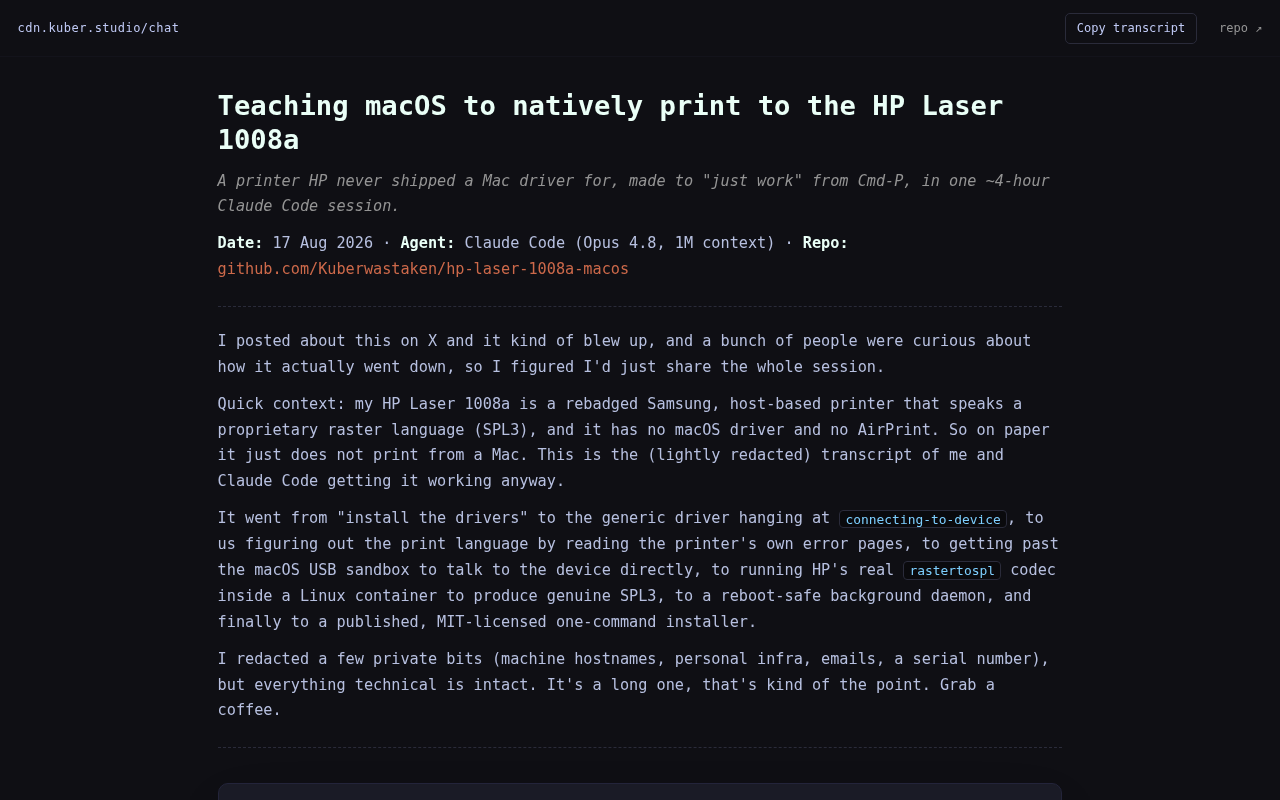
What do you do when you buy a cheap laser printer only to discover the manufacturer never provided a driver for your operating system? Most people would return it, or grudgingly run an old Windows system in a virtual machine. But one developer chose a different path — having Claude Code write a native macOS driver from scratch, teaching the system how to communicate with an HP Laser 1008a printer.
This case earned 107 upvotes and 71 comments on Hacker News, sparking heated discussion about the boundaries of AI-assisted reverse engineering. It's not just a "saving money on a printer" story — it's a real-world stress test of whether AI can handle low-level systems programming.
The Closed Nature of GDI Printers: The Root of the Problem
Why This Printer Is So Difficult
The HP Laser 1008a is a classic "host-based" (or GDI) printer. To cut costs, these budget printers offload all page rendering work — which should be handled by printer firmware — to the host computer's software. In other words, the printer itself "knows" almost nothing; it only accepts pre-processed raw data streams in a format that's typically proprietary and undocumented.
To understand the root cause, you need to distinguish between two fundamentally different printer architectures. Traditional mid-to-high-end printers have built-in processors and firmware that can interpret standard page description languages like PCL (Printer Command Language) or PostScript. This means the host only needs to send high-level instructions (e.g., "draw a 12pt letter A at coordinates (100,200)"), and the printer handles rasterization on its own. GDI printers (also called "Winprinters" in the Linux community) skip all of this. Their hardware costs can be as low as one-third of traditional printers, but the tradeoff is complete dependence on host-side software to render pages into raw bitmaps and transmit them in a proprietary format. This architectural closure makes cross-platform support inherently challenging.
For Windows users, the manufacturer's driver silently handles all conversions in the background. But once you leave the Windows ecosystem — say, on macOS or Linux — the lack of an official driver renders the printer essentially useless. Traditional solutions rely on community-reverse-engineered open-source drivers, but for obscure models, nobody bothers.
Where AI Reverse Engineering Steps In
This is exactly where Claude Code comes into play. The developer's approach: rather than waiting for the community, leverage AI's code comprehension and generation capabilities to analyze the data format the printer accepts, and build a driver/filter chain that CUPS (macOS's underlying print system) can recognize.
CUPS (Common UNIX Printing System) was originally developed by Easy Software Products, acquired by Apple in 2007, and became the core print subsystem of macOS while also serving as the default print framework for most Linux distributions. CUPS's core design philosophy is the "filter chain": a print job sent from an application passes through multiple filters for format conversion — for example, from PDF to CUPS Raster (a standard line-by-line bitmap format), then from CUPS Raster to the native data stream the target printer understands. Each filter is a standalone executable, connected through standard input/output. This modular design means that supporting a new printer theoretically requires writing only the final filter in the chain.
How Claude Code Taught macOS to Print, Step by Step
From Data Capture to Protocol Analysis
The core of achieving native printing is figuring out exactly what kind of data the printer "eats." The developer's typical approach is to first capture the raw byte stream sent to the printer in an environment with an official driver, then hand it to Claude Code to analyze the structure — which bytes are control commands, which are compressed bitmap data, and what compression algorithm is used.
In the traditional reverse engineering workflow, this step requires USB packet capture tools (such as Wireshark with USBPcap, or Linux's usbmon) to capture the complete print data stream, then byte-by-byte comparison of data produced by different print content — for example, printing a pure white page, a pure black page, and specific patterns, observing which bytes change, inferring compression algorithms from data length variations, and finally writing parsing and generation code through repeated trial and error. In open-source printer driver projects like foo2zjs and SpliX, this process often takes weeks or even months, driven by a handful of experts.
These GDI printers commonly use JBIG (Joint Bi-level Image Experts Group) or custom RLE as their data compression scheme. JBIG is a lossless compression standard specifically designed for bi-level (black and white) images, widely used in fax machines and laser printers. It exploits the statistical properties of large continuous white areas and text edges on printed pages, achieving extremely high compression ratios — a 600dpi bitmap of an A4 page is roughly 4MB raw, but typically only tens to hundreds of KB after JBIG compression. However, the specific encapsulation method, page header structure, and control commands vary across manufacturers, which is precisely the core challenge reverse engineering must overcome.
AI's value in this step lies in rapid pattern recognition. Faced with a seemingly chaotic sequence of hexadecimal data, Claude can draw on known printer language specifications (such as ZJS, GDI stream formats) to formulate hypotheses and produce parsing code for verification. This shortens the traditional "guess-and-verify" cycle from hours to minutes.
Building the CUPS Filter for Native Printing
macOS's print subsystem is based on CUPS, where every print job passes through a series of filters for conversion, ultimately generating a format the printer can recognize. To make the system "natively" support this printer, a custom filter is needed to convert standard raster data (such as CUPS Raster) into the HP Laser 1008a's proprietary data stream.
Claude Code handled the bulk of writing this C-language filter, including the data compression logic, page initialization commands, and interface code connecting to CUPS. Paired with a PPD (PostScript Printer Description) file describing the printer's capabilities, the entire native print chain was complete.
PPD files were originally defined by Adobe in 1984 alongside the PostScript language, describing a printer's physical capabilities — supported paper sizes, available resolutions, whether duplex printing is supported, how many paper trays it has, etc. Although PPDs were initially designed for PostScript printers, CUPS extended them as a universal capability description format for all printers. A correctly written PPD file paired with its corresponding filter enables macOS's print dialog to correctly display all options and pass user-selected parameters to the filter program for appropriate processing.
This means users can print directly from any macOS application by clicking "Print" — no third-party software or virtual machines needed.
Community Discussion and Debate
Praise: AI Dramatically Lowers the Reverse Engineering Barrier
Many commenters felt that the most exciting aspect of this case is that it transformed work previously achievable only by seasoned reverse engineers into a task ordinary developers can attempt with AI assistance. Reverse engineering undocumented protocols has always been tedious and demanding of deep experience, and AI's capabilities in pattern recognition, protocol inference, and boilerplate code generation fill exactly the experience gap individual developers face.
Some developers pointed out that these "rescuing e-waste" applications carry significant implications — vast amounts of hardware discarded due to lack of drivers could theoretically be revived through similar approaches, which also has positive implications for reducing electronic waste. According to the UN's 2024 Global E-waste Monitor report, the world produces over 62 million tonnes of e-waste annually, a significant portion of which involves devices with perfectly functional hardware that were discarded solely due to software compatibility issues.
Skepticism: AI Is an Accelerator, Not a Magic Key
Another camp was more measured. They emphasized that Claude Code didn't crack the protocol "out of thin air" — the truly critical work (packet capture, output verification, debugging garbled prints) still requires developers with solid systems knowledge and patience. AI is more like an efficient pair-programming partner, rapidly producing candidate code, while the human still judges correctness and handles edge cases.
Others cautioned that the stability of reverse-engineered drivers is questionable. It might work perfectly with specific paper sizes and resolutions, but could crash when faced with complex graphics or duplex printing. In other words, AI can help you achieve "Hello World" level printing, but achieving the same robustness as an official driver still has a long way to go. This is a common affliction of open-source printer driver projects — the foo2zjs project maintains drivers for dozens of GDI printers, but many still have compatibility issues in specific scenarios that require ongoing community iteration to fix.
The Deeper Significance of This Case
The True Boundaries of AI's Low-Level Programming Capabilities
This project is an excellent specimen for observing current AI programming capabilities. The domains it touches — low-level systems programming, proprietary protocol reverse engineering, C language and OS interfaces — are precisely the "hardcore" areas considered hardest for AI. Unlike generating a web page or writing business logic, there's no massive corpus of public training data to reference here; AI must rely on reasoning and domain knowledge transfer.
Notably, the challenge for AI in such tasks extends beyond code generation itself. Low-level systems programming involves memory management, byte-order handling, hardware timing constraints, and other issues where any subtle error can cause system crashes or data corruption — unlike web applications where the worst case is merely a display glitch. Claude Code's ability to contribute to this project was largely enabled by the developer providing sufficient context — including captured raw data, documentation of known similar protocols, and clear verification criteria (whether the printed page is correct).
The results demonstrate that with guidance from an experienced human, AI can indeed provide substantial help in such tasks. It cannot replace human judgment, but it significantly raises the ceiling for individual developers tackling complex problems.
The Mindset Shift from "It Works" to "I'll Try It"
Perhaps more important than the technical achievement is the mindset shift this case represents. In the past, facing "manufacturer doesn't support it" situations, individuals would simply give up. Now, "let me have AI help me try" is becoming the first reaction of an increasing number of developers. When AI dramatically lowers the cost of attempting something, those long-tail problems that nobody previously bothered with — because the effort-to-reward ratio didn't make sense — suddenly become worth trying.
This phenomenon is what economists call "activation of the long tail effect" — when tool costs drop below a certain threshold, previously uneconomical niche needs suddenly become viable. In the past, spending weeks reverse engineering a printer that costs a few hundred yuan was clearly not worthwhile; but when AI compresses that time to a few hours or less, individual developers' "impulse to tinker" is unleashed.
This is perhaps the most profound change that tools like Claude Code bring: they don't just improve efficiency — they redefine the boundary of "what problems are worth solving."
Related articles

Chain of Thought Isn't Just for AI: How Humans Can Use CoT to Improve Thinking Quality
Chain of Thought isn't just a prompt trick for large models. Starting from a Hacker News discussion, this article analyzes why CoT works for human thinking too, breaks down actionable ways to transfer it, and highlights the key differences between human CoT and machine CoT.
Cloudflare Teams Up with OpenAI: Closi…
Cloudflare Teams Up with OpenAI: Closing the Loop from Vulnerability Discovery to Defense with AI
Cloudflare uses OpenAI Daybreak to investigate security vulnerabilities and generate reviewable remediation plans, while developers use Codex to boost coding efficiency and quality.

Orca Multi-Agent Orchestration in Practice: A Guide to Parallel Collaboration with Claude and Codex
Orca is Stable AI's free open-source agent workbench supporting 34 agents like Claude Code and Codex in parallel. Learn its Git worktree isolation, multi-model orchestration, and mobile management.