Why Heavy-Tailed Weight Spectra Predict Model Quality: A Statistical Explanation

Bayesian marginal likelihood and random matrix theory explain why heavy-tailed weight spectra predict DNN quality.
Heavy-tailed spectral distributions in DNN weight matrices are known to signal better model quality, but this empirical phenomenon has lacked theoretical grounding. This study builds a probabilistic framework that derives the marginal likelihood of a DNN from its final-layer weights alone — no training data required. By modeling heavy-tailed spectra with the High-Temperature Marchenko-Pastur distribution, it proves that the limiting log marginal likelihood is convex in the heaviness parameter, yielding a unique optimum. Deviating from this optimum empirically predicts overfitting in large-scale CNNs and LLMs.
Why Heavy-Tailed Weight Spectra Predict Model Quality: A Statistical Explanation
Why deep neural networks (DNNs) perform so well remains theoretically elusive. In practice, researchers have tried countless metrics to predict model quality, but most depend on training data — making them computationally expensive on large datasets, or outright impossible to compute when training data isn't publicly available.
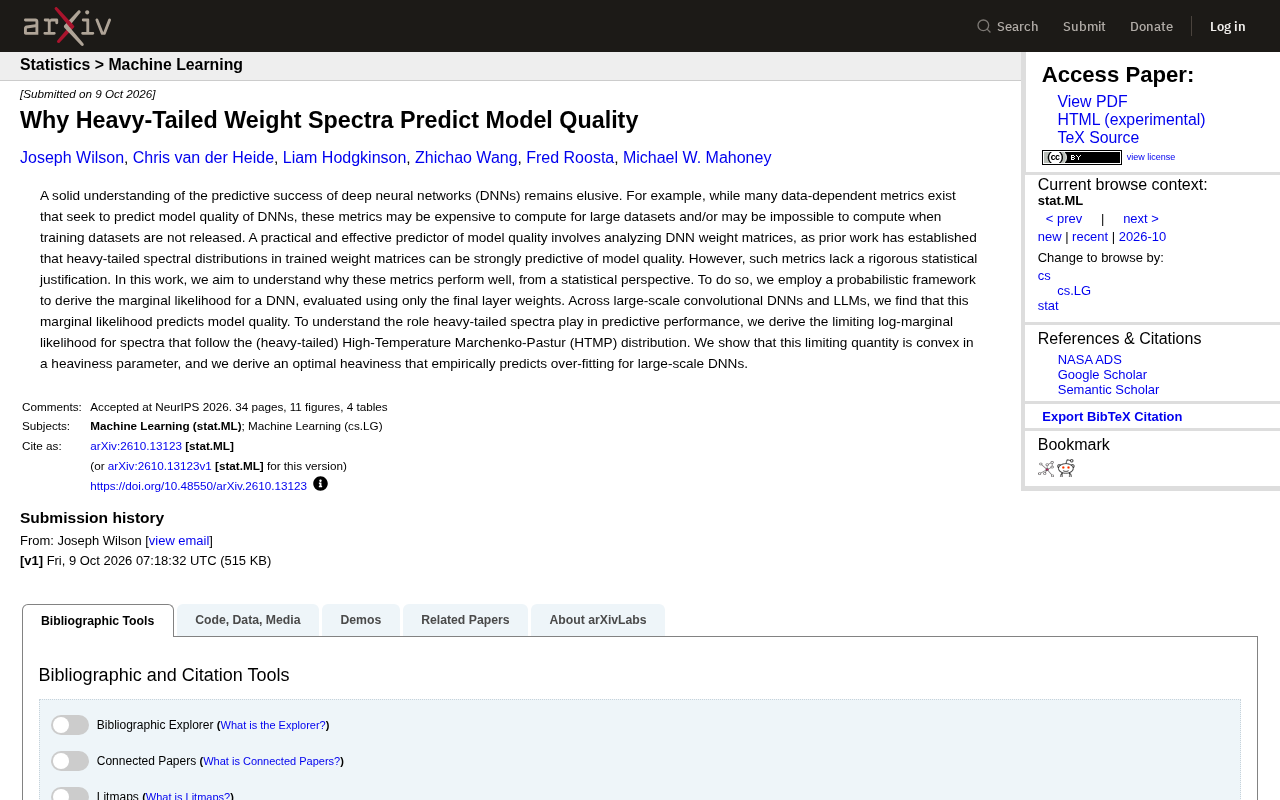
A more practical approach is to analyze the model's weight matrices directly. Prior work has noted that trained weight matrices exhibiting a heavy-tailed spectral distribution are often strong predictors of better model quality. Yet these empirical metrics have long lacked rigorous statistical grounding. The research introduced here sets out to answer a fundamental question: why do these metrics actually work?
Rethinking Model Quality Through Marginal Likelihood
The study adopts a probabilistic framework to derive the marginal likelihood of a DNN — and crucially, this quantity can be evaluated using only the network's final-layer weights. This means no access to training data is required, and no complex inference over a massive parameter space is needed, yet a principled, interpretable proxy for model quality can still be obtained.
Marginal likelihood is already a cornerstone of Bayesian statistics for measuring how well a model explains data, naturally incorporating a penalty for model complexity (i.e., the Occam's razor effect). Bringing this classical tool into DNN quality prediction gives a theoretical anchor to what was previously an empirical practice.
The research team validated this marginal likelihood on large-scale convolutional networks and large language models (LLMs), finding that it reliably predicts model quality across different architectures and task scales.
Marginal likelihood (also known as model evidence) is defined in the Bayesian framework as the probability of the data integrated over all possible parameter values: $p(\mathcal{D}) = \int p(\mathcal{D}|\theta),p(\theta),d\theta$. It jointly considers how well a model fits the data and how reasonable its parameter priors are. A complex model that fails to significantly improve fit will actually have a lower marginal likelihood, because its parameter space becomes "diluted" — this is the mathematical embodiment of the Occam's razor effect. For deep neural networks with parameter spaces reaching into the billions, computing the marginal likelihood directly is computationally intractable. One of this study's key contributions is the discovery that an effective approximation can be constructed using only the final-layer weights, dramatically reducing computational cost while retaining the theoretical guarantees of Bayesian model selection.
What Role Does the Heavy-Tailed Spectrum Play?
To understand why heavy-tailed spectra correlate with predictive performance, the study introduces a specific distributional assumption: the High-Temperature Marchenko-Pastur (HTMP) distribution. The Marchenko-Pastur distribution is a classical result from random matrix theory describing the eigenvalue distribution of large random matrices; its high-temperature variant captures heavy-tailed behavior.
Under this assumption, the study derives a closed-form expression for the log marginal likelihood as the spectral distribution approaches its limit. The result shows that this limiting quantity is a convex function with respect to a "heaviness parameter" controlling the degree of heavy-tailedness.
Convexity is analytically valuable — it implies the existence of a unique optimum. The study derives this optimal heaviness level and finds that, empirically, deviating from it predicts overfitting in large-scale DNNs. In other words, heavier tails are not unconditionally better; there exists a sweet spot. Straying from this optimal value tends to correspond with degraded model quality or elevated overfitting risk.
Random Matrix Theory (RMT) studies the statistical behavior of eigenvalues of high-dimensional random matrices. The Marchenko-Pastur law is one of its most foundational results: when the entries of an $m \times n$ matrix are i.i.d. with zero mean and finite variance, the eigenvalue density of its sample covariance matrix converges to a deterministic distribution in the limit as $m, n \to \infty$ and $m/n \to$ a constant. The "high-temperature" variant corresponds to stronger random perturbations or larger variance parameters, thickening the tails of the eigenvalue distribution — enabling it to describe the heavy-tailed behavior observed in trained weight matrices. Aligning the spectral distribution of DNN weight matrices with this theoretical distribution not only provides a parametric characterization (the "heaviness parameter"), but also makes subsequent analytic derivation of the limiting log marginal likelihood tractable. This represents one of the first systematic attempts to use random matrix theory to provide rigorous statistical foundations for empirical DNN weight spectrum metrics.
Why This Work Matters
The value of this research manifests on three levels.
Theoretically, it places previously scattered empirical observations — "heavy-tailed spectra signal good models" — within a derivable, verifiable statistical framework, filling a long-standing theoretical gap.
Practically, since the metric depends only on the weight matrix (and even just the final layer), it offers a viable model evaluation path for scenarios where training data is inaccessible. This is particularly relevant in today's ecosystem, where model weights are often open but training data is frequently proprietary.
Diagnostically, by using the optimal heaviness level to predict overfitting, it provides model developers with a signal for gauging generalization — without needing a separate validation set.
Limitations and Outlook
It is worth noting that the study is built on the specific distributional assumption of HTMP. Whether real-world weight spectra strictly conform to this assumption, and under what conditions the approximation holds, still requires broader empirical validation. Additionally, while "using only the final-layer weights" is computationally efficient, it remains an open question whether information encoded in intermediate layers might be missed.
Nonetheless, the approach of jointly applying random matrix theory and Bayesian marginal likelihood to explain DNN generalization offers a rare entry point into the deep learning "black box" — one that is both theoretically rigorous and practically valuable.
Related articles

Chain of Thought Isn't Just for AI: How Humans Can Use CoT to Improve Thinking Quality
Chain of Thought isn't just a prompt trick for large models. Starting from a Hacker News discussion, this article analyzes why CoT works for human thinking too, breaks down actionable ways to transfer it, and highlights the key differences between human CoT and machine CoT.
Cloudflare Teams Up with OpenAI: Closi…
Cloudflare Teams Up with OpenAI: Closing the Loop from Vulnerability Discovery to Defense with AI
Cloudflare uses OpenAI Daybreak to investigate security vulnerabilities and generate reviewable remediation plans, while developers use Codex to boost coding efficiency and quality.

Orca Multi-Agent Orchestration in Practice: A Guide to Parallel Collaboration with Claude and Codex
Orca is Stable AI's free open-source agent workbench supporting 34 agents like Claude Code and Codex in parallel. Learn its Git worktree isolation, multi-model orchestration, and mobile management.