Why Is AI-Generated Language So Hard to Understand?

AI text is fluent yet hard to understand, rooted in a misalignment between optimization objectives and the human path to understanding.
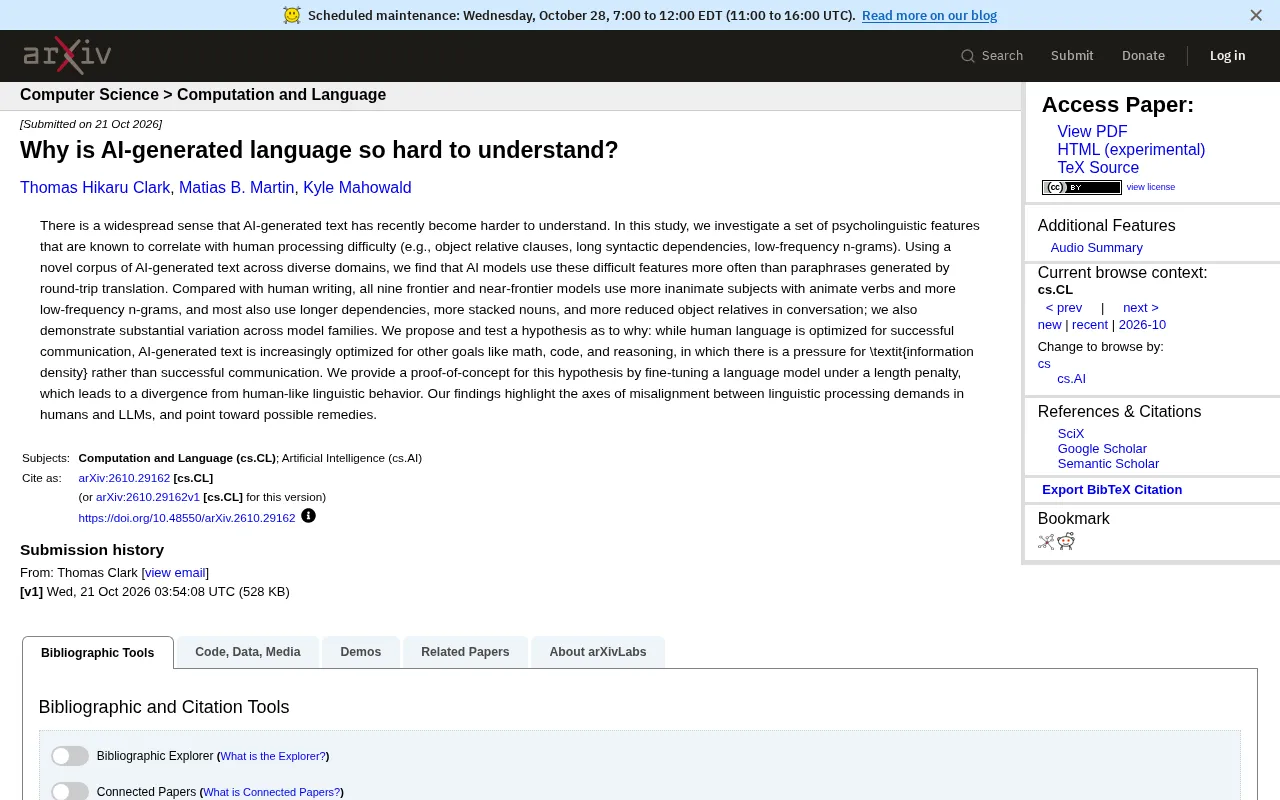
Based on a Hacker News discussion, the article dissects the multiple causes of AI-generated language being "fluent yet hard to understand": models optimize for the probability of the next token rather than the reader's comprehension efficiency; text has imbalanced semantic density, with abstract stacking forming "correct nonsense"; models lack a reader model and common ground, unable to calibrate presupposed knowledge boundaries; alignment training rewards comprehensive and balanced expression, giving rise to defensive writing that avoids positions. The discussion also notes that as models get stronger, "unintelligibility" does not disappear—it merely shifts from grammatical errors to overly smooth complexity. The article concludes with practical suggestions: ask for the conclusion first before elaboration, list arguments before writing paragraphs, and anchor concepts with concrete examples, using the human path to understanding to constrain the generation process.
On Hacker News, a discussion about "why AI-generated language is so hard to understand" attracted 71 points and 59 comments. The question seems simple, yet it touches on a deep contradiction in how current large language models generate language: models are being designed to be increasingly "fluent," yet readers often find them "confusing."
Fluency ≠ Comprehensibility: The Cognitive Load Problem of AI Language
AI-generated text is often grammatically flawless and carefully worded, yet reading it leaves you dizzy. This is not an illusion. The Hacker News discussion points out that the problem is not that AI "can't talk," but that it speaks a language without genuine communicative intent.
When humans write, authors anticipate the reader's knowledge background, reading purpose, and likely points of confusion, actively adjusting the density and order of information. When large language models generate text, however, the optimization target is "the probability of the next token," not "the reader's comprehension efficiency." The result: logical connectives between sentences are all in place, but the rhythm of information progression does not serve the human path to understanding.
One commenter offered a brilliant analogy: reading AI-generated text is like listening to someone who never pauses for breath—every word is clear, but overall it lacks the gaps that let you digest and respond.
Cognitive Load was originally a concept in educational psychology, proposed by John Sweller in the 1980s, referring to the burden working memory bears when processing information. Human working memory has limited capacity—it can handle only about 4±1 information chunks at a time—and once exceeded, comprehension efficiency drops sharply. Cognitive load is divided into three types: intrinsic load (the inherent complexity of the material), extraneous load (extra burden caused by poor presentation), and germane load (the mental effort used to build schemas). AI text is confusing to a large extent because extraneous load is too high—transitions between sentences, stacks of abstract nouns, and a lack of concrete anchors all force readers to expend extra working memory to reconstruct the author's intent. This stands in sharp contrast to the practice in human writing of "anticipating the reader's cognitive state and actively reducing extraneous load."
Semantic Density and "Correct Nonsense"
Another frequently mentioned factor is imbalanced semantic density. AI tends to cram a large number of abstract nouns and modifiers into a single paragraph, creating text that is "high-density but low-information." On the surface, every sentence states an opinion, but on close reading, many sentences repeat or dilute the same meaning.
This phenomenon is summed up in the Hacker News discussion as "correct nonsense": AI does not make obvious logical errors, but it repeatedly wraps the same safe, vague conclusion in different wording. Readers must expend extra effort to distinguish what is genuinely new information from what is merely rhetorical filler.
This contrasts with writing by human experts. Good technical writers actively compress redundancy and anchor abstract concepts with concrete examples, whereas AI often does the opposite—explaining the abstract with the abstract, wrapping generalization in generalization.
Semantic Density in social semiotics refers to the amount of meaning carried per unit of text. Linguist J.R. Martin and others treat it as a dimension for measuring register complexity: academic texts typically have high semantic density because large amounts of information are compressed into noun phrases; spoken language has low semantic density. However, high semantic density does not necessarily mean high information content—when abstract nouns merely refer to one another without experiential anchors, semantic density rises while the actual increment of information approaches zero. The "correct nonsense" mentioned in the Hacker News discussion is precisely this state of decoupling between semantic density and information content: the text is grammatically complete and terminologically accurate, yet because it lacks verifiable concrete references, readers chew on it repeatedly and still come away with vague conclusions, producing the frustration of "reading a lot but remembering nothing."
Lack of "Common Ground": AI Doesn't Know Where You Are
A consensus in the discussion is that human communication is built on common ground. When you say "this plan is similar to the last one," you assume the other person knows what "the last one" is. Human authors gradually establish this shared background in their writing, or adjust their assumptions according to the target reader.
AI lacks this ability. It does not know where the reader's knowledge boundary lies, so it either over-explains (seeming verbose to experts) or assumes too much (seeming disjointed to novices). Hacker News commenters point out that this "lack of a reader model" is a structural reason AI text is hard to understand. The model can imitate academic tone, blog tone, or news tone, but what it imitates are the surface features of a register, not the reader relationship behind the register.
Common ground is a core concept in cognitive science and pragmatics, systematically articulated by Herbert Clark and others in the 1990s. It refers to the knowledge and presuppositions that both parties in communication share, and that each knows the other knows. In human dialogue, deictic expressions such as "this" and "the last one" can be understood precisely because both parties continuously establish and update common ground through interaction—asking questions, confirming, and correcting—gradually calibrating each other's cognitive states. Clark calls this the "grounding" process. Large language models have no such opportunity for interactive calibration during single-turn generation; they can only infer the reader's likely background from statistical patterns in training corpora, and therefore cannot judge which information needs to be expanded and which can be omitted. This "non-negotiability of common ground" is the deep reason AI text is generally hard to adapt across different reader groups.
Why Does Stronger Model Capability Make Text Harder to Read?
A counterintuitive observation: as model capabilities improve, the "unintelligibility" of AI text has not disappeared—it has merely changed form. Early models had problems with grammatical errors and logical breaks, which were easy to identify; contemporary models have the problem of overly smooth complexity—complete sentence structures and accurate terminology, but overall it reads like a compliance document with no focus.
Some in the discussion attribute this phenomenon to the side effects of alignment training. To make models "helpful and harmless," the training process tends to reward comprehensive, balanced, hedged expression, which naturally leads to a style that avoids clear positions and piles up qualifications. The "unintelligibility" readers feel is partly an intuitive reaction to this defensive writing.
Alignment Training generally refers to using supervised fine-tuning, reinforcement learning from human feedback (RLHF), and other methods to make model outputs conform to human preferences and safety norms. Its reward signal often favors "comprehensive, omitting nothing, non-offensive" answers, because such outputs appear more reliable to annotators. But rewarding comprehensiveness systematically encourages models to pile up qualifications, list multiple possibilities, and avoid giving clear judgments—this is the cause of "defensive writing." Notably, this preference is not a defect in model capability but a direct product of the optimization objective: a model that scores higher in safety evaluations may simultaneously be worse in readability. Understanding this trade-off helps users distinguish between "the model can't write clearly" and "the model was trained not to prioritize writing clearly."
How to Get Along with AI Language
The Hacker News discussion did not stop at complaining. Several practical suggestions gained considerable agreement: ask the AI to "state the conclusion in one sentence" before elaborating; have it list the arguments before writing paragraphs; require concrete examples rather than definitions for key concepts. The core logic is: use the human path to understanding to constrain the generation process, rather than passively accepting the model's default output rhythm.
The unintelligibility of AI-generated language is essentially not an accidental product of technical flaws, but a misalignment between optimization objectives and human communicative needs. Recognizing this is more helpful for using such tools well than simply complaining that "AI writes badly."
One-line Summary
AI text is fluent yet hard to understand, fundamentally because optimization objectives are misaligned with the human path to understanding.
Paragraph Summary
Based on a Hacker News discussion, the article analyzes the multiple causes of AI-generated language being "fluent yet hard to understand": models optimize for the probability of the next token rather than the reader's comprehension efficiency; text has imbalanced semantic density, with abstract stacking forming "correct nonsense"; models lack a reader model and common ground, unable to calibrate presupposed knowledge boundaries; alignment training rewards comprehensive and balanced expression, giving rise to defensive writing that avoids positions. The discussion also notes that as models get stronger, "unintelligibility" does not disappear—it merely shifts from grammatical errors to overly smooth complexity. The article concludes with practical suggestions: ask for the conclusion first before elaboration, list arguments before writing paragraphs, and anchor concepts with concrete examples, using the human path to understanding to constrain the generation process.
Related articles
Learn AI Agent Development for Free: Build a Minimal Conversational Agent from Scratch
Based on Xiao Fu Ge's free Bilibili course, this lesson covers the five-stage AI Agent learning path, OpenAI protocol integration, a lightweight Java project, and building a minimal conversational agent.

Zero-Code AI God Sandbox: Is This Reddit User's Wild Idea Feasible?
A Reddit user wants 3-4 AI agents to play gods in a sandbox world for friends to interact with. Is this zero-code idea technically feasible? We break down the barriers.

Is Claude the AI That Refuses to Be a "Yes-Man"? A Reddit Discussion
Reddit discusses whether Claude is the least "yes-man" LLM. This article analyzes Claude's honesty design, comparisons with other models, and users' real attitudes toward AI people-pleasing.