Why Is AWS S3 Called the Eighth Wonder of the World? The Invisible Power of Cloud Storage
Why engineers jokingly call AWS S3 the Eighth Wonder of the World — and why they're not entirely wrong.
A viral tech community tweet placed AWS S3 alongside the Seven Wonders of the Ancient World. This article explores why the joke resonates: S3's eleven 9s (99.999999999%) data durability, its multi-AZ redundant architecture, its diverse storage class hierarchy, and its near-universal presence in modern software stacks. It also reflects on the 2017 us-east-1 outage and the broader tech culture of revering — and joking about — the invisible infrastructure we all depend on.
A Classic Tech Community Joke
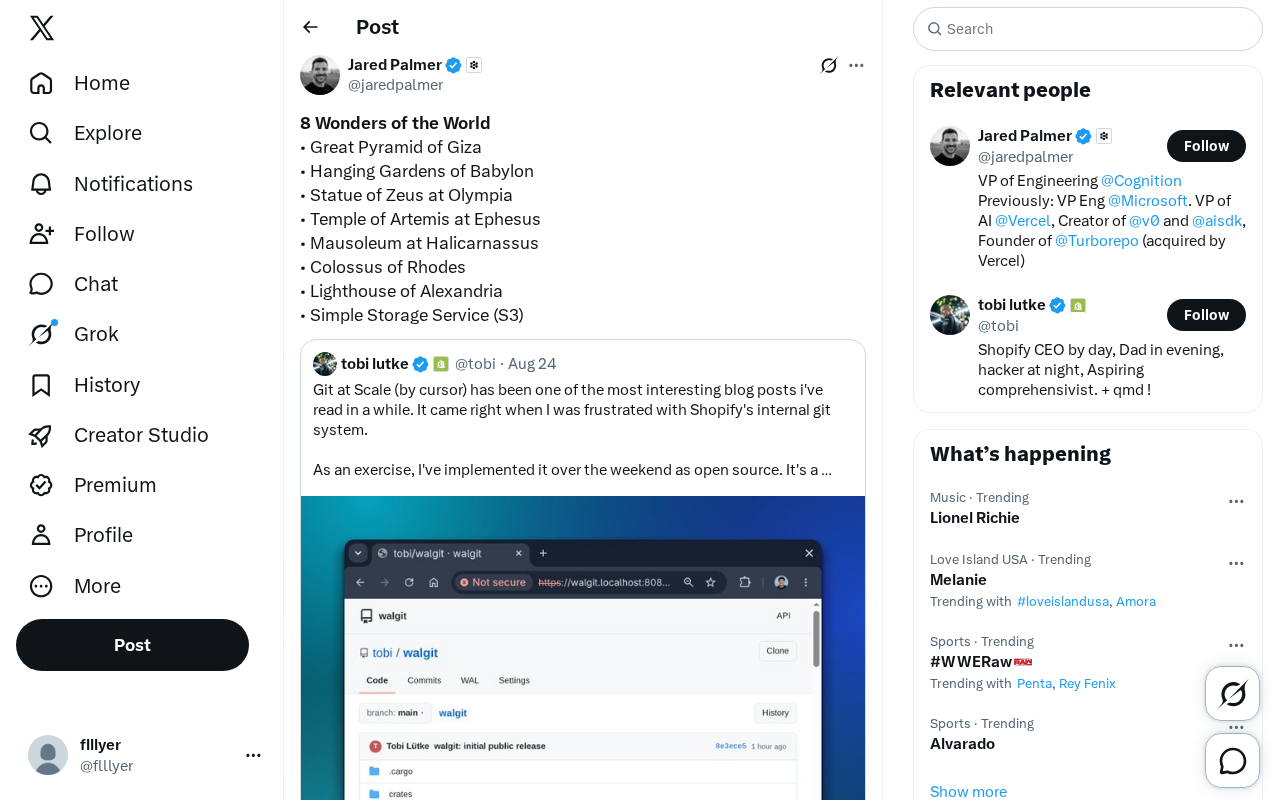
Recently, a tweet widely circulated in the tech community drew knowing smiles from engineers everywhere. The tweet presented a revised list of the "Eight Wonders of the World":
- Great Pyramid of Giza
- Hanging Gardens of Babylon
- Statue of Zeus at Olympia
- Temple of Artemis at Ephesus
- Mausoleum at Halicarnassus
- Colossus of Rhodes
- LighthouseAd of Alexandria
- Simple Storage Service (S3)
Placing Amazon S3 alongside the Seven Wonders of the Ancient World may seem tongue-in-cheek, but it speaks to a profound truth: in the modern cloud computing landscape, AWS S3 has become an "infrastructure marvel" that countless systems silently depend on. The joke resonates so widely because it strikes at the heart of every engineer's daily experience — S3 is everywhere, yet it's so often taken for granted.
Why S3 Deserves the Title of "Wonder"
The Invisible Foundation of Cloud Storage
Amazon Simple Storage Service (S3) was officially launched in March 2006 as one of AWS's earliest core cloud services. It provides object storage that allows developers to store and retrieve virtually unlimited amounts of data.
Notably, the "object storage" model that S3 employs is fundamentally different from traditional file storage and block storage. Traditional file storage organizes data in hierarchical directory structures (like NTFS or ext4 file systems). Block storage divides data into fixed-size blocks mapped directly to disk sectors (like SAN storage). Object storage, by contrast, treats data as independent "objects," each consisting of the data itself, metadata, and a unique identifier, all stored in a flat namespace. This architecture is naturally suited for storing and retrieving massive volumes of unstructured data. It eliminates the performance bottlenecks caused by directory hierarchies and makes horizontal scaling remarkably straightforward. It's precisely this architectural choice that enables S3 to effortlessly handle storage needs ranging from kilobyte-sized configuration files to multi-terabyte video assets.
From static website hosting and data lake construction to backup archiving and machine learning training dataset storage, S3 has permeated virtually every corner of modern software architecture. Among these, the "Data Lake" is a core concept in modern big data architecture — unlike traditional data warehouses that require data to be cleaned and structured before storage, a data lake allows data to be stored at massive scale in its raw format (structured, semi-structured, or unstructured), to be processed only when analysis is needed, following the "Schema-on-Read" approach. Thanks to its near-unlimited capacity, extremely low storage costs, and deep integration with the AWS ecosystem (services like Athena, EMR, Redshift Spectrum, Glue, etc.), S3 has become the de facto standard for building data lakes. Many enterprises funnel massive volumes of raw data from log systems, IoT devices, and business databases into S3, then query and analyze it on demand through various compute engines.
Many of the applications we use daily — from streaming platforms to various SaaS tools — have their underlying data sitting in S3 buckets. Because it's so reliable yet so unassuming, engineers honor its outsized importance by calling it the "Eighth Wonder of the World."
A Diverse Storage Class Hierarchy
S3 doesn't offer just one storage solution. Instead, it provides a carefully designed storage class hierarchy to accommodate different access frequencies and cost requirements. From the most commonly used S3 Standard (for frequently accessed data) and S3 Intelligent-Tiering (which automatically moves data between tiers based on access patterns), to S3 Standard-IA and S3 One Zone-IA (for infrequently accessed data that still requires fast retrieval), to long-term archival options like S3 Glacier Instant Retrieval, S3 Glacier Flexible Retrieval, and S3 Glacier Deep Archive (the lowest cost but with retrieval times of up to 12 hours) — together they provide complete coverage from "hot data" to "cold data." This tiered design lets enterprises find the optimal balance between performance and cost, and is one of the key reasons S3 can serve such a wide range of use cases.
Eleven 9s: Astonishing Data Durability by Design
S3's most impressive technical specification is its claimed "eleven 9s" (99.999999999%) data durability. This means that if you store 10 million objects, on average you might lose one object every 10,000 years. Behind this figure lies AWS's massive engineering investment in multi-Availability Zone redundant storage, automatic data verification, and self-healing.
Specifically, the key mechanism achieving this durability is AWS's multi-Availability Zone (AZ) redundant storage design. Each AWS Region typically contains three or more physically isolated Availability Zones, interconnected by low-latency, high-bandwidth dedicated networks, yet completely independent in terms of power, cooling, and network access. When data is written to S3 Standard storage, the system automatically replicates it redundantly across multiple devices in at least three Availability Zones within the same Region, continuously performing checksum verification. If data corruption or device failure is detected, the system automatically restores data from other replicas — entirely transparent to the user. This design ensures that even if an entire Availability Zone is knocked out by a natural disaster, data remains safe and sound.
For developers, the psychological value of this reliability is immeasurable — you no longer need to worry about disk failures or data loss; you can focus entirely on business logic. This is the modern meaning of a "wonder": taking an extraordinarily complex distributed storage problem and packaging it into an API so simple it's reassuring.
The Tech Culture Behind the Joke
The Double-Edged Sword of "Taking It for Granted"
The humor of this tweet also carries a subtle layer of reflection. When a cloud storage service becomes so reliable and so ubiquitous, people tend to forget the underlying complexity and treat it as something as natural as the air they breathe.
However, history has taught us a profound lesson: on February 28, 2017, S3 experienced a famous large-scale outage (in the us-east-1 region), caused by nothing more than a single input error by an engineer executing a maintenance command. Post-incident investigation revealed that while troubleshooting a performance issue with S3's billing system, the engineer ran a command intended to remove a small number of servers — but due to an incorrect input parameter, accidentally removed far more servers than intended. Among them were critical nodes of the S3 index subsystem (used for locating objects) and the placement subsystem (used for managing storage space). Because a full restart of these two subsystems required several hours, S3 service across the entire us-east-1 region was unavailable for an extended period.
That outage affected numerous well-known services including Slack, Trello, and IFTTT, temporarily crippling what felt like "half the internet." In perhaps the most ironic twist, even AWS's own Service Health Dashboard couldn't properly display outage information because it depended on S3. Afterward, AWS implemented multiple safeguards, including limiting the server capacity that could be removed in a single operation and accelerating subsystem restart procedures. This episode perfectly illustrates that the more "miraculous" a piece of infrastructure is, the greater the unimaginable responsibility and risk it carries.
The Collective Memory of the Engineering Community
Placing S3 alongside the ancient wonders is essentially an "inside joke" within the tech community. It reflects the complex emotions engineers hold toward infrastructure — a mix of reverence and ribbing. They depend on it deeply yet constantly joke about it; they trust its stability yet remain haunted by occasional outages.
The popularity of this kind of humor also shows how deeply cloud computing has woven itself into the cultural fabric of tech professionals. S3 is no longer just a product name — it has become a symbol representing the object storage paradigm of the entire cloud-native era.
From Ancient Wonders to Digital Wonders
How the Definition of "Wonder" Has Evolved
The Seven Wonders of the Ancient World were mostly grand physical structures, representing the pinnacle of engineering achievable with the limited technology of their time. In the digital age, the definition of a "wonder" has quietly shifted — it's no longer a visually imposing structure, but rather the invisible systems that sustain entire digital civilizations, hidden within code and data centers.
AWS S3 is exactly that kind of existence. It doesn't have the towering form of a pyramid, yet it achieves "eternity" in another way: the persistent preservation of data, available on demand at any time. From this perspective, listing it as the "Eighth Wonder of the World" isn't entirely a joke — it's a fitting tribute to the engineering achievements of modern cloud computing.
A Few Takeaways Worth Reflecting On
This social media quip offers several thought-provoking insights:
- Reliable infrastructure is the invisible pillar of modern digital civilization, and its true value is often only realized when it breaks. The 2017 S3 outage is the perfect example — when the "air" suddenly disappears, you realize just how much you depended on breathing.
- Great engineering design pursues simplicity from complexity. Wrapping an extremely complex distributed system into clean API calls is the core philosophy behind S3's success. Developers only need to call a handful of APIs like
PutObjectandGetObject, while all the complex logic — multi-AZ redundant replication, data verification and repair, automatic storage tier management — is completely abstracted away. - The cohesion of tech culture is built precisely through shared humor and collective memory, fostering a sense of identity and belonging among practitioners. From "S3 is the Eighth Wonder of the World" to "databases are the hardest thing to get right," these tech memes form a unique language system within engineering culture.
The next time you call PutObject or GetObject, perhaps you can silently pay your respects to this "digital wonder" — it quietly bears the weight of this era's massive data.
Related articles

Is the Agent Harness Dead? Cursor's Early Engineer Breaks Down the Real Architecture of AI Coding Agents
Cursor early engineer Jediah breaks down the real architecture of the agent harness: why "the harness is dead" is only half right, how the data flywheel lets the harness obsolete itself, and how Grokbot, software factories, and primitive design open new frontiers for agents.

Python Visitor Pattern and Better Alternatives Explained
A deep dive into Python's visitor pattern and four alternatives: method pattern, pattern matching, dictionary mapping, and functools.singledispatch. Choose the best decoupling design by change frequency.

357 Days of Deep Experience: Why Omarchy Made Me Stop Distro-Hopping
A 357-day deep dive into Omarchy: 59-second install, out-of-the-box audio and GPU support, the Quattro QuickShell rewrite migration pains, and why Arch users should try it.