Why Is Gemini 4 Carbon Released to Defenders First? The Double-Edged Sword of AI Vulnerability Discovery

Google gives its most powerful model, Gemini 4 Carbon, to cybersecurity defenders first, reflecting deep considerations about AI offense-defense boundaries and release pacing.
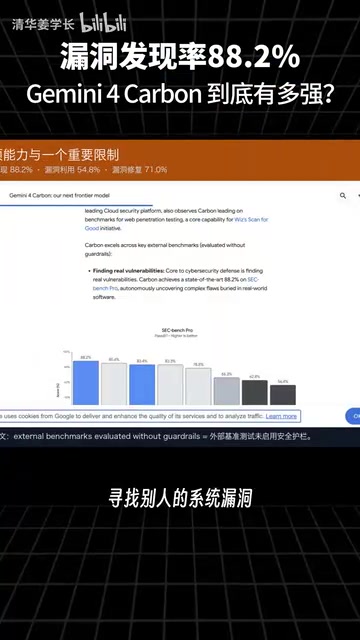
Google's Gemini 4 Carbon, billed as the most powerful AI model, was initially released only to cybersecurity defense teams. Its published scores — 88.2% vulnerability discovery, 54.8% exploitation, and 71% remediation — show the model can autonomously audit, verify, and attempt to fix software flaws. The article notes that discovery and exploitation share the same technical capabilities, which is Google's core concern in arming defenders first. Democratization of capability may lower the attack barrier, giving new tools to those previously unable to find complex vulnerabilities independently. Future cybersecurity may become a continuous AI-versus-AI race, where the time window to find and patch first becomes the scarcest defensive resource. For ordinary users, the key is watching how such capabilities are released and constrained, and whether apps carrying identity and financial information truly use new tools to close vulnerabilities.
Google's recently announced Gemini 4 Carbon is billed as the most powerful AI model to date, but interestingly, ordinary users can't access it yet — the first batch of access has gone to select cybersecurity defense teams. Behind this unconventional distribution strategy lies a serious question about the boundaries of AI capability: when a model can autonomously discover, verify, and even fix software vulnerabilities, who gets it first determines whether this technology is a shield or a spear.
An Unconventional Release Strategy
Conventionally, the most powerful models debut to developers or paying users, aiming for rapid adoption and commercial returns. Gemini 4 Carbon instead went first to cybersecurity defenders — this looks more like Google deliberately putting the brakes on the pace of capability release. According to analysis on Bilibili, the three test scores Google published are: vulnerability discovery 88.2%, vulnerability exploitation 54.8%, and vulnerability remediation 71%. These numbers show the model can not only find problems but also judge whether they can be exploited and attempt to provide fixes.
Analysts also noted that these results still need more independent verification. But even with some discount, a model that can work continuously for days, auditing security issues across massive software projects, is enough to shift the balance of power on both sides of offense and defense. Defenders getting the tool first means Google hopes to make patching outpace exploitation before the risk spreads.
Vulnerability Discovery and Exploitation Share the Same Underlying Technology
Cybersecurity has a long-standing challenge: discovering vulnerabilities and exploiting them often rely on the same set of technical capabilities. If you can read hidden security flaws in code, you can further construct attack paths; if you can verify a vulnerability is exploitable, you're only one step away from an actual breach.

This is the core of Google's concern. The payment, social, and banking apps we use every day carry chat records, photos, and identity information — some are directly linked to bank cards. Ordinary users can't read code and can only assume software companies have already secured things. But the more complex the software, the harder it is to guarantee there are no vulnerabilities; some problems may lie dormant for years until discovered externally and made public.
If AI can continuously help software companies audit code, many vulnerabilities have a chance to be fixed before causing damage — which is of course a good thing.

The reason vulnerability "discovery" and "exploitation" share a technical foundation is that both rest on a deep understanding of program flaws. Discovering a vulnerability usually means identifying a path in code that deviates from expected behavior — for example, missing bounds checks, uninitialized memory, or incorrect permission check ordering; exploiting a vulnerability extends that path into a controllable input sequence that makes the program perform what the attacker wants. Common buffer overflows, use-after-free bugs, and injection flaws are both targets scanners locate and starting points for attack chains. The difference lies mainly in the goal: defenders seek to "confirm existence and patch," while attackers seek to "confirm exploitability and weaponize." Therefore, if a model has high-accuracy vulnerability discovery capability, it is in principle not far from constructing exploitation paths — which is why capability release needs caution.
The "71% vulnerability remediation" mentioned isn't simply automatic code changes; it usually involves three stages: defect localization, patch generation, and regression verification. The model must first determine which function or data flow contains the root cause, then generate a modification that doesn't break existing functionality, and finally confirm the patch actually blocks the trigger path without introducing new problems. This process demands strong contextual understanding, because a patch that's too narrow may be bypassed, while one that's too broad may affect compatibility. The remediation success rate being lower than the discovery rate precisely shows that "fixing it right" is harder than "finding it," and explains why defenders still need human review after getting the tool — automated patching is an accelerator, not a replacement.
The Other Side of Capability Democratization
What's worth pondering is the other side: could someone who previously lacked the ability to independently find complex vulnerabilities, with AI assistance, also have a chance to do things they couldn't before? This is much like the adoption path of AI code writing — work that originally required professional expertise can now be largely handled by models.
But finding vulnerabilities in others' systems is fundamentally different from writing code. Writing code is constructive; finding vulnerabilities may point toward unauthorized intrusion. Google's approach of giving the model to defense teams first is to let defenders find problems early and fix what can be fixed, building a buffer before capabilities spread. The logic is sound, but it implies a default assumption: defenders will use the tool well, and attackers will eventually get similar capabilities too.
"Capability democratization" isn't new in security, but AI significantly lowers the barrier. In the past, finding complex vulnerabilities required long training in reverse engineering, debugger use, and protocol analysis; now, models can turn some of these steps into natural language interaction and automated reasoning. This creates tension with the "responsible disclosure" principle in the vulnerability disclosure ecosystem: when discovery capability spreads to parties lacking disclosure norms, vulnerabilities may circulate in underground markets first rather than entering vendors' remediation processes. Google prioritizing defenders is essentially building a buffer in the early part of the capability diffusion curve, letting patchers complete a round of systematic auditing before attackers acquire similar capabilities at scale. But whether the buffer works depends on whether defenders have the engineering capability to turn model output into actual patches.
The Future of Cybersecurity May Be an AI-versus-AI Race
If such capabilities become increasingly common, cybersecurity will evolve into a more intense data competition: on one side, AI constantly finds vulnerabilities; on the other, AI constantly fixes them. Who finds problems first and who acts first will become increasingly critical.
This also explains why Google chose to open access to defenders first. After AI compresses the offense-defense tempo, the time window itself is the scarcest defensive resource. Giving the powerful model to defenders first is like giving patchers a head start in the race. How long this advantage lasts depends on the speed of capability diffusion and on whether defenders actually put the tool to use — after all, getting the model first doesn't mean fixing vulnerabilities first.
For ordinary users, the takeaway is direct: software security is no longer just an internal matter for software companies, but a continuous confrontation accelerated by AI. What we can do is pay attention to how such capabilities are released and constrained, and whether the apps tied to our bank cards and identity information are actually using new tools to close vulnerabilities.
This article is based on observations and analysis by Bilibili creators regarding Gemini 4 Carbon's release strategy. Test score data is cited from Google's published information and still requires independent verification.
Related articles
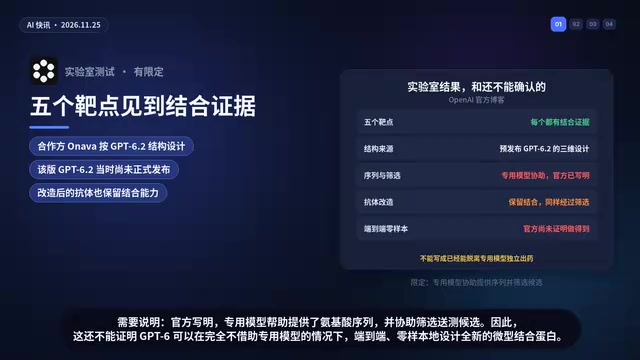
GPT-6 Designs Proteins, Claude Creations Become Apps with One Click, DeepMind Releases New Benchmark
OpenAI says GPT-6 can design protein 3D structures, Anthropic lets Claude creations install as desktop apps, DeepMind's HIP benchmark tests stability on simple questions, Google Workspace opens agent MCP interfaces.
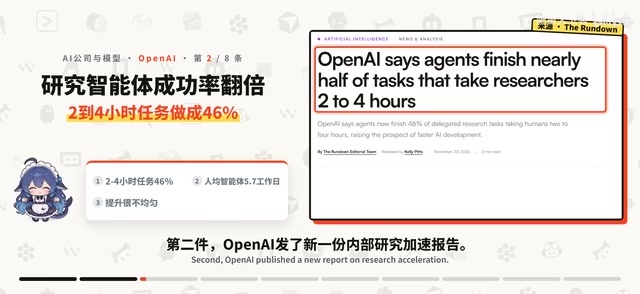
OpenAI Weekly Roundup: GPT-6.2 Rolls Out to ChatGPT, GPT-6 Designs Proteins
OpenAI's week: GPT-6.2 rolls out to ChatGPT, GPT-6 claims independent protein design, agent research share surges, perplexity proposed as a shared metric, and internal safety concerns surface.

Is the Crypto Industry About to "Turn Blue"? The Truth Behind Tech and Politics' Shifting Allegiances
Vergecast discusses whether the crypto industry will shift from the right to the Democrats, revealing the pragmatic nature of tech's politics and the costs of a crypto pivot.