Why Is Self-Hosting European Open Source Projects So Hard? Root Causes and Recommendations

Why European open source projects are harder to self-host, and what can be done about it.
A Reddit discussion highlights the difficulty of self-hosting newer European open source projects compared to mature tools like Jellyfin. The root causes include inherent architectural complexity from digital sovereignty and GDPR compliance requirements, enterprise-first design priorities, and documentation quality gaps driven by public funding incentive structures. The article offers actionable advice for both project maintainers and self-hosting users.
A Developer's Real Frustration
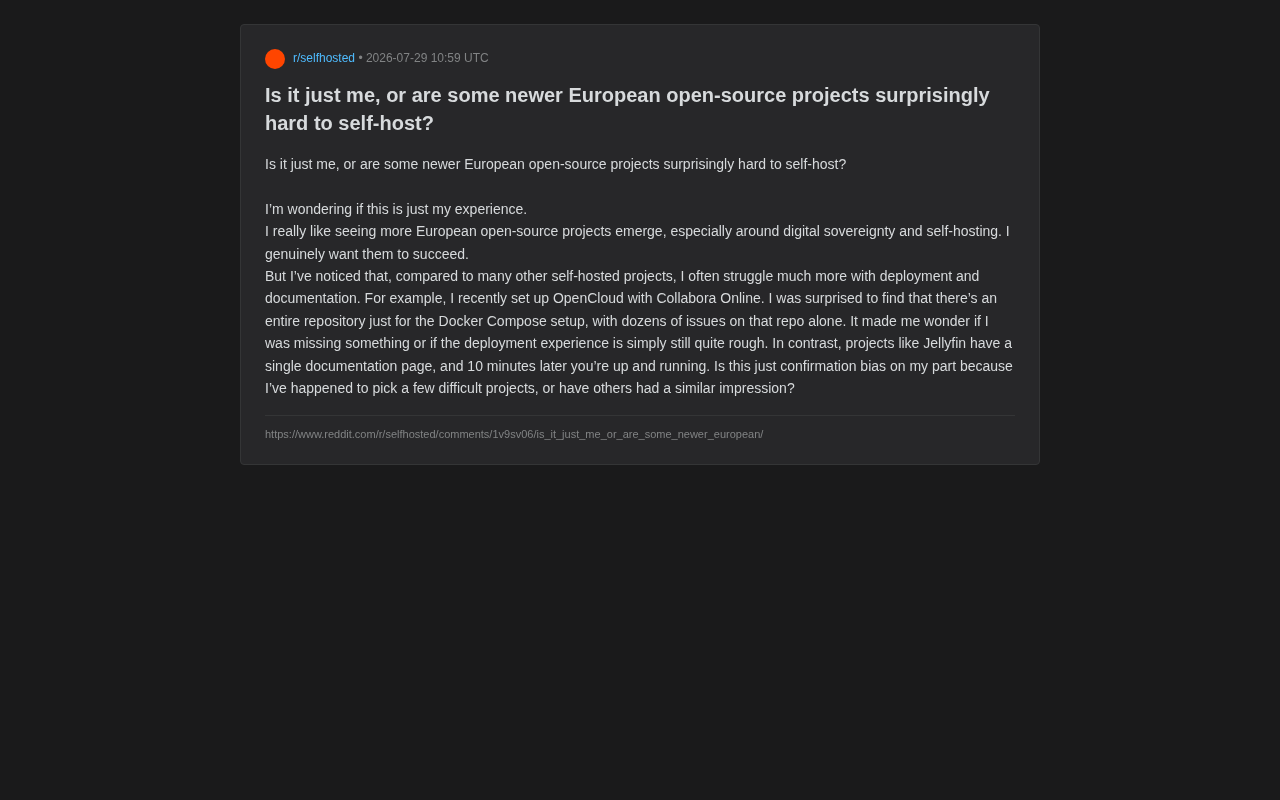
Recently, a self-hosting enthusiast sparked a highly resonant discussion on Reddit: why are some newer European open source projects so exceptionally difficult to self-host?
The user was candid — they genuinely welcome the growing wave of European open source projects built around digital sovereignty and self-hosting ideals, and sincerely hope these projects succeed. Digital sovereignty has become a core topic in European policy and tech circles in recent years, referring to the ability of individuals, organizations, or nations to maintain full control and autonomous decision-making over their digital data, infrastructure, and technology stacks. The rise of this concept is closely tied to Europe's deep-seated wariness of data monopolies held by major American tech companies — from the implementation of GDPR in 2018, to the Franco-German Gaia-X cloud infrastructure initiative, to the EU's Digital Markets Act. All of these represent concrete policy manifestations of this philosophy. In the open source space, it has given birth to projects like Nextcloud, Element/Matrix, and OpenCloud, all aimed at replacing American commercial software.
However, in practice, this user kept hitting walls — compared to other mature self-hosted projects, these European projects consistently demanded significantly more effort when it came to deployment workflows and documentation quality.
They gave a specific example: while recently trying to deploy OpenCloud with Collabora Online, they were surprised to discover that the project maintained an entirely separate repository just for Docker Compose configurations — and that repository alone had accumulated dozens of unresolved issues. OpenCloud is a relatively new open source cloud storage and collaboration platform positioned as an enterprise-grade file sync and sharing solution; Collabora Online is an online document editing suite built on LibreOffice technology, offering real-time collaborative editing capabilities similar to Google Docs. Integrating the two means simultaneously deploying a file storage service, a WOPI protocol gateway, the Collabora document rendering service, a reverse proxy, and more — each component with its own configuration requirements and version compatibility constraints. This left the user wondering: had they missed some critical step, or was the deployment experience for these projects genuinely still quite rough?
A Stark Contrast with Mature Self-Hosted Projects
To illustrate the severity of the problem, the user pointed to a widely recognized "gold standard" — Jellyfin.
As a popular open source media server, Jellyfin's deployment experience is exemplary: a single-page document, follow along for 10 minutes, and the service is up and running. The entire process requires virtually no additional research or switching between multiple repositories. Jellyfin was born in 2018 as a community fork after the Emby media server went closed-source. It follows a purely community-driven model, accepts no venture capital, and all features are completely free. Beyond its comprehensive feature set, what makes it a benchmark in the self-hosting community is its exceptional deployment experience — a single Docker image, minimal required configuration, thorough official documentation, and active community support. After nearly seven years of community refinement, its onboarding flow has reached near-perfection.
The contrast reveals a core proposition for open source projects: the onboarding experience is itself part of a product's competitiveness. In self-hosting scenarios, users are often individuals or small teams with varying levels of technical expertise. If the very first step — deployment — is full of friction, many potential users will drop off at the onboarding stage, regardless of how technically advanced the project's vision may be.
It's worth noting that self-hosting has been moving beyond the geek niche toward a much broader audience in recent years. With the proliferation of low-cost hardware like the Raspberry Pi, the maturation of Docker containerization, and the growth of community resources like Awesome-Selfhosted, an increasing number of non-professional users are attempting to run services on their own hardware. Reddit's r/selfhosted community boasts over 400,000 members and is one of the most active discussion platforms in the space. This means that if a project wants to attract this rapidly growing user base, the height of the deployment barrier will directly determine the speed of its community growth.
Why Does This Deployment Experience Gap Exist?
The user honestly acknowledged that their observation might suffer from confirmation bias — perhaps they just happened to pick a few particularly difficult projects, forming the impression that "European projects are hard to deploy." That's precisely why they posted to solicit others' opinions.
However, from a technical ecosystem perspective, there are indeed some structural reasons that can explain this phenomenon.
Architectural Complexity Under the Digital Sovereignty Paradigm
Many emerging European open source projects are fundamentally different in positioning from "single-function, maximum ease-of-use" tools like Jellyfin.
Take projects like OpenCloud as an example — they often carry far more ambitious goals: building a complete collaboration and office suite capable of replacing major tech companies, with emphasis on data compliance (e.g., GDPR), enterprise-grade permission management, and multi-component integration. This means:
- Inherently complex architecture: File storage, online document editing (Collabora), identity authentication, databases, and multiple other components must work in coordination, naturally multiplying the number of configuration items. In the context of Docker Compose, this means users need to declare and coordinate network communication, environment variable passing, TLS certificate management, and persistent storage mounting across multiple service containers within a single YAML configuration file — complexity far beyond that of a single-container application.
- Designed for enterprises, not individuals: The core user base for these projects is typically organizations with professional operations teams. Individual self-hosters are a secondary audience supported "on the side," so single-machine quick deployment gets deprioritized.
- Compliance over convenience: Digital sovereignty projects prioritize auditability, control, and customizability — properties that often come at the cost of out-of-the-box usability. Take GDPR as an example: this globally strictest data protection regulation grants users rights to access, delete, and port their personal data, while imposing rigorous compliance obligations on data processors (with penalties up to 4% of global annual revenue for violations). This directly requires systems to have independent audit logging services, fine-grained access control layers, data encryption modules, and more — each one adding to the complexity of deployment configuration.
Documentation Quality: The Underestimated "Last Mile"
Beyond architectural factors, documentation quality is an unavoidable issue.
Many European open source projects are supported by public funding, non-profit organizations, or small startups with limited human resources. Europe has a unique funding ecosystem in this regard: the EU's NGI (Next Generation Internet) initiative, Germany's Sovereign Tech Fund, France's digital revitalization programs, and others are all actively funding open source projects. However, these grants are typically milestone-oriented, with evaluations focused on feature completion, security audits, and compliance — not end-user experience or community growth metrics. This funding structure creates an interesting incentive misalignment: development teams have ample motivation to implement technical features and pass security audits, but lack clear incentives to polish deployment documentation, produce tutorial videos, or optimize the onboarding flow. Additionally, publicly funded projects usually have fixed end dates, and long-term community maintenance after project completion often lacks sustainable funding sources.
Engineers tend to invest their energy in feature development and compliance implementation, while polishing documentation and deployment scripts is consistently pushed to the bottom of the priority list. Maintaining a separate repository for Docker Compose files, with issues piling up like a mountain, is a direct manifestation of this "features first, experience later" state.
By contrast, community-driven projects like Jellyfin, after years of iteration, have long since polished their deployment documentation to perfection. This actually demonstrates that the maturity of the deployment experience is largely a function of time and community scale. A community with hundreds of active contributors will naturally have people dedicated to writing documentation, others creating one-click deployment scripts, and still others answering newcomer questions in forums — none of which can be accomplished by the core development team alone.
What Does This Mean for the Open Source Ecosystem?
Though this discussion originated from one individual's frustration, it touches on a universal pain point in open source software adoption.
For project maintainers, this is a clear signal: no matter how advanced the vision, it needs a low-barrier onboarding experience to realize its potential. The value of digital sovereignty shouldn't be reserved only for large organizations with dedicated ops teams. If individual users can get up and running in 10 minutes, both positive community feedback and contributor numbers will grow significantly. Concretely, this might mean: providing a "quick start" single-command deployment option (even with limited functionality), keeping core deployment documentation alongside the code repository rather than scattering it across separate repos, and clearly indicating the project's current maturity stage in the README.
For self-hosting users, project selection may require more realistic expectation management: projects positioned as "enterprise suites" are inherently harder to deploy than "single-purpose tools" — this isn't a sign of poor quality, but of different goals. When evaluating projects, beyond the feature checklist, documentation completeness and community activity should be equally important considerations. A practical evaluation framework includes: checking how many deployment-related issues exist on the project's GitHub, how quickly those issues receive responses, whether there are officially maintained Docker images and Compose files, and how active the community forums or chat channels are.
Conclusion
This Reddit user's observation may not be a rigorous conclusion, but it genuinely voices a common sentiment among self-hosting enthusiasts. The European open source ecosystem is thriving under the digital sovereignty wave, and that deserves encouragement. But to truly achieve "technology sovereignty for everyone," bringing the deployment experience up to Jellyfin's standard may be the most important homework these projects need to tackle next. The significance of open source lies not just in making code available, but in ensuring that everyone who wants to use it actually can — and the distance between those two things is often just the length of good documentation.
Related articles

White House Invites OpenAI and Other Giants to Preview Voluntary AI Framework: Open-Source Language Becomes Key Battleground
Trump administration invites OpenAI, Anthropic, and Google to preview a voluntary AI framework, with open-source language emerging as the core lobbying battleground that could reshape industry competition.

AI Art Prompt Structure Breakdown: Creating a Desert Crystal Pyramid Scene
Breaking down a popular Reddit AI artwork to reveal the five core elements of structured prompts: subject, material, lighting, environment, and atmosphere for AI art scene creation.

$100 Million Deal: AI Gives 50,000 Ukrainian Kamikaze Drones Autonomous Target Lock
A U.S. company struck a $100M deal with Ukraine to deploy AI visual lock-on capabilities on 50,000 cheap kamikaze drones, enabling terminal autonomous guidance to defeat electronic warfare jamming.