Why Markdown Is Becoming the Universal Language Between Humans and AI Agents

Markdown is becoming the standard data exchange format for AI agents, with unstructured-to-Markdown conversion as the critical infrastructure layer.
This article explores Markdown's core value as a universal information medium in the age of AI agents. Compared to plain text (no structure) and HTML/rich text (token-heavy redundancy), Markdown preserves key semantic structures — headings, lists, tables — with minimal symbols, making it both human-readable and machine-parseable. Since real-world data exists largely in unstructured formats like PDFs and web pages, converting them to Markdown accurately is the hardest and most critical "translation layer" in any AI pipeline, directly determining the performance of RAG systems and agent workflows.
Markdown: The Universal Information Medium for Human-AI Interaction
As AI agents rapidly proliferate, a seemingly simple yet far-reaching question is emerging: what format should humans and AI — or AI and AI — use to exchange information? An increasingly consistent answer is emerging from real-world practice: Markdown.
This lightweight markup language, originally born out of a need for simple writing, is evolving into the universal medium for information exchange between humans, machines, and intelligent agents. It's concise enough for humans to read and edit directly, yet retains enough structured semantics for machines to parse accurately. This dual accessibility is precisely the core quality that information exchange in the AI era demands.
Why Markdown and Not Something Else
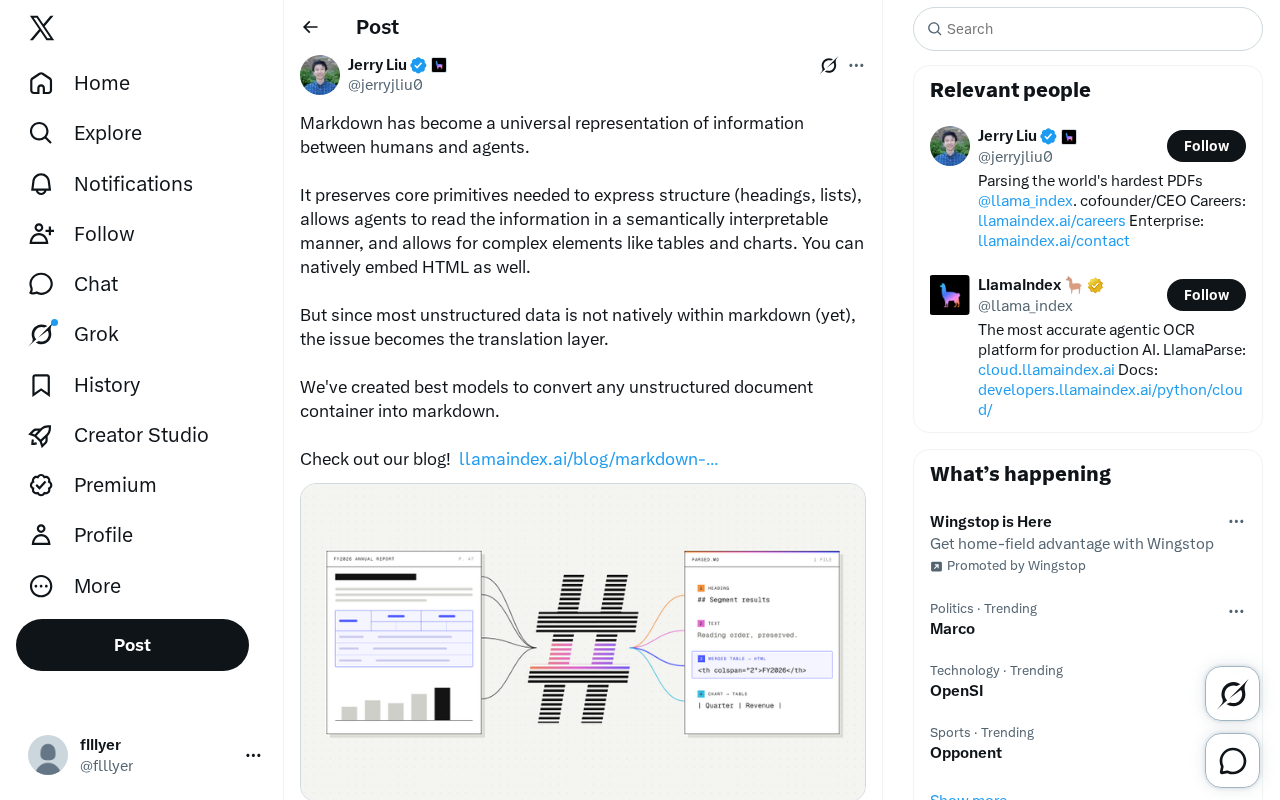
To understand Markdown's advantages, start with the core primitives it preserves. Basic structures like headings and lists make a document's hierarchy immediately legible. For AI agents, this means they can read information in a semantically interpretable way — rather than treating text as an unstructured stream of characters.
By comparison, plain text is simple but loses structure; HTML and rich-text formats are expressive but carry a large amount of redundant tags, increasing token consumption while interfering with a model's ability to focus on the actual content. Markdown sits right in the middle: conveying key structure with minimal symbols.
More importantly, Markdown doesn't sacrifice the ability to express complex content. It supports tables, diagrams, and other complex elements, and can natively embed HTML. This extensibility means that when simple syntax falls short, developers still have an escape hatch — without needing to switch to an entirely different format.
The "token consumption" mentioned here is a critical economic metric in AI engineering. Large language models are billed and processed in tokens (roughly corresponding to words or sub-word units). The more tokens in an input, the higher the API cost and the greater the inference latency. HTML markup like <div class="container"><p style="font-size:14px"> can consume many tokens while contributing nothing to the semantic meaning of the content. By contrast, Markdown uses ## for a second-level heading and - for a list item, conveying equivalent structural information at a fraction of the symbolic overhead. In production environments handling large volumes of documents, this difference compounds into significant advantages in both cost and performance.
The Real Hard Part: A Translation Layer for Unstructured Data
Despite Markdown's clear advantages, real-world data doesn't naturally exist in Markdown form. A vast amount of unstructured data — PDF documents, scans, slide decks, web pages, text embedded in images — still lives scattered across a variety of container formats.
This creates a critical challenge: the translation layer. How to accurately and losslessly convert these wildly varied unstructured documents into Markdown has become the hardest and most valuable link in the entire chain. The original author of the content targets exactly this pain point, claiming to have built the best-in-class model for converting arbitrary unstructured document containers into Markdown.
Translation Quality Determines Downstream Results
For developers building RAG (Retrieval-Augmented Generation) systems or AI agent workflows, the quality of this translation layer directly determines the success or failure of downstream tasks. If table structures are lost, heading hierarchies are scrambled, or key paragraphs are omitted during document conversion, then no matter how powerful the downstream model is, it's working from a broken input.
In other words, converting documents to Markdown is not an optional preprocessing step — it is the foundational infrastructure of the entire AI information processing pipeline. Whoever can execute this layer more accurately and reliably provides a more dependable foundation for the applications built on top of it.
RAG (Retrieval-Augmented Generation) is currently the dominant enterprise AI deployment paradigm: before answering a question, the system first retrieves relevant document chunks from an external knowledge base, then feeds them as context to a large language model to generate an answer. This architecture fundamentally depends on the retrieved content being accurate and structurally intact — if documents are already mangled at the conversion stage, the model can neither locate the correct passages nor understand the logical relationships expressed in tables or lists. The Markdown conversion layer is therefore effectively the "data quality checkpoint" of a RAG system, and its precision directly impacts retrieval recall rates and the reliability of the final answers.
Implications for Developers
Several noteworthy trends can be distilled from this discussion. Markdown is evolving from a writing format into a standard data exchange format within AI infrastructure. This means that when designing AI applications, building data pipelines around Markdown will increasingly become the default choice.
At the same time, the conversion of unstructured data into Markdown is giving rise to a dedicated tooling and model category. Whether through open-source solutions or commercial APIs, competition in document parsing capabilities will continue to intensify. For teams building knowledge bases, document Q&A systems, or agent workflows, evaluating and selecting a high-quality document-to-Markdown solution should be placed near the top of the technical decision-making priority list.
One additional note: the original content comes from a promotional post by a single vendor, and claims about having the "best model" are self-reported. Actual performance should always be validated through your own testing. That said, the underlying judgment — that Markdown is becoming the universal representation layer — genuinely reflects a real and important trend in current AI engineering practice.
Related articles

How Big Can Stars Really Get? The Physical Limits of the Largest Stars
Red supergiants are the largest stars by volume, with radii up to 2,000 times the Sun, engulfing the inner solar system. But there is no precise upper limit on stellar size—models predict up to 15,000 solar radii. The most massive blue stars are far smaller than red supergiants—biggest and heaviest are two different things.

Apple HomeView Smart Display Full Feature Breakdown: Wall-Mount or Desktop, $299
Apple launches HomeView, a $299 smart display with wall-mount and desktop options, 12MP camera for facial recognition, smart home control, music playback, and recipe step-by-step cooking. Full breakdown of watch faces, apps, privacy, and cooking integration.

Where Did the Promised New Studio Go? Craft Computing Answers After Five Years
Craft Computing's host responds to viewer questions: the new studio promised five years ago was shelved as construction costs soared from $30,000 to $75,000, and was replaced by a 168-square-foot garage conversion.