Why Mirror Molecules Won the Chemistry Nobel: Chirality and Autocatalysis Explained

Chemistry Nobel honors Cogon and Soai for discovering nonlinear effects and autocatalysis in asymmetric synthesis, unveiling homochirality and enabling precision chiral synthesis.
This article explains the Chemistry Nobel-winning work of Henry B. Cogon and Kenzo Soai on nonlinear effects and autocatalytic reactions in asymmetric organic synthesis. It begins with the basic concept of chirality and the century-old homochirality mystery—life's near-exclusive use of one enantiomer. Cogon proved in 1986 that tiny initial deviations can be greatly amplified via nonlinear effects, allowing product purity to exceed catalyst purity; Soai showed between 1995 and 2003 that certain products autocatalytically generate themselves, letting one mirror image dominate a reaction. Together they explain how life moved from slight imbalance to single chirality, enabling precision synthesis in pharmaceuticals, fragrances, agrochemicals, and new materials.
Why can mirror molecules win a Chemistry Nobel Prize? Behind this lies a profound story about chirality, nonlinear effects, and autocatalysis. According to an analysis by the YouTube channel Divya Ma'am, this year's Chemistry Nobel Prize was awarded to Henry B. Cogon and Kenzo Soai (originally spelled Kenzo Soi), recognizing their discovery of nonlinear effects and autocatalytic reactions in asymmetric organic synthesis. This research is not merely theoretical—it directly touches the core challenges of pharmaceuticals, fragrances, and materials science.
The Mystery of Chirality: Why Does Life Prefer Only One Mirror Image?
To understand this discovery, one must first grasp chirality. Chirality refers to molecules that, like left and right hands, can form mirror-image structures that cannot be superimposed. These mirror-image molecules are called enantiomers. For example, carvone (the C10H14O compound mentioned in the original), has two mirror images—one emits a minty fresh scent, while the other carries a cumin-like pungency.

The problem is that proteins in living organisms are built from amino acids, and amino acids also exist in two mirror-image forms. But life in nature almost exclusively uses only one of them—this homochirality phenomenon has been an unsolved mystery for nearly a century. More vexingly, in pharmaceuticals, one mirror image may heal while the other may harm. Humans could not predict or control this difference—until the research of Cogon and Soai emerged.
Enantiomers have nearly identical physical properties (melting point, boiling point, solubility, etc.) in achiral environments, which is why early chemists struggled to separate and identify them. However, when they interact with another chiral environment (such as enzymes or receptor proteins in the human body), their behavior diverges dramatically—just as a left hand can only fit into a left glove. The most painful lesson in history was the thalidomide tragedy of the 1950s: one enantiomer had a sedative effect, while the other caused severe fetal deformities. Because of this, the U.S. FDA issued specific guidelines in 1992 requiring that chiral drugs must separately evaluate the activity and toxicity of both enantiomers. Understanding the differential behavior of enantiomers in biological systems is a prerequisite for understanding the clinical value of Cogon and Soai's research.
Nonlinear Effects: How Are Tiny Deviations Amplified?
Henry B. Cogon's 1986 breakthrough revealed the existence of nonlinear effects. The conventional view held that two mirror-image molecules would be generated in equal amounts, but Cogon proved that an initial deviation so small as to be almost negligible could be amplified far beyond expectations during the reaction. This means that product purity can exceed catalyst purity.
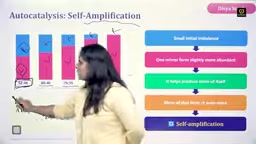
Simply put, if at the start the left-handed mirror image exceeds the right-handed one by just a few percentage points, in subsequent reactions the left-handed form will continuously reinforce itself, ultimately gaining an overwhelming advantage. This principle overturned the old understanding of "equal generation" and provided a chemical basis for explaining why life chose a single chirality.
Enantiomeric excess (ee value) is the standard metric for measuring the purity of chiral products, defined as the ratio of the difference between the concentrations of two enantiomers to their sum, ranging from 0% (completely racemic) to 100% (completely single chirality). Cogon's core contribution was discovering that the ee value of the product and the ee value of the catalyst can exhibit a nonlinear relationship: for example, using a chiral catalyst with an ee of only 10% can still yield a product with an ee exceeding 90%. This is completely different from the traditional linear model—which predicts that product ee should be proportional to catalyst ee. The chemical essence of nonlinear effects lies in the fact that chiral catalyst molecules can form dimers or oligomers, and different aggregation states have vastly different catalytic activities and chiral selectivities. When the aggregate formed by the majority enantiomer happens to be the more active species, a small amount of "impurity" enantiomer does not proportionally destroy chiral selectivity, thereby achieving an amplification effect of "using little to achieve much."
Autocatalysis: How Do Mirror Molecules Self-Replicate and Dominate Reactions?
Kenzo Soai further advanced this theory in 1995 and 2003. He discovered that certain reactions possess autocatalytic properties—the product itself can accelerate its own formation. This means that once a certain mirror-image molecule gains even a slight advantage, it can continuously replicate itself through autocatalysis, ultimately suppressing the other mirror image.
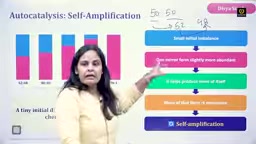
This self-amplification process can be understood through an intuitive example: suppose a machine is knitting gloves, initially producing 50 left-hand and 50 right-hand gloves; after several cycles, the number of left-hand gloves climbs from 52 to 60, 75, and all the way to 99, while right-hand gloves are almost completely squeezed out. Soai proved that this autocatalytic amplification genuinely occurs at the chemical level and can explain the origin of homochirality in living organisms.
The Soai reaction is the most famous experimental system in the field of autocatalysis: diisopropylzinc and pyrimidinecarbaldehyde react under chiral amino alcohol catalysis to produce a chiral alcohol product, and this product itself can act as a catalyst to catalyze its own formation—forming a positive feedback loop. This means that even if there is only a minuscule chiral bias at the beginning of the reaction (for example, introduced by circularly polarized light or trace impurities), it will be exponentially amplified in subsequent cycles, and the final product's ee value can exceed 99%. This experiment, for the first time, convincingly demonstrated the entire process of chiral amplification in a purely chemical system. From a broader perspective, autocatalysis is one of the core concepts in origin-of-life research—RNA molecules are believed to be able to catalyze their own replication. The Soai reaction provides experimental support for the "chemical evolution" hypothesis: before life emerged, simple chiral molecules could "select" and lock in one chirality from random fluctuations through autocatalysis, laying the foundation for the subsequent establishment of homochiral biochemical systems.
Why Is This Discovery Important? Wide Applications from Pharmaceuticals to Fragrances
The value of this discovery extends far beyond theory. In drug development, two mirror images of the same chemical formula may have vastly different efficacy—one may heal while the other may cause disease. In the past, chemists found it difficult to precisely control the generation of only the desired mirror image, but the mechanisms of Cogon and Soai show that by regulating initial deviations and autocatalytic conditions, single-chirality products can be efficiently prepared.

Its application areas include:
- Pharmaceuticals: Ensuring the synthesis of only the effective and safe enantiomer, avoiding the side effects of harmful mirror images.
- Fragrances and flavorings: Precisely formulating specific scents such as mint or cumin.
- Agrochemicals: Improving activity while reducing environmental risk.
- New materials: Providing new ideas for the design of chiral materials.
As the video summarizes, this Nobel-winning work reveals how life, through nonlinear effects and autocatalysis, moved from a tiny initial imbalance to a highly single-chirality world. It not only solves the mystery of homochirality but also empowers humanity to actively replicate this process in the laboratory, thereby opening a new chapter in precision synthesis in fields such as pharmaceuticals, fragrances, pesticides, and new materials.
One-line Summary
Chemistry Nobel honors Cogon and Soai for discovering nonlinear effects and autocatalysis in asymmetric synthesis, unveiling the mystery of life's homochirality and enabling precision chiral synthesis.
Paragraph Summary
This article explains the work for which Henry B. Cogon and Kenzo Soai won the Chemistry Nobel Prize—the discovery of nonlinear effects and autocatalytic reactions in asymmetric organic synthesis. Starting from the basic concept of chiral molecules, the article points out the nearly century-old homochirality mystery: living organisms almost exclusively use one enantiomer. Cogon proved in 1986 that tiny initial deviations can be greatly amplified through nonlinear effects, making product purity exceed catalyst purity; Soai revealed between 1995 and 2003 that certain products can autocatalytically generate themselves, allowing one mirror-image molecule to rapidly dominate a reaction. Together, these two discoveries explain how life moved from a tiny initial imbalance to a highly single-chirality world, and enable precision synthesis of single-chirality products in pharmaceuticals, fragrances, agrochemicals, and new materials.
Related articles

Chain of Thought Isn't Just for AI: How Humans Can Use CoT to Improve Thinking Quality
Chain of Thought isn't just a prompt trick for large models. Starting from a Hacker News discussion, this article analyzes why CoT works for human thinking too, breaks down actionable ways to transfer it, and highlights the key differences between human CoT and machine CoT.
Cloudflare Teams Up with OpenAI: Closi…
Cloudflare Teams Up with OpenAI: Closing the Loop from Vulnerability Discovery to Defense with AI
Cloudflare uses OpenAI Daybreak to investigate security vulnerabilities and generate reviewable remediation plans, while developers use Codex to boost coding efficiency and quality.

Orca Multi-Agent Orchestration in Practice: A Guide to Parallel Collaboration with Claude and Codex
Orca is Stable AI's free open-source agent workbench supporting 34 agents like Claude Code and Codex in parallel. Learn its Git worktree isolation, multi-model orchestration, and mobile management.