Why Most Work AI Shouldn't Default to a Blank Chat Box

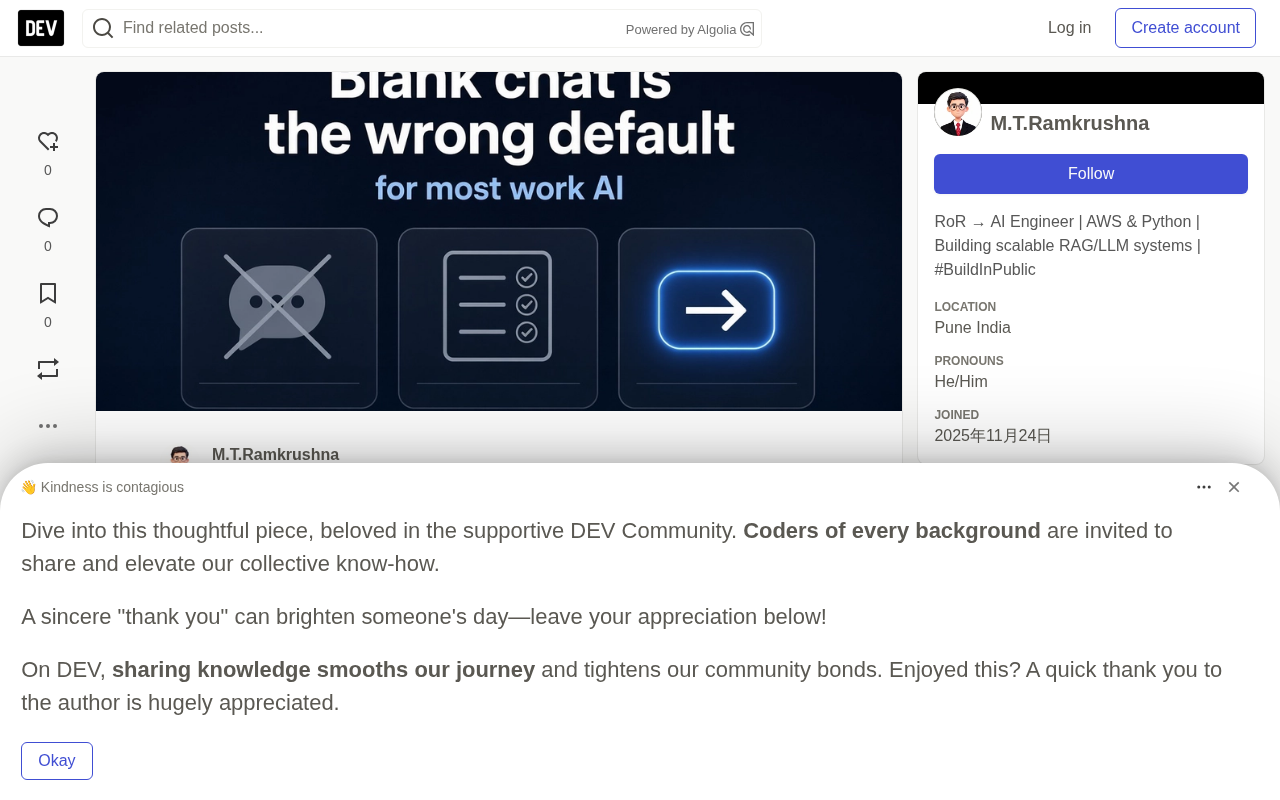
Blank chat is a great prototype, but most bounded, repeatable, side-effectful work AI should default to structured UI.
The article argues most work AI features shouldn't default to a blank chat box. Chat ships fast, looks like AI, and masks product decisions, but in production it exposes four failure modes: interrogation-style interaction, silent submission, hard-to-evaluate governance, and context tax. Chat is genuinely suited to open-ended, exploratory, long-tail tasks with inputs that can't be pre-enumerated; for bounded, repeatable, side-effectful work, forms, buttons, wizards, and review cards are the right interface. It proposes an effective hybrid pattern—chat for intent, model proposes structured plan, review card confirms, system executes—and gives builders six questions to ask before shipping.
Open any product's "AI" feature, and chances are you'll see a blank input box with a blinking cursor. It looks modern, ships in a week, and demos well—but for a large number of real work scenarios, it's the wrong interface.
If a product team can list upfront the inputs a user needs to provide, they should ship buttons, forms, and structured actions—not a chat box. Chat is for open-ended, long-tail tasks; structured UI is for bounded, repeatable work with consequences. Most teams default to chat, and only later discover the cost.
Why Teams Always Default to Chat
Three forces push nearly every AI feature toward a chat panel.
Fast to ship. A text box, a model call, a stream of tokens—it looks like a product. Forms require designing schemas, validation, empty states, and edge cases. Chat lets you skip all of that and still call yourself "AI-native."
It looks like AI. Users have already been trained by ChatGPT. A blank conversation feels like "real" AI; a form with an "Approve" button feels like an old product hastily bolted onto a model. So product teams optimize for the appearance of intelligence rather than the task that needs doing.
It masks product decisions. When you don't yet understand the workflow, chat is convenient fog. "Let users just ask" becomes a substitute for deciding what the product actually does. That fog is useful in prototyping and expensive in production.
It's fine for exploration. It's wrong as a permanent default for work that already has a fixed shape.
Where Chat Quietly Fails
Chat isn't free. The failure modes show up once the demo ends.
Interrogation-style interaction. Users know exactly what they want—"refund this order," "approve this invoice," "draft a reply to this ticket"—but the product forces them to re-explain it in prose every time. You've turned a one-click job into a dialogue. That's not help; that's friction wearing a friendly costume.
Silent submission. When the model hides a proposed action inside a wall of chat text, irreversible things slip through easily: sending, deleting, changing prices, closing tickets. There's no clear "this is what's about to happen, confirm or edit." The boundary between suggestion and action gets blurred.
Hard to evaluate, hard to govern. Free-form conversation is a combinatorial nightmare. Every session path is different. It's hard to judge "for this task, did the product succeed?" the way you would with a form that has known fields and known outcomes. When "API" becomes whatever a user typed last Tuesday, permissions, audit logs, and rollback get messier too.
Context tax. Users repeatedly paste the same ticket ID, the same policy excerpt, the same constraints. Structured UI can prefill and constrain these. Chat turns the user into the integration layer.
If your feature is a bounded task people perform repeatedly every week, these costs compound. Chat is a loan you didn't need and keep paying interest on.
Context tax refers to the information users have to repeatedly supply so the AI can understand a specific task—information that should have been remembered or prefilled by the system. For example, pasting the same ticket ID, the same policy text, or the same set of constraints every time. In a structured UI, this information typically arrives automatically as default values, URL parameters, or user session context. In a pure chat interface, users are forced to act as the "integration layer," turning humans into data movers.
The context tax is a hidden cost: a single instance may look like just a few extra lines of typing, but when the same bounded task repeats dozens or hundreds of times per week, the accumulated friction significantly reduces efficiency, increases error rates, and makes users' dependency on the product fragile. It's also a key indicator separating "demo-friendly" from "production-ready"—if users have to keep repeating themselves, the interface isn't taking on the structural responsibility it should.
When Chat Is Right
When the work is genuinely open-ended, chat is the correct interface: users can't state the input in advance ("help me think through this architecture"); the path is exploratory and changes midstream (research, brainstorming, debugging a strange failure); long-tail requests are larger than any form you could design in a quarter; the output is mainly text a human will edit, not a system action with side effects.
In those cases, a blank box is honest. The user steers, the model collaborates. Where there's no structure, don't pretend there is.
When Structured UI Wins
When you can list the inputs on a whiteboard, when the same task runs dozens or hundreds of times a week, when the action has side effects (money, email, deletion, external APIs, customer-visible state), when you need evaluation, audit trails, or human approval before submission, when latency and cost matter and you don't want three rounds of clarification before every action—prefer forms, buttons, wizards, and review cards.
This covers most "work AI": customer support tools, ops consoles, CRM assistants, finance workflows, content publishing pipelines, internal admin dashboards. The task is known, the inputs are known. The dangerous part is submission, not brainstorming.
This dividing line has been pointed out repeatedly in the product and agent UX space: the author cites three articles discussing "when agents shouldn't be chat," "chat, forms, and inline interaction patterns," and "when to force an LLM and when to use a button." The pattern across product and agent UX is consistent—dialogue for ambiguity, structure for consequences.
The Hybrid Pattern That Actually Works
A genuinely usable hybrid flow looks like this:
- Chat (or a short prompt) for intent—"refund the duplicate charge on order 1842"
- The model proposes a structured plan—typed fields: order ID, amount, reason code, customer-visible note
- A review card with buttons—edit / approve / reject, with the exact action visible before anything runs
- System execution—only after confirmation, through the normal API with logging
This is the "AI Action Review" pattern in practice: the model drafts, the UI submits. Frameworks like "Agentic UX" push the same principle—the agent proposes, the interface constrains, the human (or an explicit policy) authorizes.
Chat is the on-ramp for messy language; structured UI is the guardrail for irreversible work.
The "AI Action Review" pattern refers to an interaction paradigm where a large model drafts the intent of an action and a user or policy explicitly approves that action. Its core is positioning model output as a "proposal" rather than "execution": the model generates a typed, field-based plan, the interface renders those fields as human-reviewable cards, and only after an explicit approval action (a button click, signature, or policy decision) does the system commit through standard APIs.
The key problem this pattern solves is the "authorization boundary for irreversible side effects." Models naturally produce ambiguous text that mixes suggestions with commands, while real systems often need atomic actions and auditable logs. Separating authorization from the model's free generation and handing it to deterministic UI controls (approve/edit/reject) preserves the flexibility of language processing while ensuring every side effect has a clear owner and timestamp.
A Practical Checklist for Builders
Before shipping yet another blank chat box as the homepage, ask:
- Can I list the inputs? If so, start with a form or a prefilled card, not a blank input field.
- Is this task repeatable? If the same flow happens every week, optimize for speed on the known path, not the novelty of a new conversation.
- Does the action have side effects? If so, never bury submission inside a chat bubble. Show a review card with the exact fields and an explicit "Approve" button.
- How do I evaluate success? Prefer outcomes you can score (fields filled correctly, action executed or not) over "the conversation felt good."
- What does recovery look like? Undo, audit log, who can override—design these into the structured path, not as an afterthought in chat history.
- Where is chat still useful? Keep a conversational entry point for long-tail cases and "I don't know how to start," and route to structured review once intent is clear.
Conclusion
Blank chat is an excellent prototype and a mediocre default.
Use chat when the work is open-ended and the long tail is the product. Use structured UI when the work is bounded, repeatable, and consequential. Use both when language is the best entry point but buttons and review cards are the only safe exit.
If you can list the inputs, stop making users type into the void.
One-line Summary
Blank chat is an excellent prototype, but most bounded, repeatable, side-effectful "work AI" should default to structured UI, with chat reserved for intent entry and long-tail exploration.
Paragraph Summary
The article argues that most work AI features shouldn't default to a blank chat box. Chat ships fast, looks like AI, and masks product decisions—but in production it exposes four failure modes: interrogation-style interaction, silent submission, hard-to-evaluate governance, and context tax. Chat is genuinely suited to open-ended, exploratory, long-tail tasks whose inputs can't be enumerated in advance; for bounded, repeatable work with side effects, forms, buttons, wizards, and review cards are the right interface. The article proposes an effective hybrid pattern—chat captures intent → the model proposes a structured plan → a review card confirms → the system executes—and offers six practical questions builders should ask before shipping.
Related articles

Chain of Thought Isn't Just for AI: How Humans Can Use CoT to Improve Thinking Quality
Chain of Thought isn't just a prompt trick for large models. Starting from a Hacker News discussion, this article analyzes why CoT works for human thinking too, breaks down actionable ways to transfer it, and highlights the key differences between human CoT and machine CoT.
Cloudflare Teams Up with OpenAI: Closi…
Cloudflare Teams Up with OpenAI: Closing the Loop from Vulnerability Discovery to Defense with AI
Cloudflare uses OpenAI Daybreak to investigate security vulnerabilities and generate reviewable remediation plans, while developers use Codex to boost coding efficiency and quality.

Orca Multi-Agent Orchestration in Practice: A Guide to Parallel Collaboration with Claude and Codex
Orca is Stable AI's free open-source agent workbench supporting 34 agents like Claude Code and Codex in parallel. Learn its Git worktree isolation, multi-model orchestration, and mobile management.