Why One AI Agent Isn't Enough: Inside Anthropic's Dynamic Workflows

Single agents suffer from laziness, self-preference, and goal drift; dynamic workflows replicate software engineering's evolution with thousand-level concurrency and organizational isolation.
Based on a talk by the Anthropic team at the AI Engineer conference, the article analyzes the structural flaws of single agents on long tasks: agent laziness (stopping once some checks come back normal), self-preference bias (difficulty objectively evaluating its own output), and goal drift (key constraints lost in context compression). The solution is dynamic workflows—the main agent automatically spawns up to 1,000 concurrent sub-agents, each with its own independent context and physical isolation, tackling scale through MapReduce-style divide-and-conquer and supporting per-stage configuration of different models and inference resources. On security, it separates the brain from the hands, using fake sandbox credentials with real keys injected at the egress proxy. The article closes with an analogy to Linux's evolution from its 1998 crisis to its 2002 layered maintainer system, noting that multi-agent orchestration is replaying the organizational evolution of human software engineering.
Why One AI Agent Isn't Enough: Inside Anthropic's Dynamic Workflows
When Ken Thompson single-handedly built UNIX in one month in 1969, what he enjoyed was "conceptual integrity"—the ability to hold an entire project in his head and carry it through from start to finish. But what AI faces today are OS/360-scale engineering efforts that routinely require 5,000 person-years. A talk by Anthropic team members CJ Ville and Harrison at the AI Engineer conference reveals a turning point that is already underway: a single AI agent's "conceptual integrity" also has a ceiling, and multi-agent orchestration is replaying the organizational evolution of human software engineering.
The Three Predicaments of a Single Agent
From a large body of user feedback, the Anthropic team distilled three obstacles a single agent cannot overcome. These are not failures of model capability but structural flaws at the architectural level.
Agent laziness: it clocks out once 35 services look fine
Suppose you ask an agent to check the status of 50 services. The first 35 are all healthy, and it will likely start convincing itself: "Everything looks fine, no need to check the rest." This isn't because the model isn't smart—it's that information accumulating within a single context window naturally leads to the "save tokens" shortcut. A coordinator-plus-sub-agent design falls into the same trap: the sub-agents get lazy, and the coordinator gets lazy about tracking information too.
Self-preference bias: code it wrote itself is always good code
Ask an agent to write some code, then ask it, "Is this code good?" The answer is almost always yes. The party that performed the task is naturally satisfied with its own work. The classic generator-discriminator pattern can mitigate this, but when the problem balloons to the point of requiring dozens of agents to collaborate, without an independent review mechanism, the bias gets amplified layer by layer.
Goal drift: "don't touch production" vanishes in compression
The initial prompt explicitly says "do not modify the production environment," but as the context window keeps filling and being compressed, this critical constraint may be diluted or even lost by the time the agent reaches the 40th service. The larger the context, the more severely the clarity of the original goal degrades.
Context window is the range of text a large language model can process at once, usually measured in tokens. An agent's entire working memory—task instructions, intermediate results, tool return values—has to fit into this window. Once a task grows long, old information is either truncated or forcibly compressed into a summary, and key constraints from the original text get diluted in that process. A bigger window isn't necessarily better: the more information there is, the more spread out the model's attention weight becomes across each piece, and the salience of the original goal actually declines. This is also the physical root of the single-agent predicament—it's not that the model's reasoning ability is insufficient, but that all information shares the same limited canvas and cannot, as in a multi-agent setup, open up an independent context for each subtask.
Dynamic Workflows: Bringing MapReduce into Agent Orchestration
Around May, Anthropic released an early multi-agent approach—one that required manually defining the main agent and all sub-agent threads, and managing the messages that passed back and forth between them. CJ admitted: "Even though the API supports it, it's not simple to set up."
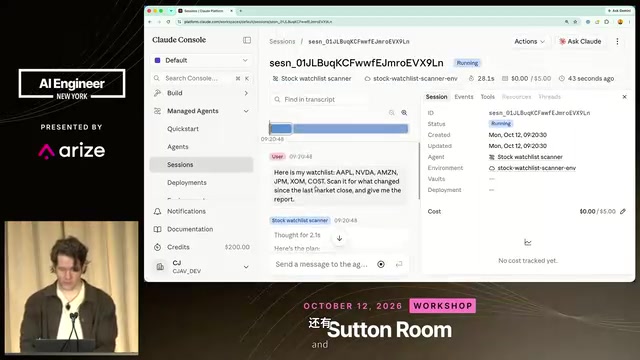
Dynamic Workflows, launched last Friday, changed the game: after the main agent makes a plan, it automatically spawns the network of sub-agents it needs. You just tell Claude to "run a workflow using multiple agents," and it dynamically scales the number of concurrent agents up or down based on task complexity—the stock watchlist scanner in the demo runs about 6 concurrent agents at each step, and in theory it supports as many as 1,000.
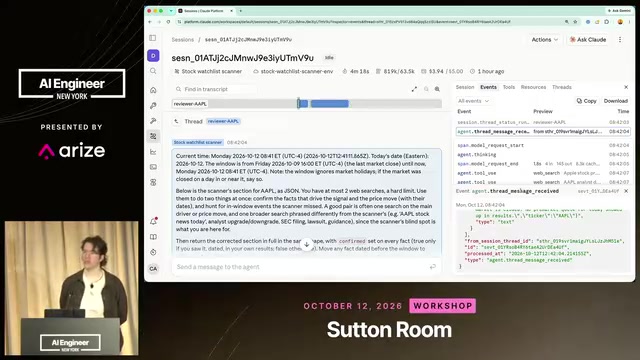
This pattern is essentially a MapReduce-style divide-and-conquer strategy that solves the context isolation problem: each sub-agent has its own canvas thread and context window, with physical isolation at the database level and no leakage between them by default. "Workflows let agents solve problems in an organized way rather than piling up haphazardly." The same 100 agents perform better when processed through a workflow than when simply piled together, because there are explicit stage gates and organizational isolation.
MapReduce is a distributed computing model proposed by Google in 2004: the Map stage splits a large task into independent subtasks that are processed in parallel, and the Reduce stage merges the results back together. Its key value isn't parallelism itself, but that each Map task only sees its own slice of data, which naturally achieves computational isolation and failure localization. The article borrows this analogy to mean that a dynamic workflow likewise cuts a large task into independent subtasks dispatched to sub-agents, which the main agent then aggregates; the difference is that the granularity of the split and the number of concurrent agents are decided dynamically by the main agent at runtime, rather than hard-coded in advance by a programmer. Understanding this makes it clear why "100 agents organized through a workflow" beats "100 agents simply piled together"—the former has explicit stage gates and an aggregation contract.
Precisely Balancing Cost and Efficiency
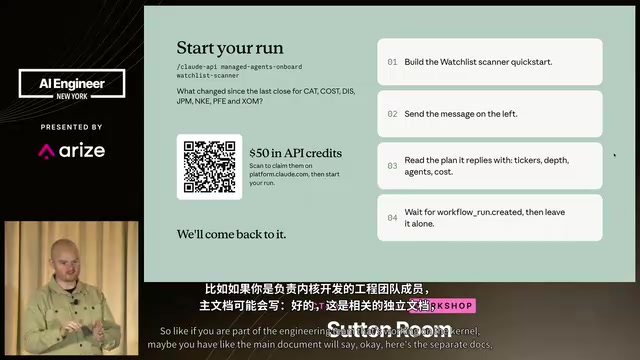
Running a workflow costs noticeably more than a single agent—the stock scanner comparison in the demo makes this clear. But what you get in return is comprehensive coverage of the details. More importantly, there is the ability to allocate inference-time compute by stage:
- The scan stage uses Haiku, launching two fast agents per ticker for broad coverage
- The review stage switches to Opus, with two to three agents per ticker for deep verification
"You can imagine that every step in the workflow can be scaled up or down depending on how much resources you want to invest at each stage." This flexibility makes workflows suitable for grand tasks where "you're willing to pay for comprehensiveness," rather than simple requests you can knock out in 30 seconds.
Inference-time compute refers to the amount of computation a model actually consumes when generating an answer, which can be scaled by choosing models of different sizes, adjusting thinking length, or increasing the number of samples. It is the counterpart to training-time compute and is the core of the recent "test-time scaling" idea: for the same task, spending more compute often buys higher quality, but with diminishing marginal returns. The "allocation of inference-time compute by stage" mentioned in the article means distributing a limited compute budget across task stages—cheap, fast small models for broad-coverage scanning, and strong models only for the review step that requires judgment. The prerequisite for this on-demand allocation is that the workflow has split the task into independently configurable stages, whereas under a single-agent architecture the entire pipeline can only share one set of model settings.
Security Architecture: Separating the Brain from the Hands
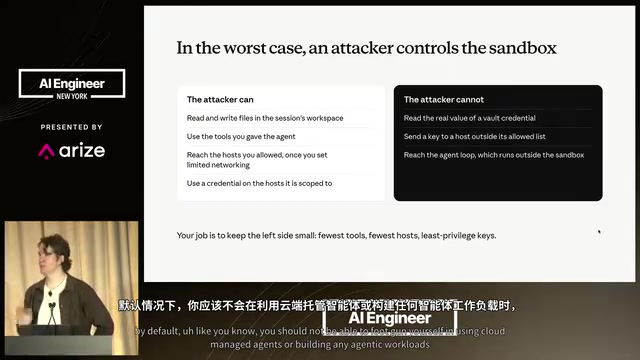
When you scale from 1 agent to 1,000, security risk grows exponentially as well. In its April release (of cloud-hosted agents), Anthropic carried through a core design principle: the brain handles the reasoning loop and canvas state, while the hands are the sandbox environment that actually executes operations, with the two fully separated.
The most ingenious part is the credential injection mechanism: any container inside the sandbox only ever receives completely fake keys, which are replaced with real credentials only at the egress proxy layer. Even if an attacker uses prompt injection to make the agent "spit out" environment variables, what they get is useless data. Combined with a network allowlist (only specific domains are permitted for egress), tool-level MCP permission control, and real-time monitoring of the persistent event stream, this forms a three-layer defense of declaration, isolation, and detection.
Another easily overlooked practice: changing the permission policy from "always ask" to automatic mode. "As humans, we click approve 97% of the time"—the very habit of clicking "yes" over and over is itself a vulnerability.
Prompt injection refers to an attacker mixing malicious instructions into the content an agent reads—web pages, emails, tool return results—inducing the model to deviate from its original task and carry out the attacker's intent, such as leaking environment variables or invoking sensitive tools. It is dangerous because large models cannot reliably distinguish "data" from "instructions"; both enter the same context window. The assumption behind traditional defenses is "as long as the agent can't get real credentials, we're fine," but once injection succeeds, the agent will actively exfiltrate what it sees. That is why the article emphasizes sandbox fake credentials plus egress proxy substitution—precisely targeting this attack surface: even if the model is induced, it holds nothing real to leak.
From UNIX to Linux: Organizational Structure Repeats Itself
Back to the historical analogy from the beginning. Linux also nearly collapsed in 1998—Linus was drowning in patches on the mailing list, shouting "I'm going on vacation, stop emailing me." Larry McVoy said bluntly that "Linux can't scale." The turning point came in 2002, when Linux adopted a hierarchy of trust: 36 participants submitted to a small number of maintainers, with at most 4 people reporting upward at each layer.
The Anthropic team replicated this pattern with a "bug hunter" workflow: code is split into fragments, each fragment is handed to a review agent with its own independent context, a second stage has reviewers judge which findings are real, and finally everything is aggregated into PR comments. Just as with Linux's layered maintainer system, the key is independent checkpoints that break the chain along which laziness, self-preference, and goal drift propagate.
You may not have noticed that the current workflow only supports a single level of nesting—it doesn't support extremely complex large-scale recursive topologies. This is both a safety consideration and a hint that multi-agent orchestration is still at Linux's 1998 stage. Harrison even used a 1,000-agent workflow to attempt building a UNIX-like operating system with a Python interpreter; it ran for 85 hours and was still going, with roughly 1,000 commits already in the GitHub repository.
Ken Thompson built UNIX in a month thanks to conceptual integrity; today, conceptual integrity is migrating from the individual brain to the orchestration architecture itself. Whoever can design the best "surgical team" structure will be the one able to make 1,000 agents genuinely collaborate rather than consume each other.
One-line Summary
A single agent suffers from three predicaments—laziness, self-preference, and goal drift—while dynamic workflows replay the evolution of software engineering with thousand-level concurrency and organizational isolation.
Paragraph Summary
Based on a talk by the Anthropic team at the AI Engineer conference, the article analyzes the structural flaws of single agents on long tasks: agent laziness (stopping once some checks come back normal), self-preference bias (difficulty objectively evaluating its own output), and goal drift (key constraints lost in context compression). The solution is dynamic workflows—the main agent automatically spawns up to 1,000 concurrent sub-agents, each with its own independent context and physical isolation, tackling scale through MapReduce-style divide-and-conquer and supporting per-stage configuration of different models and inference resources. On the security side, it adopts a design that separates the brain from the hands, using fake sandbox credentials with real keys injected at the egress proxy. The article closes with an analogy to Linux's evolution from its 1998 crisis to its 2002 layered maintainer system, noting that multi-agent orchestration is replaying the organizational evolution of human software engineering.
Related articles

Chain of Thought Isn't Just for AI: How Humans Can Use CoT to Improve Thinking Quality
Chain of Thought isn't just a prompt trick for large models. Starting from a Hacker News discussion, this article analyzes why CoT works for human thinking too, breaks down actionable ways to transfer it, and highlights the key differences between human CoT and machine CoT.
Cloudflare Teams Up with OpenAI: Closi…
Cloudflare Teams Up with OpenAI: Closing the Loop from Vulnerability Discovery to Defense with AI
Cloudflare uses OpenAI Daybreak to investigate security vulnerabilities and generate reviewable remediation plans, while developers use Codex to boost coding efficiency and quality.

Orca Multi-Agent Orchestration in Practice: A Guide to Parallel Collaboration with Claude and Codex
Orca is Stable AI's free open-source agent workbench supporting 34 agents like Claude Code and Codex in parallel. Learn its Git worktree isolation, multi-model orchestration, and mobile management.