Why Open Models Are Becoming the Go-To Choice for AI Teams: Nathan Lambert's Years of Insight

Nathan Lambert will speak at Forge SF on why open models are becoming the default choice for AI development teams.
A growing number of AI teams are shifting toward open models, and the trend is moving from niche to mainstream. Nathan Lambert, author of Interconnects and co-founder of Trillium Labs, has tracked this space for years and will speak on "How Open Models Win" at the Forge conference in San Francisco on November 3rd. Compared to closed API services, open models offer significant advantages in local deployment, fine-tuning, data privacy, and cost control — prompting engineering teams, founders, and investors to rethink their AI infrastructure strategies. The open vs. closed model debate is fundamentally reshaping the AI development landscape.
The Forces Driving the Rise of Open Models
More and more AI teams are turning to open models for development — a trend that didn't happen overnight. Nathan Lambert (@natolambert), author of Interconnects and co-founder of Trillium Labs, has been writing about this topic for years and will deliver a talk titled "How Open Models Win" at the Forge conference in San Francisco.
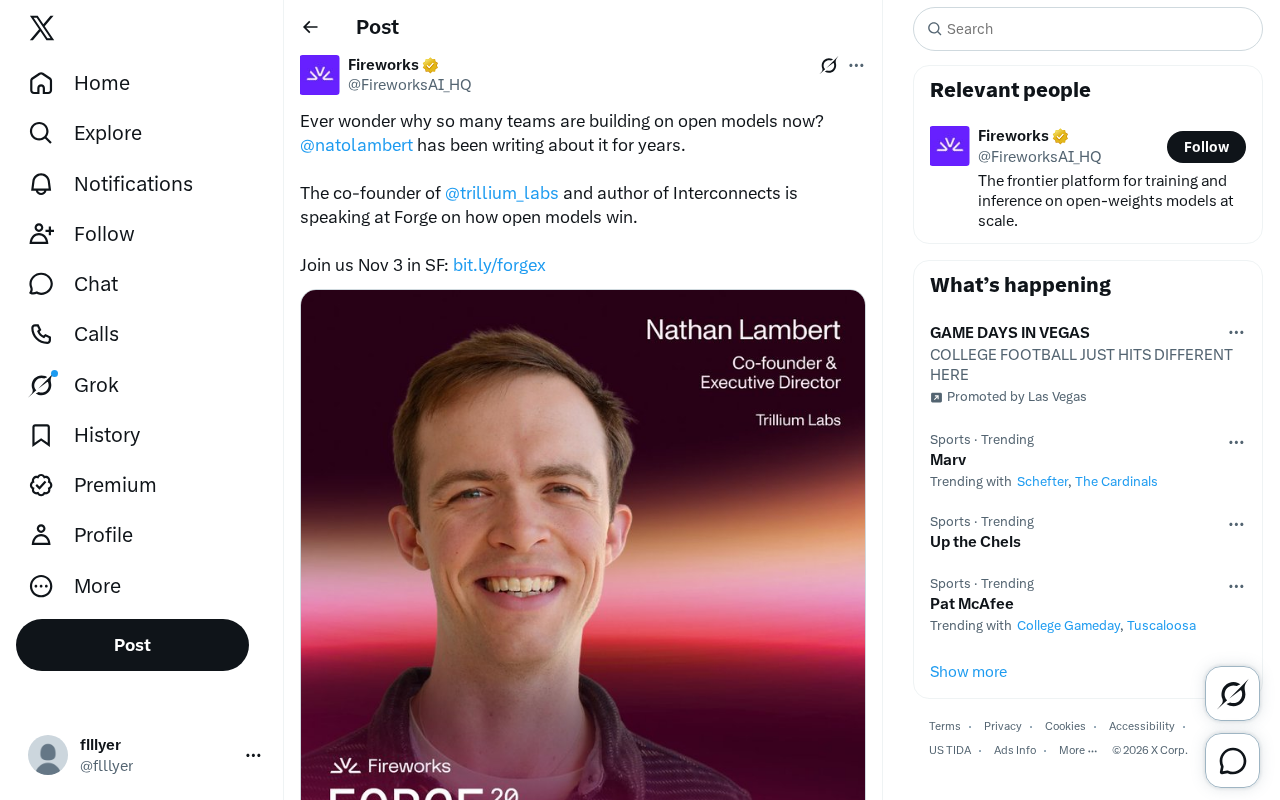
This brief preview from Twitter may be short on detail, but it reflects a meaningful industry signal: open models are moving from the margins to the mainstream, becoming a serious option for teams building AI applications.
Interconnects is a technical newsletter run by Nathan Lambert, focused primarily on Reinforcement Learning from Human Feedback (RLHF), model alignment, and the open AI ecosystem. Lambert previously worked on the alignment team at Hugging Face, giving him a perspective that bridges academic research and industry practice. Interconnects has built considerable influence within the AI research community, occupying a space between academic papers and mainstream tech media — filling the gap between technical depth and readability. Trillium Labs is the company he co-founded, also centered on the open model ecosystem. Understanding this background helps explain why his read on open model trends is treated as a meaningful reference point in the industry, rather than mere advocacy.
Why Teams Are Betting on Open Models
From an industry standpoint, the reasons teams choose open models are often multifaceted. Compared to fully closed API services, open models give developers far greater control — including local deployment, fine-tuning, data privacy protection, and predictable long-term costs.
What gives Nathan Lambert's perspective particular weight is its consistency. He wasn't chasing a trend after it emerged — he was documenting and analyzing the development of open models long before they gained widespread acceptance. That long-term tracking makes his judgment on "why open models can win" especially worth paying attention to.
Open models are worth distinguishing from traditional "open source software." Open models typically refer to large language models whose weights are publicly downloadable — such as Meta's Llama series and Mistral. Developers can run these models locally or on private cloud infrastructure without going through a third-party API. That said, "openness" exists on a spectrum: some models release weights but restrict commercial use, while others open up training data and code as well. This stands in contrast to closed models like GPT-4 and Claude, which users can only access through paid APIs with no direct access to model parameters. This distinction matters enormously in regulated industries like finance and healthcare, where certain data legally cannot be transmitted to third-party servers — making locally deployable open models the only viable option.
The Forge Conference and What to Expect
According to the preview, the talk is scheduled for November 3rd at the Forge conference in San Francisco. With a focus on "how open models win," it's expected to draw on the analytical frameworks Lambert has developed over years of writing for Interconnects, unpacking the competitive dynamics between open and closed AI ecosystems.
For engineering teams, founders, and investors navigating AI infrastructure decisions, this kind of systematic analysis from a frontline researcher tends to be far more useful for understanding where things are headed than scattered tech news.
The Bigger Trend Behind a Brief Announcement
It's worth noting that the original source material is simply an event preview with limited information density. But the topic it points to — the competitiveness of open models — is genuinely one of the most discussion-worthy issues in AI today. The open vs. closed debate, and the tradeoffs between model capability and controllability, are actively reshaping the entire AI development ecosystem.
For readers who want to go deeper on this topic, following Nathan Lambert's Interconnects and keeping an eye on content from the Forge conference will be an effective way to get first-hand insights.
Related articles

Kimi K3.1 Hands-On Test: Open-Source Model Nears Opus, Video Generation Steals the Show
Kimi K3.1 completed motion graphics, 3D rendering, mini-games, and video generation in a live test. Analysis of its 2.8T MoE architecture, gap vs Opus/GPT, and hidden video generation.

Sam Altman: Why Life's Biggest Advice Should Still Come from Humans
OpenAI CEO Sam Altman on the limits of AI advice: AI can talk you out of an impulsive email, but life's biggest advice should still come from humans.

"Black October": Did AI Uncover 3% of All Critical Vulnerabilities Ever?
A Reddit post claims 3% of all critical software vulnerabilities ever were found in the past month, dubbed 'Black October.' We break down the statistical issues, how AI-assisted code auditing accelerates discovery, and how developers should respond.