Why OpenAI Is Absent from Nvidia's AI Agent Safety Alliance

OpenAI skipped Nvidia's AI agent safety alliance publicly but is reportedly collaborating behind the scenes.
Nvidia recently launched the Open Agent Safety Platform to address risks from rogue autonomous AI agents, but top player OpenAI was notably absent from its public supporter list. According to TechCrunch, OpenAI is actually collaborating with Nvidia privately on the issue. This "public absence, private engagement" posture reflects a careful balancing act between brand positioning, standards influence, and the undeniable need for industry-wide technical cooperation on agent safety.
An Industry Alliance Without OpenAI
Nvidia recently launched an industry-wide initiative called the Open Agent Safety Platform, aimed squarely at a growing concern: how to curb the risks posed by "rogue" AI agents. As autonomous AI agents are deployed at scale across enterprise and consumer settings, their potential for unauthorized actions, unexpected behavior, and malicious exploitation has become an unavoidable safety challenge for the entire industry.
Notably absent from the list of public supporters is one of the most prominent players in the field — OpenAI. This "absence" immediately sparked speculation: Is it a difference in philosophy? Or is it competitive rivalry?
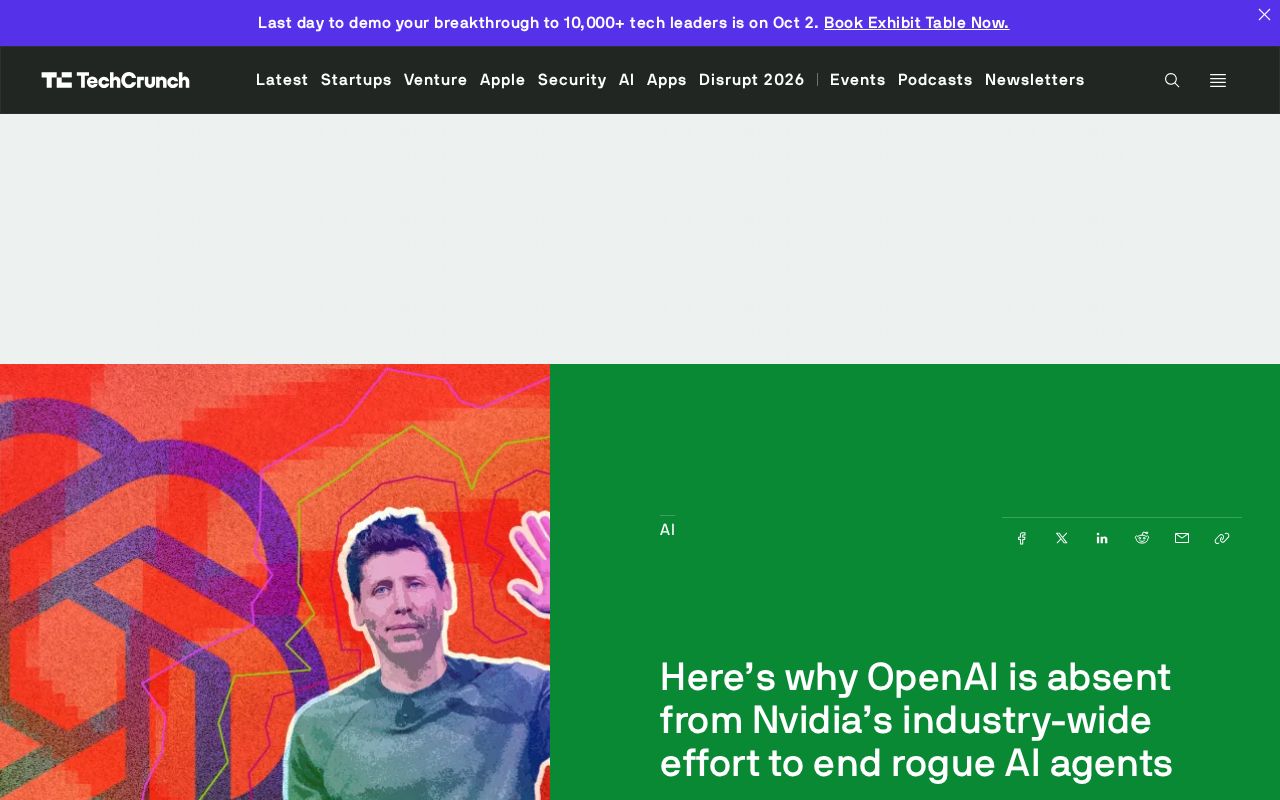
Publicly Absent, Privately Engaged
According to information obtained by TechCrunch, the reality is more nuanced than it appears. While OpenAI has not publicly endorsed Nvidia's Open Agent Safety Platform, it is reportedly collaborating with Nvidia behind the scenes on related issues.
In other words, "not publicly supporting" is not the same as "not participating." This posture of keeping public distance while maintaining private engagement is actually quite common among tech giants. Companies often choose not to put their name on an initiative led by a competitor — out of concerns over brand positioning, strategic autonomy, and avoiding being locked into a particular coalition — while still ensuring they stay engaged through bilateral channels on key technical collaboration.
Why This "Hot-and-Cold" Stance
From an industry dynamics perspective, OpenAI's choice has its own internal logic. As one of the leaders in large language models and agentic AI, OpenAI has its own methodology and product roadmap for agent safety. Publicly joining a safety platform led by a hardware vendor like Nvidia could mean ceding ground in the battle over standards and definitions.
For Nvidia, championing an "industry-wide" open safety platform serves a dual purpose: fulfilling its responsibility as an infrastructure provider while also reinforcing its strategic position in the AI value chain. It needs as many leading players as possible to participate in order to boost the platform's credibility and de facto standard status. A top-tier player like OpenAI publicly joining would significantly amplify its influence — which is precisely why its absence is so conspicuous.
The existence of private collaboration, however, signals that both sides understand: agent safety is a systemic problem no single party can solve alone. Despite the competition and the battles over narrative control, underlying technical cooperation remains necessary.
This model of "participating substantively without signing on publicly" has precedents in the technical standards world. Historically, Internet protocols, mobile communication standards, and more recently AI model evaluation benchmarks (such as MLPerf, driven by MLCommons) have all seen similar dynamics — leading companies often want to retain influence over where standards go, but are reluctant to be publicly bound by a framework dominated by a competitor. For OpenAI, its own agentic product lines (such as Operator and the Assistants API) and its forthcoming enterprise deployments all require building an independent, credible safety narrative. Publicly endorsing an Nvidia-led platform might be read by the market as depending on a hardware vendor for its foundational safety architecture — a tension with its brand positioning as an "end-to-end AI capability provider."
Rogue Agents: An Unavoidable Industry Challenge
Regardless of coalition structure, the core issue Nvidia's initiative addresses deserves serious attention. Once AI agents are given the ability to call tools, access data, and execute sequential operations, defining their behavioral boundaries, detecting anomalies, and constraining permissions are all engineering and governance challenges that remain unsolved.
An industry-level safety platform that can establish common detection mechanisms, behavioral constraint frameworks, and interoperability standards would clearly be beneficial for reducing overall risk. But whether such initiatives can actually be implemented often depends on the participation of leading vendors and the compatibility between competing standards. OpenAI's stance of "privately participating while publicly watching" reflects the delicate balance the industry is striking between cooperation and competition.
Technical note: A "rogue agent" refers to an AI system that executes operations beyond its intended scope or authorized boundaries. Current mainstream autonomous agent architectures (such as ReAct and AutoGPT paradigms built on large language models) typically have the ability to call external tools, access file systems or databases, make network requests, and even autonomously generate and execute code. This "tool use" capability, while improving efficiency, also introduces several new risk vectors: agents can be hijacked via prompt injection attacks and made to execute malicious operations; they may also use faulty task-chain reasoning to acquire resources or permissions beyond their authorization under the guise of "completing the objective." In more complex multi-agent scenarios, a compromised sub-agent can relay malicious instructions to other nodes, creating cascading risks. Current countermeasures primarily include the Least Privilege principle, human-in-the-loop checkpoints, behavioral sandbox isolation, and runtime intent auditing — but standardization remains low, and the lack of a unified industry framework is precisely the gap Nvidia's initiative aims to fill.
Conclusion
Based on the information disclosed so far, OpenAI is not positioned against Nvidia's safety initiative — it has simply chosen a more cautious, strategically flexible mode of participation. For observers tracking the trajectory of AI safety, what's really worth following may not be who signed their name on the list, but whether these behind-the-scenes collaborations can ultimately be translated into actionable safety standards.
Note: This article is based on a single-source report from TechCrunch; specific details of the collaboration remain to be further disclosed.
Related articles

Deep Learning's Three Architectures and the Universal Approximation Theorem: A Complete Guide to MLPs, CNNs, and Transformers
Explaining the inductive bias differences among MLP, CNN, and Transformer, the existence meaning of the Universal Approximation Theorem (UAT), and the role of Taylor expansion in approximation analysis, while clearing up common misconceptions.

GitLab Emergency Patch Release: Analysis of Critical Security Fixes
GitLab releases critical patch 19.5.1, sparking 355 points of discussion on Hacker News. This article analyzes the background, upgrade steps for self-hosted instances, and verification points to help DevOps teams respond quickly to security updates.

Switch 2 Jailbreak: Hackers' Challenges and Security Considerations
Explore the possibility and technical difficulties of Switch 2 jailbreaking, analyzing hacker community dynamics, Nintendo's security measures, and legal and ethical controversies.