Why Perplexity Fell Out of Favor: The Moat Problem Facing AI Search Products

Perplexity's decline illustrates why feature-based moats in AI applications are dangerously shallow.
A Reddit post by a software developer who once called Perplexity indispensable — and now barely uses it — exposes a fundamental challenge in the AI application layer. As ChatGPT and Claude rapidly build out web search capabilities, vertical AI products like Perplexity face platform absorption: their core differentiators get commoditized by better-resourced incumbents. The piece dissects why feature moats are fragile, how subscription value erodes when benchmarks shift, and what it takes to build a defensible AI product.
From Indispensable to Almost Irrelevant: One Power User's Disappointment
A post on Reddit recently struck a chord with a large number of AI users. The author, a software developer, admitted that just six months ago, Perplexity was the most important AI service in his life. Even without a top-tier subscription at $200/month, he relied on its research features and various news tabs — he even went so far as to say Perplexity had "replaced half of his internet usage."
Founded in 2022, Perplexity AI is a conversational search engine built on large language models (LLMs). Notably, its core technical architecture doesn't rely on proprietary models. Instead, it calls APIs from OpenAI, Anthropic, and others, combined with real-time web retrieval (RAG, or Retrieval-Augmented Generation), to deliver sourced answers to users. This "API + retrieval augmentation" model allowed Perplexity to launch quickly and build an early reputation — but it also planted a structural vulnerability: deep dependence on upstream model providers.
Now, however, this user's attitude has done a complete 180: "I barely use it anymore, and when I do, I'm often disappointed." He cited several core issues — frequent hallucinations, responses full of unrequested information, and a subscription that feels increasingly thin. What frustrated him most was that, as an annual paying subscriber, he felt the service had drifted far from what he was promised when he first signed up.
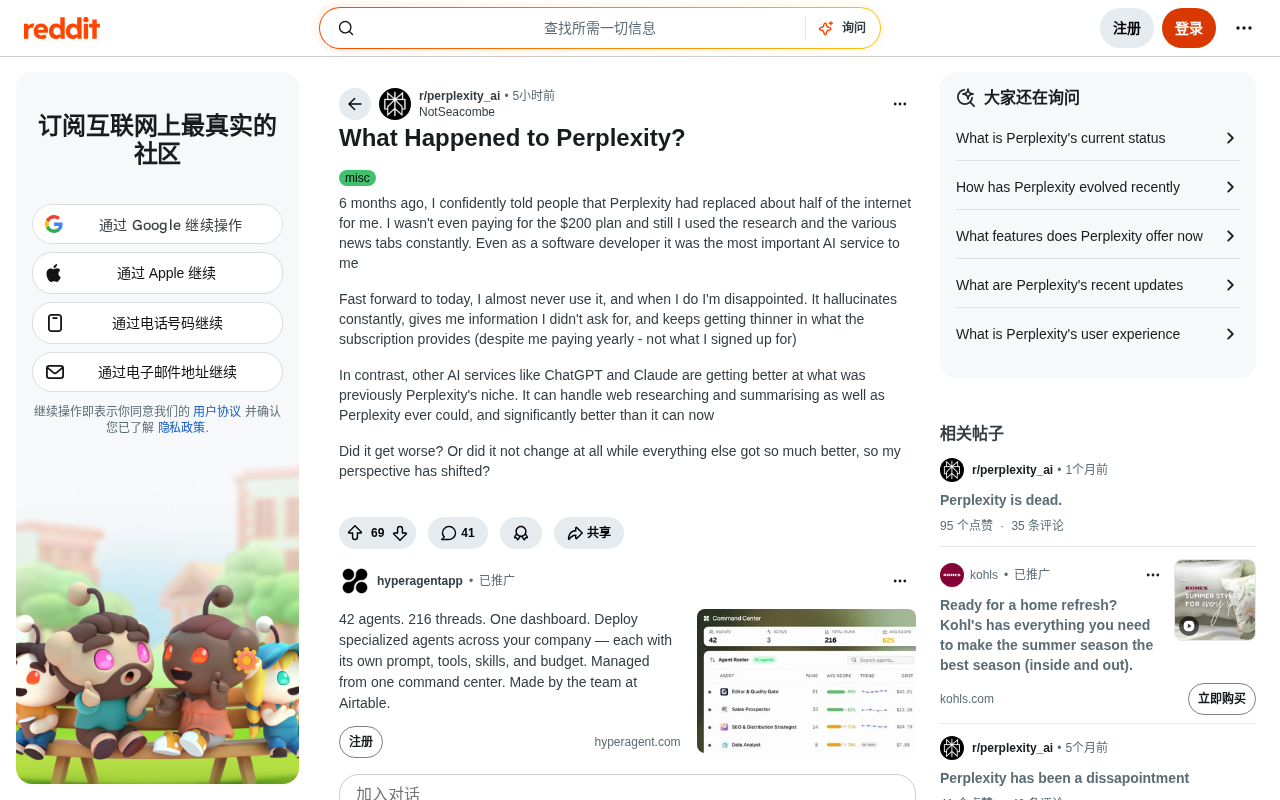
The value of this post isn't in the personal complaint — it's in how precisely it reflects the central question facing the AI search space today: As general-purpose large models continue to evolve, how long can vertically focused AI products hold onto their differentiated advantages?
Did Perplexity Get Worse, or Did the Competition Just Get Better?
The original poster raised a remarkably insightful question himself: "Did it actually get worse? Or did it stay roughly the same while everything around it improved, shifting my frame of reference?"
This question cuts to the heart of product competition. The answer is likely: both.
The Expanding Capabilities of General-Purpose Models
The user explicitly noted that ChatGPT and Claude are becoming increasingly good at handling territory that "used to belong to Perplexity" — web search and information summarization. In his view, these general-purpose assistants now "do it just as well as Perplexity did at its peak, and even better than Perplexity does now."
This observation isn't an isolated one. Between 2023 and 2024, general-purpose LLM providers rolled out web search capabilities in rapid succession, directly threatening Perplexity's differentiated position. OpenAI launched a web browsing plugin for ChatGPT in 2023, and in 2024 deepened that into ChatGPT Search with real-time retrieval and source citations. Anthropic strengthened citation and retrieval features in Claude. And Google, with Gemini natively integrated into its search engine, holds a natural structural advantage in this space. This trend confirms the tech industry's "platform absorption" pattern: when a capability proves important enough, the platform players controlling the underlying infrastructure will almost inevitably internalize it. As web search becomes a standard feature of large models, a product built exclusively around AI search naturally faces the risk of being commoditized.
The Relative Degradation of Product Experience
On the other hand, the user's descriptions of "more hallucinations" and "irrelevant information" also point to real product experience issues.
Understanding this requires a look at Perplexity's core technology — Retrieval-Augmented Generation (RAG). The basic mechanism: a user's question is translated into a search query, relevant documents are retrieved from the web or a specific knowledge base, and those documents are fed as context to a language model to generate the final answer with source citations. In theory, this significantly reduces AI "hallucinations" — instances where the model fabricates information. However, RAG is no silver bullet. When retrieved source documents are low quality, semantic matching is imprecise, or the model over-extrapolates when synthesizing multiple documents, hallucinations still occur. The user's perception of "increasing hallucinations" may stem from declining retrieval quality, behavioral shifts from model changes, or simply a stricter evaluation standard as user expectations have risen.
For a search tool whose brand promise is "accurate, well-sourced answers," hallucinations are the most lethal trust killer. Once users begin to doubt the reliability of answers, the product's core value collapses with it.
The Moat Problem for Vertical AI Products
What Perplexity is experiencing is, at its core, a classic "platform absorption" crisis.
Why Feature-Based Moats Are Fragile
In the AI application layer, products built purely on "doing a particular capability better" tend to have very shallow moats. In VC circles, this is called "Layer Risk" — when foundational capabilities are provided by a small number of model companies that are also potential competitors, the applications built on top have almost no defensive recourse. Truly defensible AI application moats typically come from four directions: proprietary data or a data flywheel; deep integration into specific industry workflows that create high switching costs; strong brand trust and user habits; or a specialized ecosystem built around particular use cases (plugin marketplaces, enterprise integrations, etc.). Perplexity hasn't built sufficient depth in any of these four dimensions.
Perplexity's value proposition is "AI search" — but search is precisely the high-frequency entry point every major model provider wants to own. That means Perplexity has long been within the crosshairs of giants.
The Erosion of Subscription Value
The user's specific mention of a subscription that feels "increasingly thin" deserves close attention. Perplexity's subscription model includes multiple tiers: a Pro plan at around $20/month and a top-tier plan at $200/month, marketed around access to advanced models, higher daily query limits, and professional research features.
Subscription products face a structural challenge, however: users' perception of "value" is dynamic and constantly updated against shifting market benchmarks. The behavioral economics concept of "anchoring" works in reverse here — when ChatGPT Plus ($20/month) and Claude Pro ($20/month) offer capabilities increasingly close to or exceeding Perplexity Pro, users anchor their evaluation of their current subscription against the most capable competitor. Once they sense a gap, churn becomes nearly inevitable. When a subscription product maintains or raises its price while perceived user value declines, the willingness to renew evaporates quickly.
What This Means for AI Application Builders
This discussion serves as a warning bell for the entire AI application industry.
First, single-point features are not enough to build a moat. Any capability that can be "handled in passing" by an underlying model should never be a product's sole selling point. Real moats more likely come from unique data accumulation, deep workflow integration, specialization within a vertical industry, or exceptional user experience.
Second, the frame of reference is always moving. As the original poster reflected, user expectations rise with the overall progress of the industry. A product that "hasn't gotten worse" can still appear to fall behind in a fast-moving AI race simply by not improving fast enough — stagnation is regression.
Third, trust is the lifeblood of AI products. For use cases like search and research where accuracy is paramount, hallucinations are not minor flaws. Once user trust is depleted, the cost of rebuilding it is extraordinarily high.
Conclusion: One User's Confusion, One Industry's Mirror
It's worth noting that the core information in this piece comes from a single Reddit user's subjective experience and does not represent all Perplexity users. Perplexity still has a large user base and continues to ship new features.
But it's precisely this kind of authentic user voice that lets us glimpse the brutal logic of competition in the AI application layer: as general-purpose large models continuously expand their capability boundaries, vertical AI products must find value that model providers cannot or will not easily replicate — or risk becoming a transitional form erased by the tides of progress.
Whether Perplexity has truly gotten worse may be a matter of perspective. But the question of "shifting frames of reference" is one every AI practitioner and user would do well to take seriously.
Key Takeaways
Related articles

ChatGPT Space Launches: Team Collaboration and New Pages Features Explained
ChatGPT Space is OpenAI's new team collaboration feature with Pages, real-time collaboration, and Slack/Google Drive sync. We break down its privacy design, multi-platform integration, and the full workflow from conversation to document.

Migrating Apache Spark UDFs to GPU Acceleration with AI Agents
NVIDIA developer blog explains how AI Agents rewrite Apache Spark UDFs for GPU acceleration, covering migration criteria, agent rewriting and verification workflows, plus pitfalls like result consistency and CPU-GPU transfer overhead.
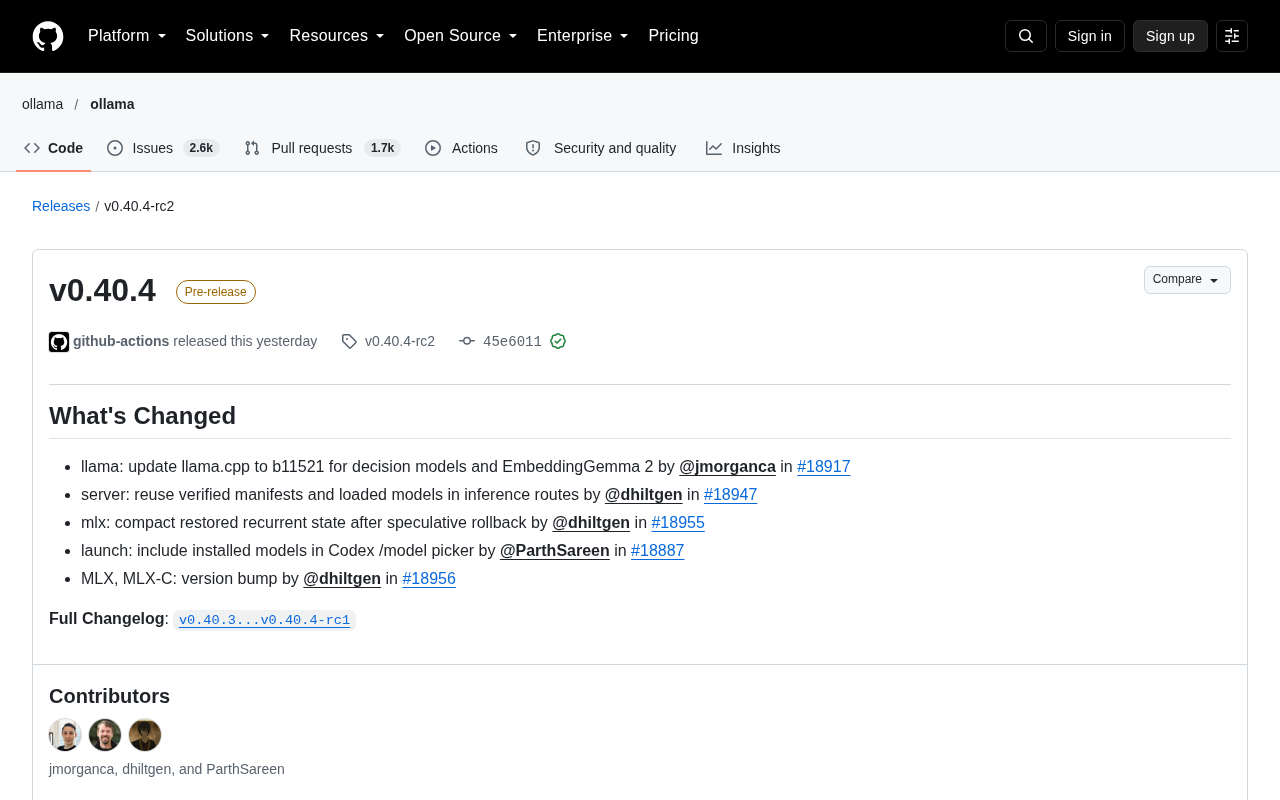
Zed Editor v0.40.4-rc2 Released: Usage Credits Now Available Without Upgrading
Zed editor releases v0.40.4-rc2, allowing users to use usage credits for AI features without upgrading to a paid plan, lowering the trial barrier.