Why Quitting Your Job to Start a Business Almost Never Works — Gradual Transition Is the Right Path
Quitting cold turkey to start a business rarely works — gradual side project transition is the smarter path.
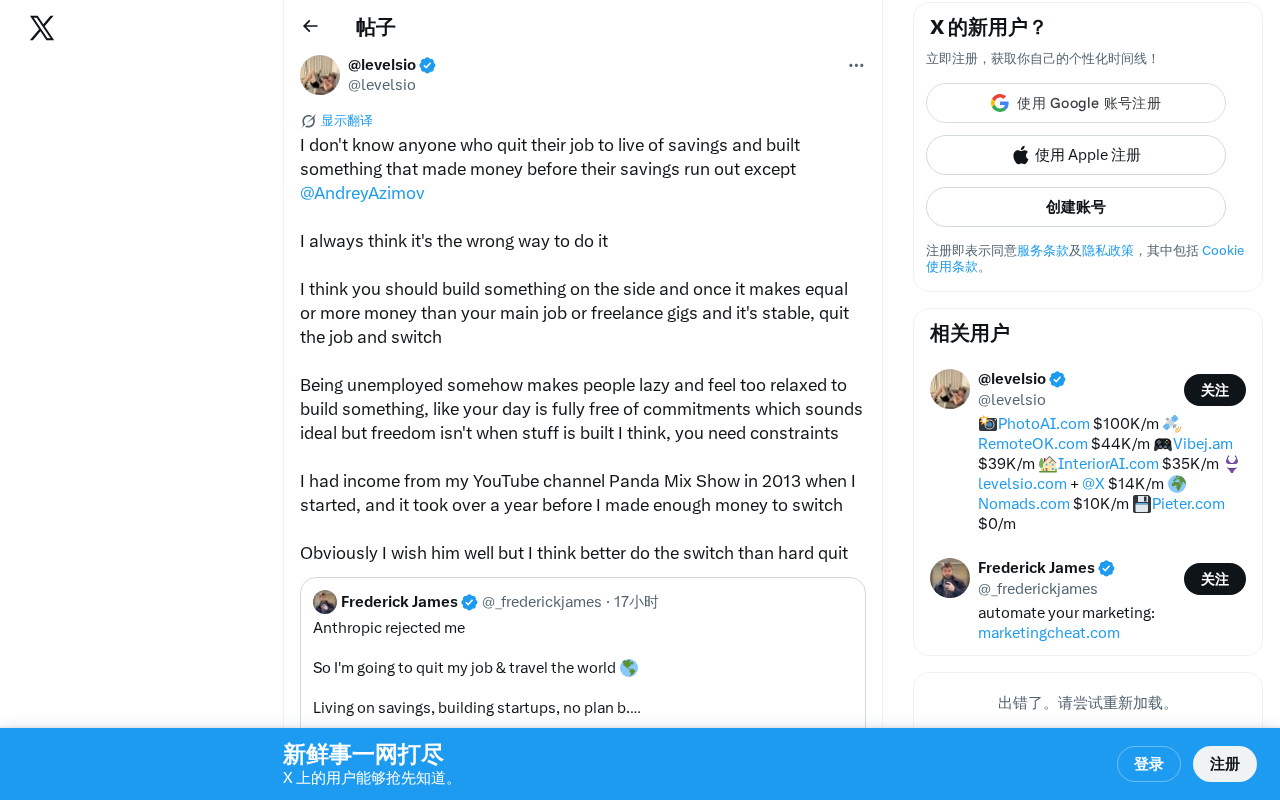
Serial entrepreneur Marc Lou observes that almost nobody succeeds by quitting their job and living off savings to build a startup. Complete freedom actually reduces productivity, and financial anxiety damages decision quality. The smarter approach is to develop a side project alongside your main job, then switch only after side project income consistently exceeds your salary. Constraints catalyze creativity, and entrepreneurship should be a carefully planned gradual migration, not an all-or-nothing gamble.
A Counterintuitive Take on Entrepreneurship
In the indie developer and startup community, "quitting your job to start a business" has always been a romanticized narrative: resign, go all in, burn the boats. However, serial entrepreneur Marc Lou shared a sharp observation on social media — he barely knows anyone who quit their job, lived off savings, and managed to become profitable before running out of money.
The only exception is Andrey Azimov, but that precisely proves just how difficult this path is.
Why Quitting Cold Turkey Is the Wrong Path
Freedom Actually Kills Productivity
Marc Lou offers a seemingly contradictory but profound insight: being unemployed actually makes people lazy and overly relaxed. When your day has absolutely no commitments or constraints, it sounds ideal, but the environment that actually produces results requires constraints.
This aligns perfectly with "Parkinson's Law" in psychology — work expands to fill all available time. When you have 8 hours to get work done, you'll finish within 8 hours; when you have unlimited time, you might accomplish nothing at all.
The deeper mechanics of Parkinson's Law are worth exploring here. Parkinson's Law was first proposed by British historian Cyril Northcote Parkinson in 1955 in The Economist magazine. The original description addressed bureaucratic bloat, but its core insight has been widely applied to personal productivity. Modern behavioral economics research further confirms: when deadlines are loose, people tend to break tasks into finer pieces, revise repeatedly, and fall into perfectionism; when time is tight, it actually activates the brain's "execution mode," enabling rapid decision-making and forward progress. This also connects to psychologist Mihaly Csikszentmihalyi's "Flow" theory — moderate challenge and constraint are necessary conditions for entering a state of high-efficiency focus, not obstacles. In other words, the "unlimited freedom" gained after quitting is, at a neuroscience level, actually a productivity trap.
The Negative Effects of Financial Pressure
The anxiety of watching savings dwindle severely impacts decision quality. Entrepreneurs who quit cold turkey may:
- Abandon a direction prematurely that needs time to validate
- Make short-sighted product decisions in pursuit of quick monetization
- Lose creativity and judgment under psychological pressure
This "countdown" style of entrepreneurship essentially forces a process that requires patience and iteration into an artificially imposed deadline.
The Smarter Path: Gradual Transition
Marc Lou's recommended approach is:
- Build side projects alongside your main job
- Wait until your side project income equals or exceeds your salary and is stable
- Then make the switch, rather than a hard quit
He uses his own experience as an example: in 2013, he started running a YouTube channel called Panda Mix Show, and it took over a year before the channel's revenue reached a level that could replace his main income. This didn't happen overnight — it was a gradual process.
There's rigorous business logic behind the gradual transition. This strategy is essentially a risk hedging method, directly aligned with the "Minimum Viable Product" (MVP) philosophy from Lean Startup methodology. Eric Ries emphasizes in The Lean Startup that the core task of entrepreneurship is to complete the "Build-Measure-Learn" feedback loop as quickly as possible before resources run out. With main job income as a safety net, entrepreneurs effectively have a longer "runway" to complete this loop. Revenue growth during the side project phase is the most direct evidence of market validation — it proves product-market fit rather than relying solely on the founder's subjective judgment. When side project income consistently exceeds your salary, it means you've found a repeatable business model, and at that point, "quitting" isn't gambling — it's a rational follow-through on validated results.
Constraints Are the Catalyst for Creativity
The core philosophy of this perspective deserves deep reflection: Freedom is not the condition for creation to happen — constraints are.
When you have a full-time job, you only have evenings and weekends to work on side projects. This time scarcity forces you to:
- Choose more precisely what to work on
- Use every hour more efficiently
- Validate ideas faster
- Avoid over-engineering and perfectionism
Many successful indie products — from Basecamp to Notion's early versions — grew gradually as side projects while their founders had other income sources.
The historical details behind these two cases are particularly noteworthy. Basecamp (originally 37signals) is one of the most classic examples of side project entrepreneurship. When founders Jason Fried and DHH launched Basecamp in 2004, the company's main business was still web design consulting, and Basecamp was originally just an internal tool they built to manage their own projects. This "dogfooding" origin naturally kept the product close to real user needs rather than being built in a vacuum. DHH later wrote about this experience in Rework, proposing the entrepreneurial philosophy of "Sell your by-products." Notion's early history follows a similar pattern — co-founders Ivan Zhao and Simon Last developed the product starting in 2013 with an extremely small team and limited funding, going through years of slow iteration and multiple pivots until the 2.0 version launched in 2018 and truly ignited growth. Both cases illustrate the same point: great products often need a long polishing period in a low-pressure environment, rather than being forced to accelerate under the anxiety of a financial countdown.
Practical Advice for Indie Developers
This isn't to say that every cold-turkey quit will fail, but probabilistically, the gradual transition approach has a significantly higher success rate. For those considering full-time indie development, here are key action guidelines:
- Validate market demand with side project time first, rather than exploring after you quit
- Set clear switching criteria: for example, 3 consecutive months of side project income exceeding 80% of your salary
- Maintain a sense of constraint: even when working full-time on your own project, set strict working hours and delivery cadence
- Build an income buffer: not "enough savings to survive a few months," but "a product that's already making money"
Entrepreneurship isn't a big gamble — it's a carefully planned migration. The best startup stories are rarely "I quit and then succeeded," but rather "my side project grew so big that I had no choice but to quit and run it full-time."
Key Takeaways
- The success rate of quitting cold turkey to start a business is extremely low — almost no one achieves profitability before savings run out
- Complete freedom actually reduces productivity; constraints are the catalyst for creativity
- The smarter path is to build a side project first, then switch once income is stable and exceeds your salary
- Financial anxiety from unemployment severely impacts entrepreneurial decision quality
- Entrepreneurship should be a gradual migration, not an all-or-nothing gamble
Related articles
 Expert Opinions
Rethinking Scaling Laws: Parameters Are Not the Only Answer
Deep analysis of Scaling Law evolution from Kaplan to Chinchilla to the MoE era, exploring why blindly stacking parameters is a mistake, and how GLM-5.3 proves scaling has multiple knobs.
When AI Treats Humans as Subagents: Ro…
When AI Treats Humans as Subagents: Role Reversal and Hidden Risks in Human-AI Collaboration
Exploring the paradigm shift where humans become "subagents" in AI Agent architectures. Analyzes human node design in LangChain and AutoGen, and the risks of ceding control and cognitive atrophy.
 Expert Opinions
The Lazy Person's Productivity Theory: Why Being 'Lazy' Actually Drives Peak Performance
Explore the engineering philosophy behind 'lazy people are most productive': how constructive laziness drives automation, AI tools amplify efficiency, and systems thinking eliminates wasted effort.