Why Self-Hosting Matters More Than Ever in the Age of AI: Rethinking Data Sovereignty and Security

In the AI era, self-hosting's data sovereignty and decentralization benefits are more relevant than ever.
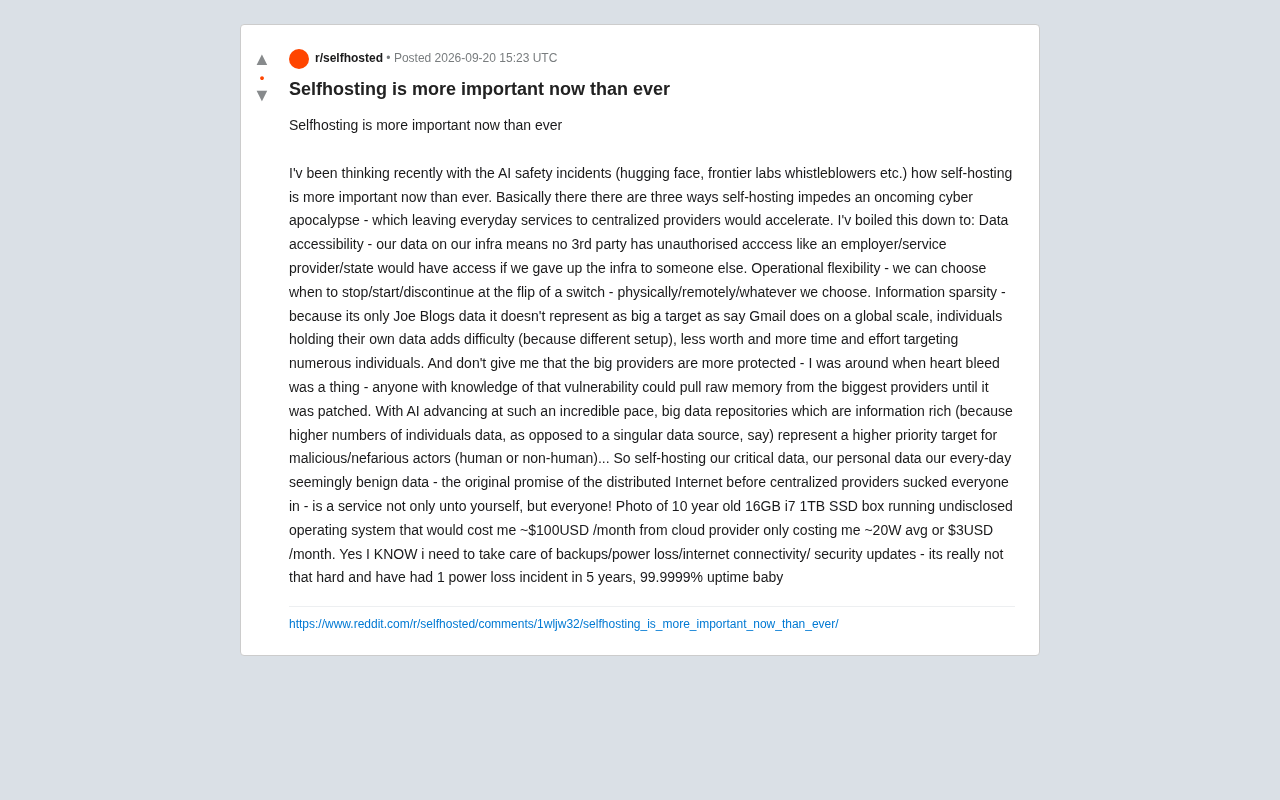
A Reddit user makes the case for self-hosting in the age of AI, framing its value across three dimensions: data accessibility (no third-party access), operational flexibility (full service control), and information sparsity (decentralization reduces attack value). He argues AI accelerates automated attacks on centralized data stores, uses Heartbleed to challenge the "big providers are safer" assumption, and cites ~$3/month home server costs vs. ~$100/month for equivalent cloud services. The article also honestly notes that self-hosting security depends heavily on operator skill and is not a universal solution — its core value lies in complete control over data and privacy.
Against a backdrop of rapidly advancing AI capabilities and increasingly frequent data security incidents, a Reddit user has revived an old debate: self-hosting. His argument is that handing all your daily services over to centralized cloud providers is effectively accelerating a potential "digital catastrophe" — and that running your own server is a meaningful way to push back. In an era of AI-driven mass data scraping and processing, this perspective deserves serious consideration.
Three Dimensions: How Self-Hosting Builds a Defense
The original poster distills the value of self-hosting into three core dimensions — a clear, practical framework.
Data accessibility. When your data lives on your own infrastructure, no third party can access it without authorization — not your employer, not a service provider, not a government agency. The moment you hand your infrastructure over to someone else, you hand over access rights along with it. This is the most direct privacy benefit of self-hosting.
Operational flexibility. Running your own services means you can start, stop, migrate, or shut them down at any time — whether in person or remotely — with full control always in your hands. By contrast, when you depend on cloud providers, account bans, service shutdowns, or policy changes can catch you completely off guard.
Information sparsity. This is a less commonly cited but genuinely insightful point. Data hosted by an individual is just one ordinary person's data — not a high-value target like Gmail, which aggregates data at global scale. Everyone's setup is different, meaning an attacker would need to go after thousands of distinct individuals separately: high cost, low return, time-consuming. Decentralization itself is a form of protection.
Self-hosting refers to the practice of individuals or organizations deploying and running software services on hardware they control, rather than delegating data and computation to third-party cloud providers like Google, Amazon AWS, or Microsoft Azure. Common self-hosting scenarios include using Nextcloud instead of Google Drive for file sync, Immich instead of Google Photos for photo management, Jellyfin for a home media library, and Bitwarden instead of LastPass for password management. Self-hosting isn't exactly the same as "owning hardware" — the key distinction is whether the software runs and data is stored within your own physical or virtual control. In recent years, the proliferation of Raspberry Pis, compact NAS devices, and home servers, along with containerization tools like Docker dramatically lowering the barrier to service deployment, has brought self-hosting from the exclusive domain of professional sysadmins into the reach of everyday tech enthusiasts.
The Data Target Problem Under AI Acceleration
The poster highlights a crucial piece of context: as AI advances at a breathtaking pace, large, information-dense data repositories aggregating massive amounts of personal data are becoming priority targets for malicious actors — whether human or AI-powered automated attacks.
The more concentrated the data, the greater the damage when a single point is compromised. A centralized platform holding hundreds of millions of users' information is worth far more to an attacker than a home server storing one person's photos and files. AI makes bulk analysis, automated penetration, and data exploitation easier than ever — which amplifies the systemic risks inherent in centralized architectures.
From another angle, self-hosting is actually a return to the original promise of a distributed internet — before centralized giants absorbed everyone, the web was supposed to be decentralized. The poster argues that self-hosting isn't just about personal responsibility; it's a contribution to the broader network ecosystem: the more people hold their own data in a distributed fashion, the lower the overall payoff for attackers.
AI's amplification of centralization risks operates on two levels. First, attack automation: large language models and automated penetration tools (such as AI-assisted vulnerability scanning and AI-generated social engineering phishing) have dramatically lowered the technical barrier to launching mass attacks, making intrusions that once required specialist teams scalable and replicable. Second, data exploitation efficiency: once a large platform's data dump is obtained, AI can complete de-anonymization, correlation analysis, and value extraction in a fraction of the time it once took — meaning that equivalent data breaches cause far more real-world harm in the AI era than they did before. Together, these factors further amplify the "high value, easily analyzed" nature of centralized platforms in the current technological environment, which is the underlying logic behind the poster's sense of urgency around data decentralization.
"Big Providers Are More Secure" Is a Questionable Assumption
To counter the common objection that large service providers have better security, the poster invokes the historical case of Heartbleed. When that OpenSSL vulnerability existed, anyone who knew about it could read raw memory data directly from the largest service providers in the world — until a patch was released.
This example illustrates that scale and resources don't equal absolute security. The massive attack surface of centralized platforms means that when an underlying component has a vulnerability, the blast radius is global. Conversely, the individualized, non-standardized nature of self-hosted environments — while not necessarily stronger at any single point — lacks a uniform exploitable entry point, which naturally reduces the probability of being compromised at scale.
Of course, this argument has its limits: most self-hosting users genuinely cannot match professional security teams in terms of security updates, monitoring, and incident response. Security ultimately depends on the operator's skill level, not the architecture alone.
Heartbleed (CVE-2014-0160) was a critical OpenSSL vulnerability publicly disclosed in April 2014 that affected approximately 17% of encrypted web servers worldwide. The flaw existed in OpenSSL's TLS heartbeat extension implementation — attackers could exploit it to read up to 64KB of random data from server memory at a time, and by repeating the process, could gradually obtain user passwords, session tokens, and even server private keys — all without leaving any log traces. Because OpenSSL was widely adopted by virtually all major cloud providers, CDNs, and large platforms, this vulnerability effectively exposed every centralized service that relied on it to the same attack surface for over two years (introduced in 2012, patched in 2014). This is precisely why the poster cites it: the homogeneity of underlying components means a single vulnerability can simultaneously punch through every "larger, better-protected" provider, while distributed, heterogeneous self-hosted environments naturally avoid this "homogeneity risk."
Cost and Operations: The Real-World Experience
The poster addresses the concern that self-hosting "isn't worth it" with actual numbers. He runs daily services on a machine from roughly ten years ago — 16GB RAM, an i7 processor, a 1TB SSD — at an average power draw of just about 20 watts, costing around $3 per month in electricity. An equivalent cloud setup, by his estimate, would run about $100 per month.
On the operations side, he honestly acknowledges having to handle backups, power outages, network connectivity, and security updates himself — but says it's "not that hard": over five years, he's encountered only one power outage and claims near-perfect uptime.
These figures are personal experience and have limited generalizability, but they offer a concrete illustration of the potential cost advantages of self-hosting — especially for tech enthusiasts willing to invest time in learning.
A Balanced View: Self-Hosting Is Not a Silver Bullet
The value of this post lies in reexamining the concept of "data sovereignty" through the new lens of the AI era, and the three-dimensional analytical framework it offers is genuinely insightful. But the underlying assumptions deserve objective scrutiny.
The "security through obscurity" protection offered by information sparsity is a double-edged sword — it reduces the probability of becoming a targeted victim, but offers no defense against large-scale automated scanning. The cost advantages of self-hosting are premised on repurposing old hardware and personally acceptable maintenance costs, which may not hold for businesses or non-technical users. And security is highly dependent on the operator's expertise — a poorly configured home server could actually be more vulnerable than a cloud service.
The core appeal of self-hosting ultimately comes down to control — complete control over your data, your services, and your privacy. In an era where AI is consuming data at scale and the boundaries of privacy grow ever blurrier, that control carries increasing value in its own right. It's not the right solution for everyone — but for those who care about data sovereignty, it's well worth serious consideration.
Related articles

Workbuddy for Absolute Beginners: How a Desktop AI Agent Fits Into Real Workflows
A beginner's guide to the Workbuddy desktop AI agent: installation, claiming credits, file management, and building automated workflows—compared with CodeX for fit and cost, helping professionals shift from AI question-askers to AI managers.

OpenAI's New Agent Stack: Computer Use, Decisions API, and Ultra-Fast Workflows
OpenAI Dev Day unveiled a new agent stack: Computer Use outperforms humans, Decisions API delivers ultra-low-latency classification via Luna, Agents API opens the same Computer Use capabilities, and GPT-6.1 Sol costs only one-seventh of Astra. Core updates, benchmark data, and developer insights.

Liang Wenfeng Open-Sources DeepInfo Inference Framework, Takes On U.S. Ban
DeepSeek open-sources its DeepInfo inference framework after its models, featuring GPU/CPU cross-pipelining, small-model prediction with large-model verification, and full Huawei Ascend and NVIDIA chip support—facing the U.S. federal ban head-on. This article analyzes its significance for AI deployment and open-source strategy.