Why Software Rendering Still Fascinates: A Developer's Technical Confession

Software rendering isn't just a cheap substitute for hardware acceleration—it's a cognitive tool and engineering fallback for understanding the graphics pipeline.
Inspired by the Hacker News post "I Love Software Rendering," this article argues for software rendering's enduring value. A CPU can in principle do everything a GPU does, and a pure software renderer exposes every pipeline stage as readable code—ideal for debugging and teaching, and reliable in embedded, GPU-less, and deterministic scenarios. With low resolution, SIMD, and multithreading, CPU rendering can reach interactive frame rates, since many pipeline stages are limited by memory bandwidth, branch divergence, and draw call overhead. Ultimately, software rendering is an engineering philosophy: its value lies not in replacing the GPU, but in transparency and a fallback.
Why Software Rendering Still Fascinates: A Developer's Technical Confession
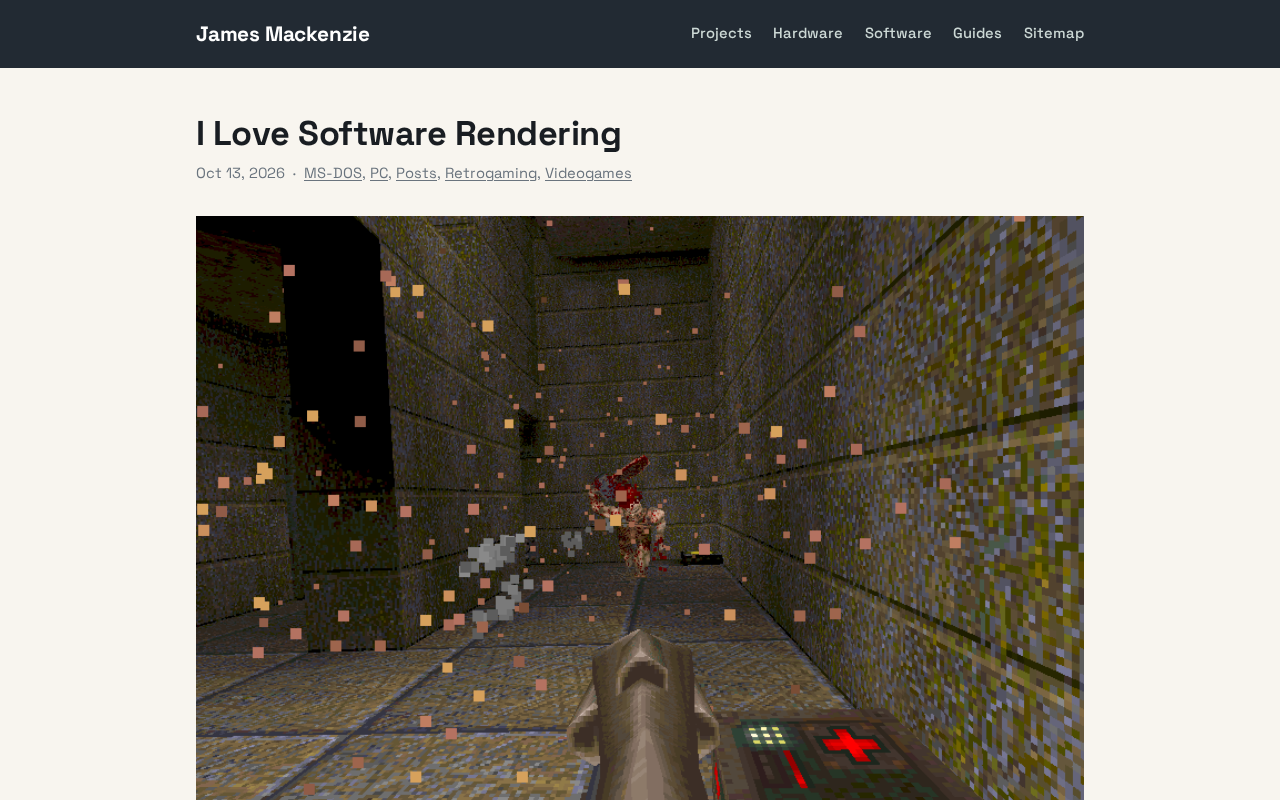
In an era when GPU compute is available at your fingertips, one developer took to Hacker News to declare "I Love Software Rendering." The post, which sparked lively community discussion, isn't driven by nostalgia—it touches on an often-overlooked technical truth: software rendering is far more than a cheap substitute for hardware acceleration.
The CPU Is the Mother of Everything
Modern game engines and graphics frameworks overwhelmingly treat the GPU as the absolute core of the rendering pipeline. But advocates of software rendering point out that anything a GPU can do, a CPU can in principle do too—just at a different speed. This means a pure software renderer is the best teaching tool for understanding how the graphics pipeline works internally: from vertex transformation, rasterization, and texture sampling to the final pixel write, every step is exposed to the developer as readable code.
This transparency is especially valuable in debugging scenarios. When a GPU driver throws an opaque error code, a software renderer lets you trace the problem line by line. For specialized use cases that demand precise control over rendering behavior—embedded systems, GPU-less server environments, or scientific visualization requiring deterministic output—software rendering is often the more reliable choice.
The Performance Gap Isn't as Big as You Think
A recurring argument in the community discussion is that, under certain conditions, software rendering's performance can exceed expectations. When rendering resolution is low, scene complexity is manageable, or SIMD instructions and multithreaded optimization are leveraged, a CPU renderer can absolutely reach interactive frame rates.
This isn't to deny the GPU's overwhelming advantage in massively parallel computation. The real insight is that many stages of the graphics pipeline don't actually fully utilize the GPU's parallelism—they're instead constrained by memory bandwidth, branch divergence, or draw call overhead. A software renderer can sidestep these bottlenecks through more aggressive algorithmic optimization. The classic Quake and Doom, running in pure software mode on modern hardware, still deliver surprisingly impressive frame rates today.
SIMD (Single Instruction, Multiple Data) is key to understanding software rendering performance. It lets the CPU perform the same operation on multiple data elements simultaneously with a single instruction—for example, blending colors, comparing depth, or transforming coordinates for 4 or 8 pixels at once. Modern x86 processors offer SSE and AVX instruction sets, while ARM has NEON, theoretically multiplying a software renderer's pixel-processing throughput several times over. By organizing pixels into vectors in batches and avoiding scalar loops, a software renderer can significantly narrow the gap with the GPU.
Branch divergence is the invisible killer of GPU performance. GPUs execute in SIMT fashion; if threads within the same warp diverge into different branches due to conditional logic, the two paths are executed serially, leaving some threads idle. Boundary checks during rasterization and conditional filtering during texture sampling easily trigger divergence. In contrast, the CPU's out-of-order execution and branch prediction are more forgiving of such control flow, and a software renderer can proactively avoid it with branchless algorithms—this is the theoretical basis for its edge in complex, irregular scenarios.
From Teaching Tool to Engineering Philosophy
Devotees of software rendering often hold a deeper view: it's an engineering philosophy, not merely a technical choice. Understanding the underlying mechanisms gives developers a fallback when GPU abstraction layers fail, and it demystifies the "magic"—the operations wrapped up by drivers and APIs are, at heart, still arithmetic and memory access.
This mindset has influenced design decisions in many well-known projects. Some game engines keep a software rasterization backend as a reference implementation, virtual machines and emulators often use software rendering as the baseline rendering path, and certain high-performance computing visualization tools bypass the graphics API entirely, compositing pixels directly on the CPU.
A software rasterizer backend refers to a pure-CPU implementation of triangle filling, depth testing, and fragment shading retained within an engine. It typically shares the same scene graph and material descriptions as the hardware backend, differing only in the low-level draw calls. Keeping it has three engineering benefits: as a reference implementation for regression testing, allowing precise comparison against GPU output for anomalies; as a fallback for GPU-less environments, ensuring CI servers or embedded devices can still render images; and as a testing ground for new algorithms, where changing a line of shading code can be verified without recompiling drivers or shaders.
Draw call overhead is an often-ignored cost of the GPU. Every time a draw command is submitted, the CPU must go through API validation, state switching, and command buffer writes, which the driver then translates for the hardware. When a scene consists of thousands of small objects, these fixed costs can far exceed the actual rasterization time. A software renderer has no such API boundary—it can traverse scene data directly, and combined with batching and instancing, it can actually be more efficient in scenes with dense small primitives or frequent state changes.
Echoes from the Community
In the Hacker News discussion, many developers shared their own experiences using software rendering in projects: some built dependency-free UI frameworks with it, some handled batch image processing on servers without a GPU, and others truly came to understand the GPU driver's black-box behavior by writing a software renderer. These practices all point to one conclusion—the value of software rendering isn't in replacing the GPU, but in being an indispensable cognitive tool and engineering fallback.
In an age of increasingly complex graphics APIs, "I Love Software Rendering" isn't just a nostalgic slogan—it's a call for technical transparency.
One-line Summary
Software rendering isn't just a cheap substitute for hardware acceleration—it's a cognitive tool for understanding the graphics pipeline and an engineering fallback.
Paragraph Summary
Drawing on the Hacker News hit "I Love Software Rendering," the article argues for software rendering's enduring value. First, a CPU can in principle do everything a GPU does, and a pure software renderer exposes vertex transformation, rasterization, and texture sampling as readable code—an ideal tool for debugging and teaching, especially reliable in embedded systems, GPU-less servers, and deterministic scientific visualization. Second, with low resolution, SIMD optimization, and multithreading, CPU rendering can hit interactive frame rates, since many pipeline stages are already limited by memory bandwidth, branch divergence, and draw call overhead—where software can optimize aggressively. Finally, the article elevates software rendering to an engineering philosophy: keeping a software rasterizer backend as a reference, VMs using it as a baseline path, and community developers building dependency-free UI frameworks and server-side image processing with it. Its value lies not in replacing the GPU, but in transparency and a fallback.
Related articles

Chain of Thought Isn't Just for AI: How Humans Can Use CoT to Improve Thinking Quality
Chain of Thought isn't just a prompt trick for large models. Starting from a Hacker News discussion, this article analyzes why CoT works for human thinking too, breaks down actionable ways to transfer it, and highlights the key differences between human CoT and machine CoT.
Cloudflare Teams Up with OpenAI: Closi…
Cloudflare Teams Up with OpenAI: Closing the Loop from Vulnerability Discovery to Defense with AI
Cloudflare uses OpenAI Daybreak to investigate security vulnerabilities and generate reviewable remediation plans, while developers use Codex to boost coding efficiency and quality.

Orca Multi-Agent Orchestration in Practice: A Guide to Parallel Collaboration with Claude and Codex
Orca is Stable AI's free open-source agent workbench supporting 34 agents like Claude Code and Codex in parallel. Learn its Git worktree isolation, multi-model orchestration, and mobile management.