Why Teams Still Hesitate Over Free RAG Evaluation Services

External RAG retrieval evaluation services face barriers not in technology, but in data compliance, implicit obligations, and onboarding costs.
The article discusses a Reddit RAG community question about an external free retrieval evaluation service. The service only evaluates retrieval quality, delivering configuration comparisons, degradation analysis, regression test cases, etc. The discussion shows that the team's core concerns are not technical, but data access permissions, implicit obligations of free pilots, and underestimated onboarding costs. Free may actually reduce the team's willingness to take it seriously, while paid collaboration makes expectations and commitments more balanced. Conditions for teams to accept include verifiable methodology, clear data boundaries, reusable deliverables, and transparent free/paid differences. For service developers, publicizing methodology and offering options to run within the client's environment build more trust than simply demonstrating technical capability.
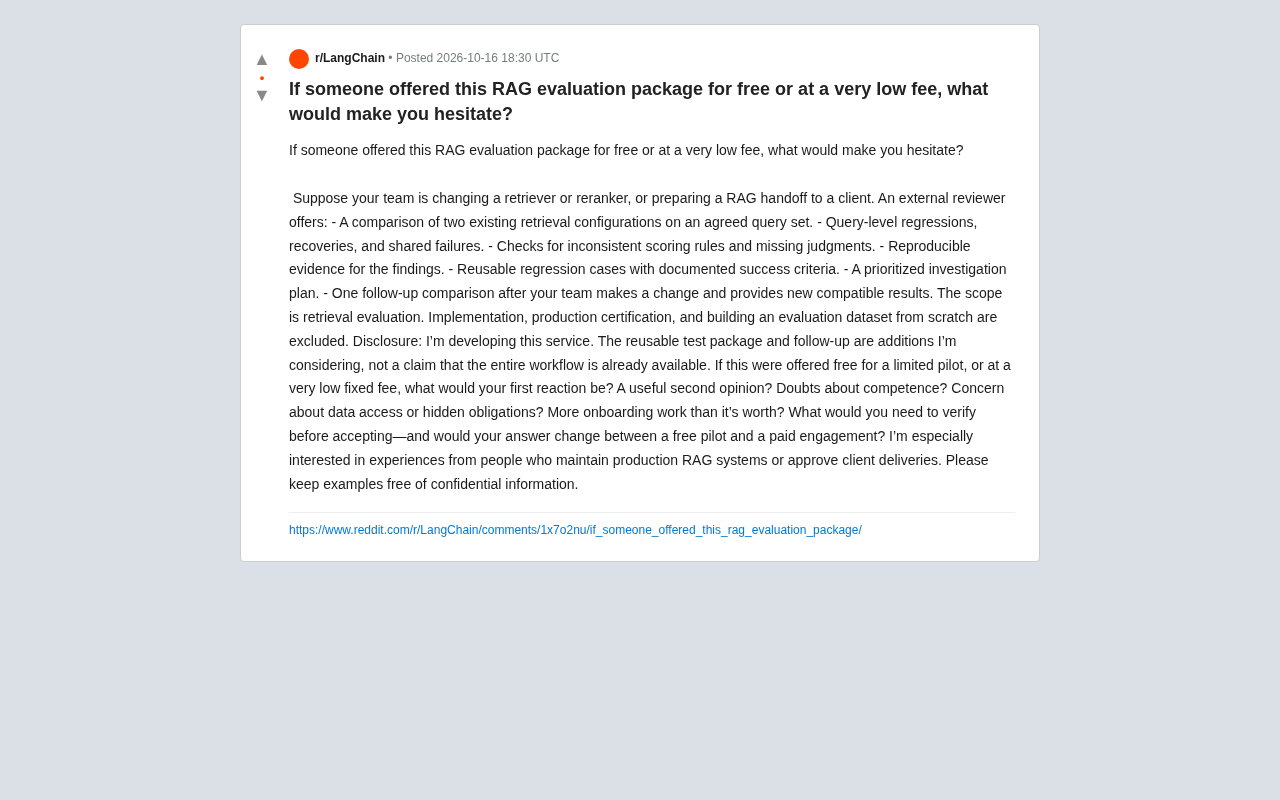
In the Reddit RAG technology community, a developer posed a thought-provoking question: If there were an external review service that provided independent evaluation of your RAG retrieval quality, free or at very low cost, would you accept it?
The scope of this service is clear—it only does retrieval evaluation, not implementation, production certification, or building evaluation datasets from scratch. The specific deliverables include: a comparison of two existing retrieval configurations on an agreed query set, query-level degradation/recovery/common failure analysis, scoring rule consistency checks, reproducible evidence, reusable regression test cases and success criteria, a prioritized investigation plan, and one follow-up comparison after team changes.
The Psychological Resistance Behind "Free"
The poster admits they are developing this service and specifically emphasizes that "the reusable test package and follow-up comparison are add-ons under consideration, not a claim that a complete workflow is ready." This proactive disclosure is commendable, but it also reveals the core contradiction RAG teams face when dealing with external free services.
Responses centered on several levels. The most direct reaction was "Can this provide a useful second opinion?" It sounds reasonable—when a team is about to switch retriever or reranker, or preparing to deliver a RAG system to a client, an external perspective might indeed catch issues the team overlooked. But the immediate suspicion is: How do we verify this person's competence? Does a free service mean someone inexperienced is practicing?
RAG (Retrieval-Augmented Generation) is one of the mainstream AI application architectures today: it allows large language models to first retrieve relevant document snippets from an external knowledge base before generating an answer, then feed these snippets as context into the model. Compared to relying solely on memory in model parameters, RAG can significantly improve timeliness, traceability, and domain accuracy of answers. The effectiveness of a RAG system highly depends on two stages: retrieval and generation. The retrieval stage is responsible for finding the most relevant snippets from massive documents, commonly using vector retrieval, keyword retrieval, or hybrid retrieval; the generation stage has the model organize answers based on retrieval results. It is widely believed that retrieval quality is the ceiling of a RAG system—if the retrieved content is irrelevant, even the strongest generation model cannot produce good answers. Therefore, independently evaluating retrieval quality has become a real and frequent pain point in RAG engineering.
Data Access and Implicit Obligations
More practical concerns come from data access permissions. RAG system query sets and retrieval results often contain sensitive information, especially in client-facing delivery scenarios. Handing over queries, document snippets, or scoring results to an external party, even with confidentiality promises, may be directly vetoed by compliance teams. Some respondents pointed out that data access agreements during free pilot phases are often vaguer than paid contracts—because neither party has incentive to go through the full legal process.
Another frequently mentioned issue is implicit obligations. Will the free service convert to a paid dependency at some point? If the team already relies on this external evaluation report in their workflow, the switching cost later could be much higher than the immediate savings. This "free first, then lock-in" model is not uncommon in developer tools.
Retriever and Reranker are two key components in the RAG retrieval pipeline. The Retriever is responsible for quickly recalling a batch of candidate snippets from a large document library, with common implementations including dense retrieval based on vector similarity, sparse retrieval based on algorithms like BM25, and hybrid retrieval combining both. The Reranker then performs finer relevance scoring on the candidates recalled by the Retriever, reorders them, and selects Top-K to feed into the generation model. Since Rerankers typically use cross-encoders to compute query-document pairs one by one, they are more accurate but slower, so they generally only act on a small number of candidates. Changing the Retriever or Reranker directly alters the context fed into the model, thereby affecting the output quality of the entire RAG system. This is why the article mentions "regression risk when switching retriever or reranker"—any component change requires evaluating whether retrieval quality has degraded.
Is Onboarding Cost Underestimated?
"More onboarding work than it's worth" was a blunt feedback. To enable an external party to do meaningful retrieval comparison, the team needs to: export the agreed query set, ensure results from two configurations are comparable, provide context for scoring rules, and explain what counts as a good result in the business logic. These preparatory tasks themselves may consume days of engineering time.
If the free service only covers a very narrow evaluation dimension, and the coordination cost exceeds the benefit, then free itself is not sufficiently attractive. An engineer maintaining a production RAG system mentioned that instead of introducing external evaluation, it's better to invest the same effort in improving internal regression testing—at least those tests are the team's own assets.
What Would Actually Make People Accept
Based on the discussion, the conditions for teams to accept external RAG evaluation are roughly:
- Verifiable methodology: The other party can clearly explain scoring rules, comparison logic, and how missing judgments are handled, rather than giving a black-box conclusion.
- Clear data boundaries: During the pilot phase, only anonymized or synthetic query sets are accessed, or the evaluation process can run within the team's internal environment.
- Reusable deliverables: Regression test cases and success criteria are things the team can take away and continue using, not bound to the service provider's platform.
- Transparent free vs. paid differences: What the free pilot covers and what paid engagement adds should be clearly stated upfront.
Some respondents specifically distinguished the mindset difference between free pilots and paid collaborations: when free, people are more willing to "give it a try," but expectations are lower, and if deliverables are not specific enough, they get ignored; when paid, they prepare data and review resources more seriously and question conclusions more rigorously. This means free doesn't necessarily lead to higher adoption—it may simply reduce the team's willingness to take it seriously.
Regression testing in the RAG context refers to repeatedly verifying whether system performance degrades after retrieval configuration changes using a fixed set of queries with standard answers or scoring criteria. It aligns with traditional software testing: establish a baseline first, then compare results after each modification. The "query-level degradation/recovery/common failure analysis" mentioned in the article is a refinement of regression testing—degradation means the new configuration performs worse on some queries, recovery means previously failing queries are fixed, and common failure means queries that both configurations fail to answer well. Success criteria are pre-agreed quantitative thresholds, such as recall, MRR (Mean Reciprocal Rank), or NDCG (Normalized Discounted Cumulative Gain) reaching a certain value. With reusable regression test cases and success criteria, teams can quickly determine whether changes are improvements or introduce problems in each iteration, without redesigning evaluations each time.
Implications for RAG Evaluation Service Developers
This discussion has direct reference value for those building similar services. Beyond technical capability, how trust is built may be more critical: publicize evaluation methods, offer options to run within the client's environment, clarify data usage boundaries, and position the free pilot as "methodology validation" rather than "complete delivery."
Evaluating retrieval quality of RAG systems is indeed a real pain point—regression risk when switching retriever or reranker, quality evidence when delivering to clients, and the burden of maintaining internal evaluation sets are all issues teams face daily. But the barriers to adopting external services are often not technical but "non-technical friction" like trust, compliance, and onboarding costs.
The original poster finally asked, "Would your answer differ between a free pilot and a paid collaboration?" From the discussion, the answer is yes, but the direction may be opposite to expectations: free lowers the barrier to try, but also lowers the level of seriousness; paid increases commitment, but also makes expectations for delivery quality more balanced.
One-line Summary
The real barrier to external RAG retrieval evaluation services is not technology, but data compliance, implicit obligations, and onboarding costs.
Paragraph Summary
The article discusses a question in the Reddit RAG community about an external free retrieval evaluation service. The service only evaluates retrieval quality, delivering configuration comparisons, degradation analysis, regression test cases, etc. The discussion shows that the team's core concerns are not technical, but data access permissions, implicit obligations of free pilots, and underestimated onboarding costs. Free may actually reduce the team's willingness to take it seriously, while paid collaboration makes expectations and commitments more balanced. Conditions for teams to accept include verifiable methodology, clear data boundaries, reusable deliverables, and transparent free/paid differences. For service developers, publicizing methodology and offering options to run within the client's environment build more trust than simply demonstrating technical capability.
Related articles

Chain of Thought Isn't Just for AI: How Humans Can Use CoT to Improve Thinking Quality
Chain of Thought isn't just a prompt trick for large models. Starting from a Hacker News discussion, this article analyzes why CoT works for human thinking too, breaks down actionable ways to transfer it, and highlights the key differences between human CoT and machine CoT.
Cloudflare Teams Up with OpenAI: Closi…
Cloudflare Teams Up with OpenAI: Closing the Loop from Vulnerability Discovery to Defense with AI
Cloudflare uses OpenAI Daybreak to investigate security vulnerabilities and generate reviewable remediation plans, while developers use Codex to boost coding efficiency and quality.

Orca Multi-Agent Orchestration in Practice: A Guide to Parallel Collaboration with Claude and Codex
Orca is Stable AI's free open-source agent workbench supporting 34 agents like Claude Code and Codex in parallel. Learn its Git worktree isolation, multi-model orchestration, and mobile management.