Why the Army Sent to Arrest Cortés Ended Up Joining Him Instead

Cortés turned the army sent to arrest him into his own reinforcements by promising them a share of imperial wealth.
This article examines the often-overlooked internal power struggles behind Spain's conquest of the Americas. When Governor Velázquez sent the larger force under Narváez to arrest the insubordinate Cortés, Cortés left Alvarado to hold Tenochtitlan and marched to meet the threat head-on. After a small engagement, he offered Narváez's soldiers a share of imperial riches — and they defected en masse. The article argues that this pattern of internal betrayal and defection, repeated in Pizarro's conquest of the Inca, reveals the conquest as a fractious, contingency-driven process rather than a unified colonial advance.
The Internal Power Struggles Behind the Conquest
There is a crucial detail often overlooked in the history of Spain's conquest of the Aztec and Inca empires: the Spanish were deeply divided among themselves, even fighting each other. Whether in Pizarro's conquest of the Inca or Cortés's conquest of the Aztec, the same pattern emerges — the conquistadors were far from a unified force, and power struggles within the colonial establishment were just as fierce as any battle against indigenous peoples.
Historian Si Sheppard recounts a particularly dramatic turning point: the Governor of Cuba, Velázquez, dispatched an army to arrest Cortés — only for that army to abandon its mission and defect to Cortés's side.

The Governor's Fury and His Counterstrike
The story begins with the Governor of Cuba. Cortés had acted unilaterally, far exceeding the scope of his original commission, seizing the glory and prestige that Velázquez believed rightfully belonged to him. Furious, the governor assembled a new expedition, placing it under the command of Pánfilo de Narváez.
Notably, this punitive force was actually larger than the army Cortés had originally brought to Mexico. It landed on the Mexican coast with a clear objective: to capture this insubordinate subordinate and make him pay for his unauthorized actions.

Pánfilo de Narváez (c. 1478–1528) was a Spanish conquistador whose career was defined by misfortune. For this campaign against Cortés, he brought roughly 900 soldiers, 80 horses, and several cannons — a force far superior to Cortés's original contingent. After his capture, he was held in Cortés's camp for over two years. Upon his release, he accepted a royal commission to explore Florida, but that expedition ended in catastrophe: most of his men perished on the North American continent, and Narváez himself drowned in the Gulf of Mexico. His expedition's chronicler, Álvar Núñez Cabeza de Vaca, was one of the few survivors, and went on to write a remarkable account of his journey across North America — one of the most important documents of early European exploration of the continent's interior.
Cortés Acts Decisively
Faced with this sudden threat, Cortés understood he had to move fast. He was already holding the Aztec capital of Tenochtitlan, a precarious position at the best of times.
He made a bold decision: he left his hot-tempered lieutenant Alvarado behind to hold the capital, and marched as many men as he could spare toward the coast to confront Narváez's army directly. It was a high-stakes gamble — the dangers of leaving Alvarado in charge would indeed come back to haunt him — but Cortés clearly judged that the more immediate threat came from his fellow Spaniards at his back.

Alvarado's tenure as guardian of Tenochtitlan had grave consequences. He ordered the massacre of a large number of Aztec nobles and warriors during a religious festival, an event known as the Massacre in the Main Temple. The killings enraged the Aztec population and triggered a full-scale uprising. When Cortés returned with reinforcements, he found the entire city in revolt, forcing a desperate retreat on the night of June 1520 — the infamous La Noche Triste, or "Night of Sorrows" — during which he lost enormous numbers of men and vast quantities of treasure. This was the true cost of his gamble: both fronts had exploded simultaneously. Only by forging a far larger indigenous alliance was he ultimately able to take the city in 1521.
Diplomacy Over the Sword
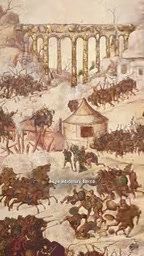
In a modest skirmish, Cortés defeated Narváez. But the real victory was not won by force — it was won through diplomacy.
Cortés addressed the opposing troops directly: "My friends, why should we shed each other's blood? The wealth of an entire empire lies within my grasp. Join me, and we will share in that fortune together." The appeal worked on the vast majority of the soldiers. The army sent to arrest him became his reinforcements.
This episode vividly illustrates that the conquistadors relied not only on firearms and horses, but on a keen understanding of human nature and the power of promised reward. Cortés recognized that it was far better to absorb his countrymen than to bleed them dry — and so he marched back toward the capital at the head of a significantly larger force.
Why This Story of Internal Conflict Matters
This episode matters because it dismantles the simplified narrative of a united Spanish front conquering the Americas. The reality is that every step of colonial expansion was accompanied by suspicion, betrayal, and bitter competition for power.
Cortés survived crisis after crisis through sharp situational awareness and a remarkable ability to turn enemies into allies. And this pattern of internal fracture played out again in Pizarro's conquest of the Inca. Understanding this is essential to seeing that era of conquest for what it truly was: a history saturated with ambition, calculation, and contingency.
The internal power struggles during Pizarro's conquest of the Inca Empire (1532–1572) were, if anything, even bloodier than those of the Cortés era. Francisco Pizarro and his partner Diego de Almagro fell out over the distribution of Peru's wealth and eventually went to war. In 1538, Pizarro defeated Almagro at the Battle of Las Salinas and had him executed; in 1541, Pizarro himself was assassinated in his Lima palace by Almagro's supporters. The civil wars between the Pizarro faction and representatives of the Crown dragged on for years afterward, a period historians call the "Conquistador Wars." This cascade of internecine violence makes clear that the conquest of the Americas was never a simple story of "civilization versus barbarism." It was a complex struggle involving multiple competing forces — Spanish factions, indigenous allies, and indigenous resisters — all intertwined in a contest whose outcome was never as inevitable as it might seem in hindsight.
Related articles

JobRunner MCP Server: AI Agents Can Now Fix Failed Java Jobs
JobRunner launches an open-source MCP server enabling AI agents to view cluster status, diagnose failures, and recover Java jobs—incident response from any cloud coding environment or existing agent.

MLAI Digital Launches 9 Security Agents: MCP Server Safeguards the Full Lifecycle of Agentic AI
MLAI Digital launches Security MCP Server with nine built-in specialized security agents covering vulnerability discovery, attack simulation, prompt injection detection, API and infrastructure assessment, and accelerated remediation—embedding security validation across the full Agentic AI lifecycle from development to production.

Running Isaac Lab on H100 GPUs: Exploring Better Approaches
Exploring optimization methods for running Isaac Lab on NVIDIA H100 GPUs, including MIG configuration, mixed precision, TensorRT acceleration, and community experience to improve robotics simulation and reinforcement learning efficiency.