Why The Legend of Zelda: Ocarina of Time Never Fades

Ocarina of Time laid the series' foundation with its 3D interaction paradigm, level design, and narrative structure, influencing to this day.
The article reviews why The Legend of Zelda: Ocarina of Time is still considered a classic after more than twenty years. It successfully brought the series from 2D to 3D space with locking, context-sensitive buttons, and auto-jumping, solving 3D control issues. Breath of the Wild's open world still inherits its dungeon logic, item unlocks, and 'explore-discover-grow' loop. Ocarina's tight, layered dungeons and time-travel narrative remain rare in today's massive-world trend, so its value doesn't depreciate.
More than two decades later, The Legend of Zelda: Ocarina of Time remains an irreplaceable classic in the hearts of countless players. Although Breath of the Wild completely changed the series' direction with its open world, the 3D adventure paradigm established by Ocarina of Time still influences game design today. This article analyzes from multiple angles why this work can transcend eras and continue to radiate charm.
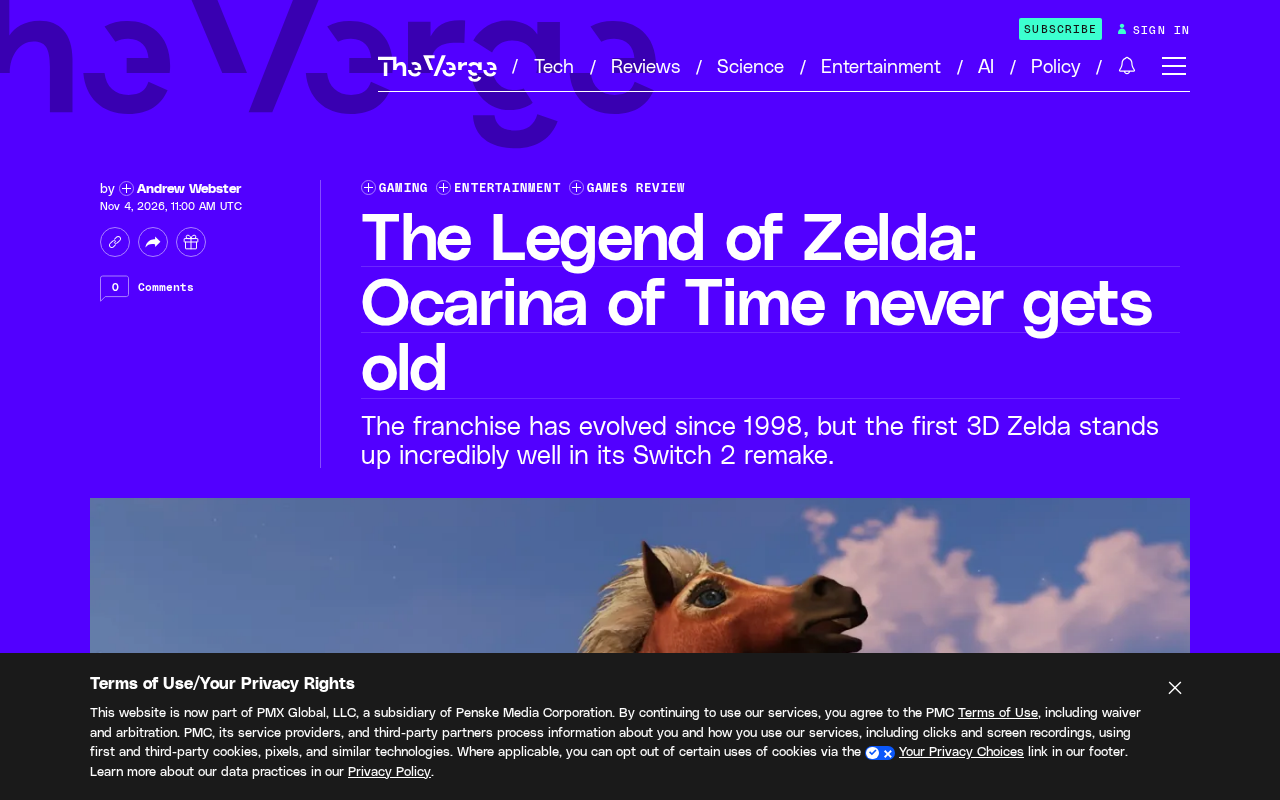
The Paradigm Revolution from 2D to 3D
The most fundamental contribution of Ocarina of Time lies in its success in bringing the Zelda series from a 2D top-down perspective into 3D space. According to game media retrospectives, this transformation was not simply an increase in dimension, but a redefinition of how players interact with the game world. Designs such as enemy locking, context-sensitive buttons, and auto-jumping were all new rules that Ocarina of Time established for 3D action-adventure games.
These mechanics may seem commonplace today, but at the time they solved the core pain point of chaotic 3D space operation. Many subsequent works directly or indirectly adopted this interaction logic, demonstrating the foresight of its design.
Z-Targeting is the key interaction solution that Ocarina of Time provided for 3D action games. On the N64's single-stick controller, players found it difficult to precisely control movement and camera simultaneously. The locking system allowed players to hold the Z button to continuously align the camera and character orientation toward a single target, thereby simplifying complex spatial judgment into a stable loop of "move around the target—attack—dodge." It solved the core contradiction between melee hit detection and camera control in 3D environments, and was later inherited in various forms by numerous action games such as Devil May Cry and Dark Souls, becoming a universal vocabulary for 3D combat design.
Context-Sensitive Button refers to the same button executing different actions depending on the character's situation. In Ocarina of Time, the A button triggers different behaviors in scenarios such as jumping, climbing, dialogue, picking up items, and opening doors, greatly reducing the need for button count and avoiding players having to memorize numerous button combinations in complex 3D scenes. This design allowed the limited buttons of the N64 controller to support rich adventure actions, and became a common practice in subsequent 3D adventure games.
The Revolution and Inheritance of Breath of the Wild
Twenty years after Ocarina of Time's transition to 3D, Breath of the Wild once again brought disruptive changes to the series. It constructed an open adventure centered on player freedom and expression, where players no longer follow fixed routes but can freely explore and respond to challenges.
However, the freedom of Breath of the Wild did not come from nowhere. The dungeon design logic, item unlock mechanisms, and the "explore-discover-grow" loop established by Ocarina of Time were inherited and amplified in a more open form in Breath of the Wild. The two may seem opposed, but are in fact continuous.
The "Explore—Discover—Grow" loop is the core structure of the Zelda series: players enter unknown areas, discover hidden paths or items through observation and experimentation, and then use newly acquired abilities to unlock areas previously inaccessible. Ocarina of Time organized this loop on a dungeon-by-dungeon basis, with each dungeon introducing a key item and designing puzzles and boss fights around it. Breath of the Wild amplified this loop to the entire open world, replacing linear progression in closed dungeons with "see a distant goal—plan a route—acquire abilities or resources—continue exploring." The forms differ, but the psychological mechanism driving players forward is the same.
Dungeon design logic in Ocarina of Time is embodied as "overall structure first": dungeons are often organized around a central mechanic (such as water level raising and lowering, or time switching between forest and temple), with floors and rooms arranged accordingly. Players need to first understand the overall spatial relationships, then solve local puzzles one by one. This design emphasizing spatial cognition and mechanic teaching contrasts with the small puzzles centered on a single concept in Breath of the Wild's shrines, but the latter still inherits the teaching rhythm of "introduce concept—practice concept—combine concepts."
Why Ocarina of Time's Experience Still Holds Up
Although graphics technology has long since iterated, Ocarina of Time's pacing control and level design still stand the test of time. Its dungeon structures are compact and layered, with each item's introduction accompanied by a closed loop of teaching and application. This design approach actually seems scarce in today's trend of pursuing massive worlds.
Furthermore, Ocarina of Time's combination of music and narrative is also quite moving. The time-travel setting allows players to switch between childhood and adulthood dimensions, and this structural ingenuity is still discussed today.
Overall, the reason Ocarina of Time "never grows old" is that it made foundational contributions in interaction paradigms, level design, and narrative structure. These contributions do not depreciate due to outdated graphics; rather, they become more precious as time passes.
One-line Summary
Ocarina of Time established the series' cornerstone with its 3D interaction paradigm, level design, and narrative structure, with its influence continuing to this day.
Paragraph Summary
The article reviews why The Legend of Zelda: Ocarina of Time is still regarded as a classic more than twenty years later. First, it successfully brought the series from a 2D top-down perspective into 3D space, solving the pain points of chaotic 3D operation through designs such as enemy locking, context-sensitive buttons, and auto-jumping, establishing rules for 3D action-adventure games. Second, although Breath of the Wild once again revolutionized the series with an open world, its dungeon logic, item unlock mechanisms, and "explore—discover—grow" loop can still be traced back to Ocarina of Time, showing continuity between the two. Finally, Ocarina of Time's compact and layered dungeons, pacing control with closed loops of teaching and application, and time-travel narrative structure are actually scarce in today's pursuit of massive worlds, so its value does not depreciate due to outdated graphics.
Related articles

GPT-6 Astra's Weight-Reading Trick: Only for Small Networks, Practical Value Comes from Writing Code
GPT-6 Astra can read network weights directly, but without tools it is limited to small networks of ~170K weights. Fixing QUEN 3.5 0.8b's reasoning loop required Python and 50 batches; game identification took nearly an hour. This article maps the capability's boundaries and two security reminders.

GPT-6 Astra Rewrites Qwen Weights: 7.9% to 48.1% — Did It Learn Math or Just Learn to Stop?
MIT researchers used GPT-6 Astra to edit Qwen's weights directly, raising math scores from 7.9% to 48.1% with no training. But reproductions show the gain mainly comes from fixing loops and teaching the model to stop, not new math ability.

Can Qwen 3.8 27B Really Read Neural Network Weights? A 16GB Hands-On Test
MIT claims LLMs can directly read neural network weights. We tested Qwen 3.8 27B on a 16GB GPU: the signal is real, but "native reading" is false.