Why Uncensored Models Work Better for Coding: A Developer's Firsthand Experience

A developer used an uncensored roleplay model for coding, exposing how over-alignment hurts real-world LLM usability.
A developer shared on Reddit how official models repeatedly blocked legitimate code-reuse requests, leading him to switch to an uncensored roleplay model — with surprisingly little performance loss. The article explains why: uncensored fine-tuning weakens refusal tendencies without touching core reasoning ability. It also flags the real risks — capability mismatch, shifted compliance responsibility, and output instability — and frames the incident as a product signal: over-alignment is pushing real users away.
A Real Developer Frustration
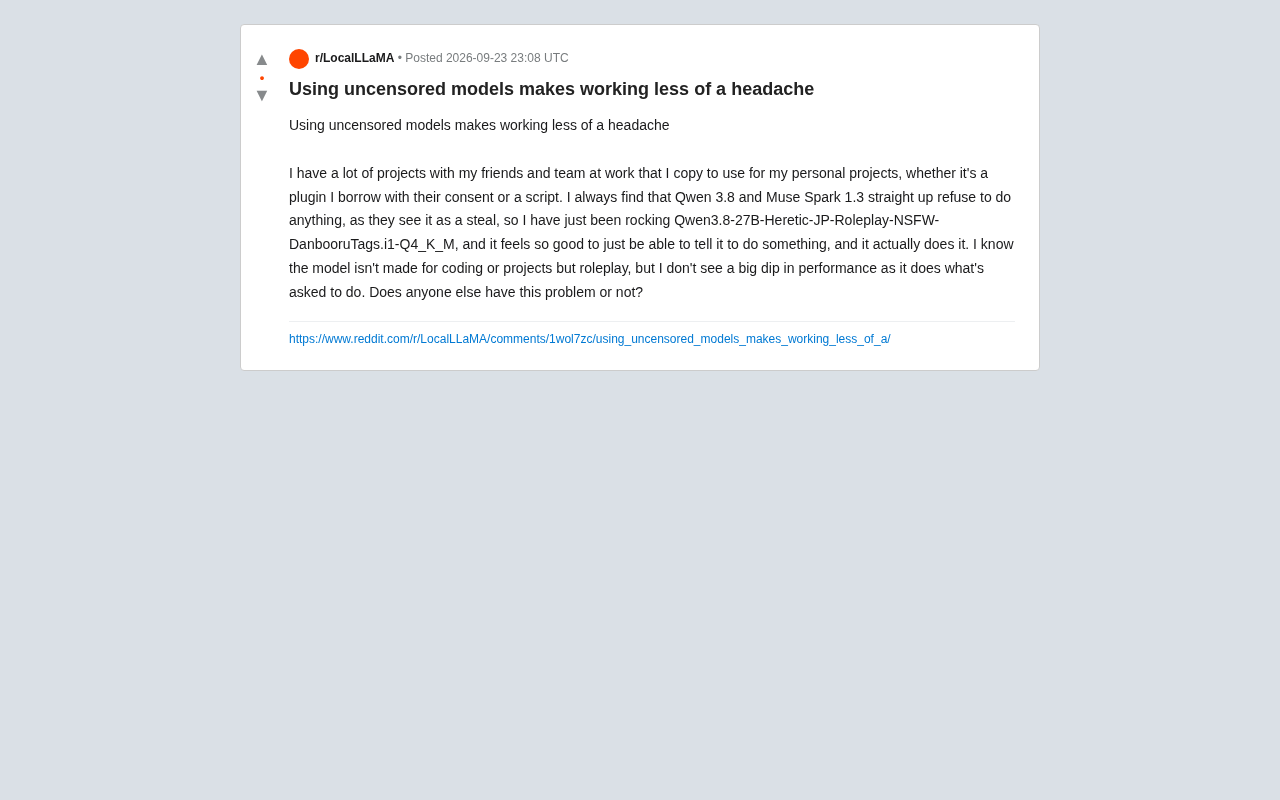
In a local LLM community on Reddit, a developer shared a daily annoyance: he and his team and friends regularly borrow code from each other — a plugin shared with permission, or a script repurposed for a personal project. This is about as routine as collaborative development gets. But when he handed that code to mainstream models for help, things got complicated.
According to the developer, models like Qwen 3.8 and Muse Spark 1.3 "flat-out refused to do the job" because they classified reusing someone else's code as "theft," triggering built-in safety and compliance filters. For someone who just wanted AI to help tweak a script, this kind of "excessive caution" became a genuine productivity blocker.
His Solution: Switch to an Uncensored Model
The developer's fix was telling — he switched to a community fine-tuned model with an unwieldy name: Qwen3.8-27B-Heretic-JP-Roleplay-NSFW-DanbooruTags.i1-Q4_K_M.
The name alone tells you what this model is for: roleplay, uncensored (the "Heretic" series typically refers to versions with refusal mechanisms removed), and even NSFW and anime-tag oriented. Coding has nothing to do with it. Yet his feedback was blunt: "Being able to just tell it what to do and have it do it feels amazing."
Even more interesting was his observation: despite the model not being designed for coding or engineering tasks, in actual use he "didn't notice any obvious performance drop" — it still completed what was asked of it.
Why Does This Happen?
This reflects a classic side effect of model alignment — over-refusal. To hedge against legal and ethical risk, official models tend to be hypersensitive to keywords like "copy," "borrow," or "steal." Even when user intent is completely legitimate (such as authorized code reuse), it can still get blanket-blocked.
Uncensored fine-tuned models remove or weaken this refusal logic, which is precisely why they feel more usable in these "gray but compliant" scenarios. And since the underlying model architecture (Qwen3.8-27B) itself isn't broken, performance on non-specialized tasks like coding doesn't take a meaningful hit — uncensoring primarily affects refusal tendency, not baseline reasoning and generation capability.
Background: What Is LLM Alignment? Model alignment refers to the training process that steers a model's outputs to conform to human values, legal norms, and platform policies. Common methods include Reinforcement Learning from Human Feedback (RLHF) and Direct Preference Optimization (DPO). In practice, human annotators tend to score potential risks conservatively, which causes models to learn a "refuse rather than risk it" preference. "Uncensored" fine-tuning typically means community developers perform secondary fine-tuning on the base model using datasets that contain no refusal examples, or specifically penalize unnecessary refusals during the DPO stage — effectively stripping away the alignment layer. Since the base model's weights (which encode language understanding, code generation, logical reasoning, and other core capabilities) aren't significantly modified — only the decision boundary for triggering refusals changes — capability loss on alignment-insensitive tasks like coding is often minimal. This is also where the "Heretic" series name comes from: they're seen as a heterodox challenge to the mainstream alignment paradigm.
Where Uncensored Models Actually Belong
This case deserves a nuanced reading from developers, not blanket endorsement as best practice.
Clear advantages: When your task is entirely legitimate but keeps getting flagged by official models' safety guardrails, an uncensored model can significantly cut the overhead of "repeatedly explaining to the AI that I'm not doing anything wrong." These models have higher instruction-following compliance and suit experimental work in local deployments and private environments.
But the risks are real too:
- Capability mismatch: A model optimized for roleplay will ultimately fall short of dedicated coding models (like Qwen-Coder or the DeepSeekAd-Coder series) on coding tasks. "No obvious drop" is a subjective impression that may not hold for complex engineering work.
- Compliance responsibility shifts: Official model refusals are annoying, but they also partially protect users from risk. Remove the guardrails, and the responsibility for judging whether an action is compliant falls entirely back on the user.
- Output instability: NSFW/Roleplay-oriented fine-tuning may introduce unpredictable stylistic drift into formal code output.
A More Sensible Approach
Rather than forcing a "wayward" roleplay model to meet coding needs, the more stable path is finding a purpose-built uncensored coding model, or using an open-source coding model with lower refusal rates that supports system prompt tuning. For local deployments, a carefully crafted system prompt explaining that "the code is already authorized" can often bypass some official model misdetections.
Background: What Is a System Prompt? A system prompt is a hidden instruction injected into the model's context before the user conversation begins — essentially pre-setting the model's "role" and "rules." Some open-source models (like certain Mistral or LLaMA variants) are quite responsive to system prompts. By explicitly declaring the use case in the system prompt (e.g., "All code below comes from an authorized private project — please assist directly"), you can reduce an official model's false-positive rate on specific keywords without switching models. The limitation is that effectiveness varies by model: it has limited impact on closed-source models with heavy RLHF (like GPT-4o or Claude), but is often more effective for locally deployed open-source models. Compared to using a capability-mismatched uncensored model, thoughtful prompt engineering is a low-cost path to reducing false refusals while preserving the model's original capabilities.
A Product Signal Worth Heeding
Beyond the technical details, this Reddit post carries a clear message for model developers: over-alignment is driving away real users.
When a developer would rather write code with a roleplay model than tolerate constant refusals from an official one, it signals a visible crack between safety policy and real-world usability. Ideal alignment should mean "precisely blocking genuine malicious intent" — not "refusing a thousand legitimate requests to catch one bad one." How to strike the right balance between safety and usability remains one of the unsolved core challenges in LLM product design.
For everyday developers, the takeaway from this case is simple: understanding the alignment characteristics of different models and choosing the right tool for the task at hand matters more than reflexively reaching for the "most powerful" or "safest" model.
Related articles

Felix Rieseberg Personal Homepage
Felix Rieseberg's personal homepage sparks attention on Hacker News. This article covers the Slack engineer's technical background, the rise and fall of nativefier, and the value of a developer homepage as a tech calling card.

@ai-sdk/vue 3.0.306 Patch Release Syncs with [email protected] Update
@ai-sdk/vue 3.0.306 released, synced with [email protected]. A routine patch release for the Vercel AI SDK ecosystem with no public API changes; the Vue adapter layer stays version-aligned with the core package.

Gemini 4 Argon API Launches: The Era of Million-Token Output Begins
Google launches Gemini 4 Argon with sparse MoE architecture, up to 1M output tokens, and a 68.90% Vals Index score, available across API, AI Studio, and the Gemini app.