Wiki-Style Memory: A New Paradigm for AI Agent Long-Term Memory

Wiki-style memory brings structured, editable, cross-referenceable knowledge organization to AI Agent long-term memory.
Wiki-style memory is an emerging paradigm for AI Agent long-term memory that draws inspiration from Wikipedia's knowledge organization. Unlike traditional approaches such as RAG or summary compression, it structures information into interconnected, editable entries that can self-revise over time. This approach addresses context window limitations and enables selective memory management, providing a scalable foundation for truly autonomous AI Agents.
A Deep Dive into AI Memory
Recently, a technical webinar centered on "wiki-style memory" has drawn significant attention from the industry. The webinar, presented by industry expert Jeff, focused on the core challenge of how AI systems build, organize, and maintain long-term memory. Judging from the discussion on Twitter, Jeff has clearly been thinking deeply about this problem for a long time.
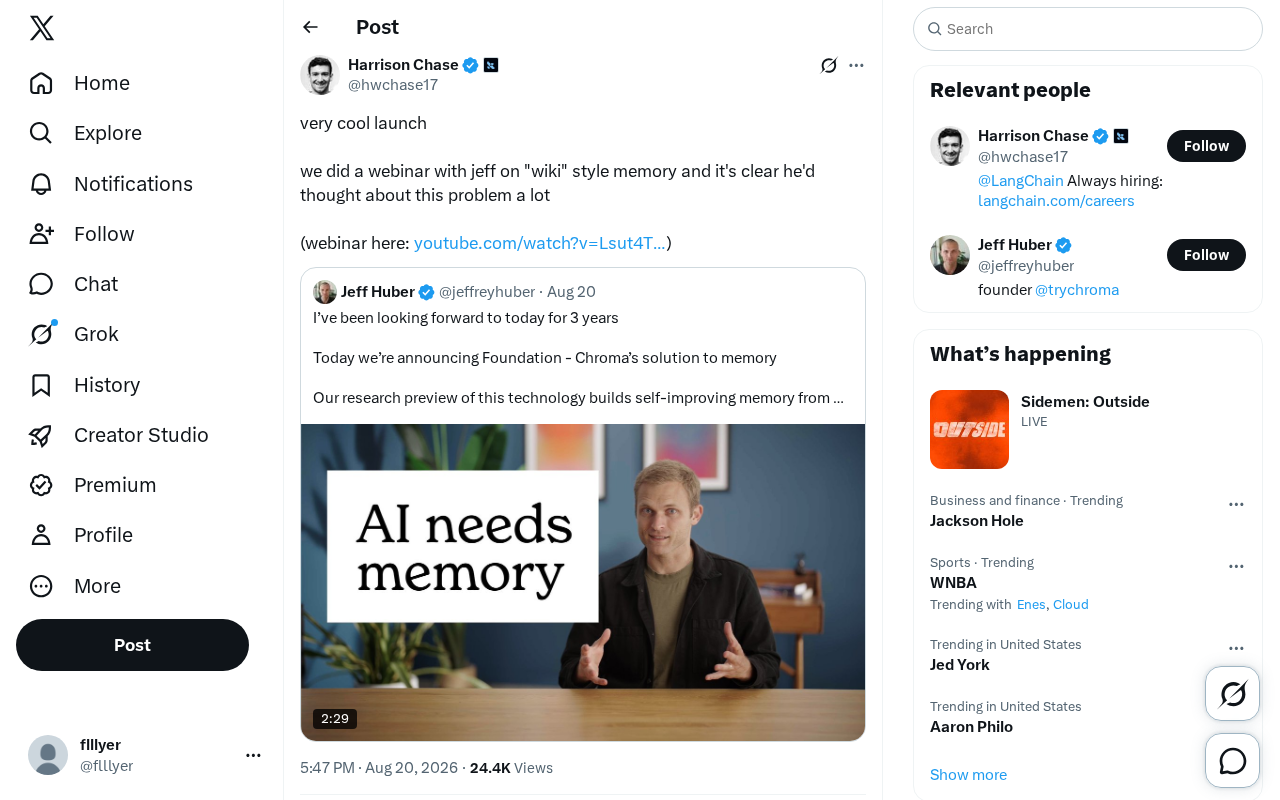
With the rapid adoption of large language models (LLMs) and AI Agents, "memory" has evolved from a peripheral topic into a critical factor that determines the success or failure of AI applications. Traditional conversational AI is typically confined to information within the context window — once the conversation exceeds that window, the model "forgets" earlier interactions. Wiki-style memory aims to solve this fundamental limitation at the architectural level.
What Is Wiki-Style Memory?
Inspired by Wikipedia
The core idea behind "wiki-style memory" draws inspiration from how Wikipedia organizes knowledge. Unlike simply stacking and storing conversation history, wiki-style memory emphasizes organizing information in a structured, entry-based, and cross-referenceable manner.
Under this paradigm, an AI system no longer treats memory as a linear chronological log. Instead, like Wikipedia, it breaks knowledge down into interconnected "entries." Each entry revolves around a specific entity, concept, or event, and establishes connections to other related entries through links. When the AI needs to recall certain information, it can quickly locate the relevant entry — much like a human consulting an encyclopedia — and follow links to expand into related knowledge.
Advantages Over Traditional AI Memory Approaches
Current mainstream AI memory solutions generally fall into two categories: Retrieval-Augmented Generation (RAG) powered by vector databases, and simple conversation summary compression. Both have their limitations — RAG excels at semantic retrieval but struggles to maintain structured knowledge relationships; summary compression tends to lose details and has difficulty handling information updates and conflicts.
The unique value of wiki-style memory lies in its introduction of "editability" and "structure." When new information conflicts with an existing entry, the system can update the entry content like a wiki editor, rather than simply appending new data. This allows the AI's memory to continuously "self-revise" through interactions, maintaining information consistency and timeliness.
Why Long-Term Memory Is a Core Challenge for AI Agents
The Physical Boundaries of Context Windows
Although context windows for large models have expanded dramatically in recent years — from a few thousand tokens to millions — simply enlarging the window is not a sustainable solution. On one hand, ultra-long contexts bring significant inference costs and latency; on the other hand, research has shown that models suffer from the "lost in the middle" problem in very long contexts, where attention to information in the middle of the context drops off.
As a result, the industry has gradually reached a consensus: true long-term memory should not rely on cramming all information into the context, but rather should be achieved through carefully designed external memory systems. This is a point Jeff repeatedly emphasized during the webinar — memory is a systems engineering problem, not merely a model capability problem.
Balancing Information Organization and Forgetting
Human memory is efficient precisely because we actively forget unimportant information while reinforcing important memories. AI systems need a similar mechanism. Wiki-style memory, through its entry-based organization, naturally supports tiered information management — core entries are retained long-term, while peripheral information can be gradually phased out. This kind of "selective memory" is closer to the essence of intelligence than indiscriminately storing all history.
Implications for AI Agent Development
Memory Is the Foundation of Agent Autonomy
For the rapidly evolving field of AI Agents, long-term memory is particularly significant. A truly autonomous Agent needs to execute complex tasks over extended time spans, remembering user preferences, historical decisions, and task progress. An Agent without reliable memory is essentially a tool with "goldfish memory," incapable of handling truly valuable long-term work.
Wiki-style memory provides Agents with a scalable memory infrastructure. As an Agent continuously interacts with its environment, its memory base grows and improves like Wikipedia, gradually forming a deep understanding of specific domains or users.
Thoughts from a Product Perspective
Interestingly, this discussion didn't remain at the theoretical level — it was accompanied by an actual product launch. This signals that wiki-style memory has moved from a research concept to engineering implementation. For AI application developers, this means they can leverage mature memory frameworks to quickly add long-term memory capabilities to their applications, without having to build complex memory management systems from scratch.
Conclusion
Wiki-style memory represents an important direction in AI memory research — it no longer treats memory as simple data accumulation, but instead draws on the wisdom of human knowledge organization to build a structured, editable, and interconnected memory system. As this webinar revealed, solving the AI memory problem requires not just bigger models, but a profound understanding of the nature of information organization.
As the era of AI Agents arrives, how to enable machines to "remember" and "effectively leverage" past experience will become a key differentiator for the next generation of AI applications. Wiki-style memory may well be an important step toward that goal.
Related articles

Chain of Thought Isn't Just for AI: How Humans Can Use CoT to Improve Thinking Quality
Chain of Thought isn't just a prompt trick for large models. Starting from a Hacker News discussion, this article analyzes why CoT works for human thinking too, breaks down actionable ways to transfer it, and highlights the key differences between human CoT and machine CoT.
Cloudflare Teams Up with OpenAI: Closi…
Cloudflare Teams Up with OpenAI: Closing the Loop from Vulnerability Discovery to Defense with AI
Cloudflare uses OpenAI Daybreak to investigate security vulnerabilities and generate reviewable remediation plans, while developers use Codex to boost coding efficiency and quality.

Orca Multi-Agent Orchestration in Practice: A Guide to Parallel Collaboration with Claude and Codex
Orca is Stable AI's free open-source agent workbench supporting 34 agents like Claude Code and Codex in parallel. Learn its Git worktree isolation, multi-model orchestration, and mobile management.