WikiFix for Confluence: Using AI to Automatically Fix Contradictions and Redundancies in Your Knowledge Base

WikiFix uses AI to continuously monitor and fix contradictions, duplicates, and orphan pages in Confluence knowledge bases.
WikiFix for Confluence is an AI-powered data governance tool designed to tackle three persistent problems in enterprise knowledge bases: contradicting pages, redundant duplicates, and unmaintained orphan pages. Its core design follows a human-in-the-loop model — AI monitors and suggests fixes, which humans approve before one-click execution, balancing automation efficiency with operational safety. The deeper logic aligns with the growing trend of connecting Confluence to RAG systems: knowledge base data quality directly determines AI assistant reliability. WikiFix launched on Product Hunt with 84 upvotes and a 7th-place ranking, validating real demand — though detection accuracy, scalability, and fix controllability still await real-world validation.
When Your Knowledge Base Becomes a "Data Minefield" for AI
Companies store documentation in tools like Confluence hoping to give their teams a single source of truth. In reality, the opposite often happens: two conflicting versions of the same process exist side by side, duplicate pages are scattered across different spaces, and countless unmaintained "orphan pages" linger in forgotten corners. It's already painful enough for humans to navigate — but when this content gets fed into an AI assistant, the problem compounds dramatically. The AI treats outdated or conflicting information as fact, making it even harder for teams to distinguish what's accurate.
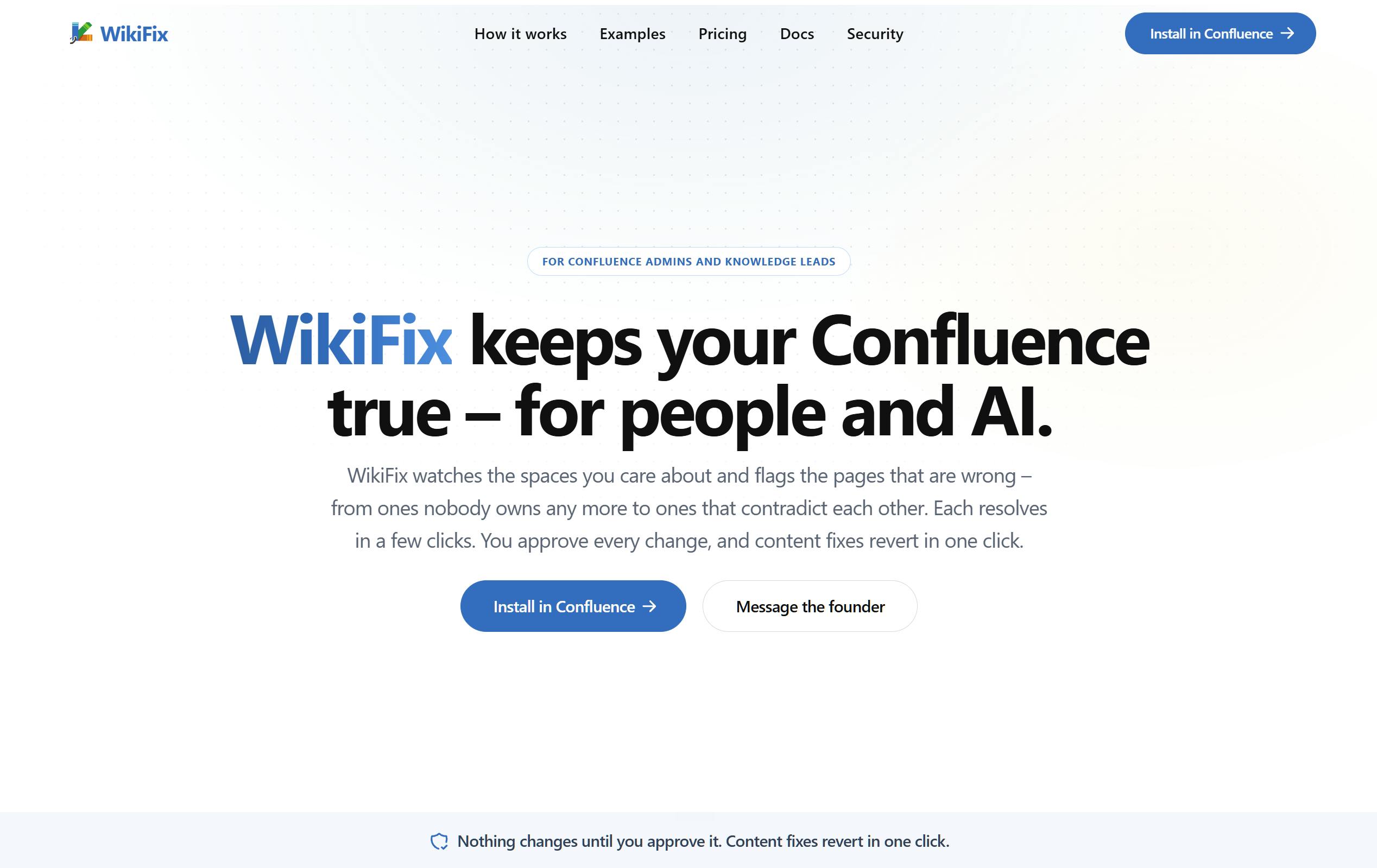
WikiFix for Confluence is built specifically to address this pain point. After launching on Product Hunt, it earned 84 upvotes and ranked 7th for the day, across three categories: Productivity, SaaS, and Artificial Intelligence. The product's core value proposition can be summed up in one sentence: continuously monitor your knowledge base for problems, then fix them with a single click once you've approved the changes.
What Problems Does It Actually Solve?
According to the official description, WikiFix targets three classic knowledge base ailments:
Contradicting Pages
Two documents giving different answers to the same question is perhaps the most insidious and dangerous problem a knowledge base can have. For example, one doc says the reimbursement limit is $500, while another says $800. These cross-page logical conflicts are nearly impossible to catch manually, and when an AI retrieves content, it might randomly land on either version — producing a misleading answer. WikiFix's value lies in proactively identifying these semantic-level inconsistencies.
Duplicates
As teams grow and spaces multiply, the same topics get recreated and copy-pasted repeatedly, creating information redundancy. Duplicate pages waste maintenance effort and dilute the accuracy of both search results and AI retrieval.
Orphan Pages
Pages with no incoming links and no place in the navigation structure are typically forgotten historical artifacts. They may contain outdated information, yet they remain indexed by full-text search and AI crawlers.
The Philosophy Behind "Approve, Then Fix"
There's a key word in WikiFix's product logic worth paying attention to: approve. The tool doesn't let AI modify your documents on its own. Instead, it monitors, detects issues, and suggests fixes — which a human must approve before anything is executed.
This human-in-the-loop design is critically important in enterprise contexts. A knowledge base is an organization's institutional memory. If an automated tool rewrites content without oversight, the risks are high — an accidental deletion or incorrect merge could cause irreversible damage. By keeping humans in the approval loop, WikiFix positions AI as a "detector and recommender" while returning final decision-making authority to the team. The one-click execution then solves the efficiency problem of traditional manual cleanup, striking a balance between safety and speed.
Human-in-the-Loop (HITL) is a safety paradigm in AI system design that preserves human review and intervention at critical decision points within an automated workflow. The core distinction from a fully automated approach is this: AI handles perception and suggestion at scale, while humans retain veto power over high-risk actions. In enterprise knowledge management, HITL is especially necessary — because determining whether a document is "correct" often requires business context that pure semantic similarity cannot capture. AI might mistakenly flag an intentionally preserved "historical version comparison" as a duplicate. WikiFix's approval workflow is essentially a safety net for AI uncertainty, ensuring that the efficiency gains from automation don't come at the cost of data integrity.
Why the Timing Is Right for This Product
WikiFix's marketing copy repeatedly emphasizes one thing: enabling teams to trust what they "read or hear from AI." That framing reflects a very real and current need.
More and more companies are connecting Confluence to internal AI assistants or RAG (Retrieval-Augmented Generation) systems, transforming knowledge bases from "documents for humans" into "data sources for AI." And AI output quality is directly dependent on the quality of the underlying data — garbage in, garbage out. When a knowledge base is riddled with contradictions, duplicates, and stale content, even the most powerful large language models can't deliver reliable answers.
From this perspective, WikiFix is fundamentally a data quality governance tool — one that serves the credibility of knowledge bases in the age of AI. It doesn't do Q&A itself; it ensures that the "raw material" Q&A systems depend on is clean. As enterprise AI adoption grows, governance products focused on data foundations like this will find an increasingly well-defined market.
RAG (Retrieval-Augmented Generation) is the dominant architecture for deploying large language models in enterprise settings. Here's how it works: when a user asks a question, the system first retrieves relevant document snippets from a knowledge base, then feeds those snippets as context to the language model, which generates an answer based on that content. This differs from relying purely on a model's pre-trained knowledge — in RAG, answer quality is directly tied to the quality of what gets retrieved. If two contradictory documents are both retrieved, the model may "synthesize" an answer that's inaccurate in both directions, or give inconsistent responses across different sessions. This is exactly the core scenario WikiFix targets: RAG architectures elevate the stakes of knowledge base data quality from "an employee reading the wrong doc" to "an AI system outputting errors at scale" — making governance a much higher priority.
A Sober Take: What Still Needs Validation
As an early-stage product that just launched on Product Hunt, WikiFix has limited publicly available information. A few key questions are worth considering for potential users:
- Detection accuracy: Identifying semantic contradictions is far harder than finding duplicate pages. How precise is the AI's judgment, and what's the false positive rate? This is central to the product's success.
- Scalability: For large knowledge bases with tens of thousands of pages, the monitoring and analysis performance remains unclear.
- Granularity of fixes: The specifics of what "one-click fix" actually does — and whether rollback is supported — directly affects how comfortable enterprises will feel using it.
The 84-vote reception suggests the direction resonates with a real pain point, but the product's actual effectiveness still needs validation through real-world use. For teams that rely heavily on Confluence and plan to connect it to AI, WikiFix at least offers a compelling idea worth trying: before you let AI read your knowledge base, clean up the knowledge base itself.
Related articles

Felix Rieseberg Personal Homepage
Felix Rieseberg's personal homepage sparks attention on Hacker News. This article covers the Slack engineer's technical background, the rise and fall of nativefier, and the value of a developer homepage as a tech calling card.

@ai-sdk/vue 3.0.306 Patch Release Syncs with [email protected] Update
@ai-sdk/vue 3.0.306 released, synced with [email protected]. A routine patch release for the Vercel AI SDK ecosystem with no public API changes; the Vue adapter layer stays version-aligned with the core package.

Gemini 4 Argon API Launches: The Era of Million-Token Output Begins
Google launches Gemini 4 Argon with sparse MoE architecture, up to 1M output tokens, and a 68.90% Vals Index score, available across API, AI Studio, and the Gemini app.