WildMAE: How Structure-Aware Masked Autoencoding Improves Wildlife Image Reconstruction

WildMAE adds zero-gated convolutional residuals and gated cross-attention to the decoder to improve wildlife image reconstruction.
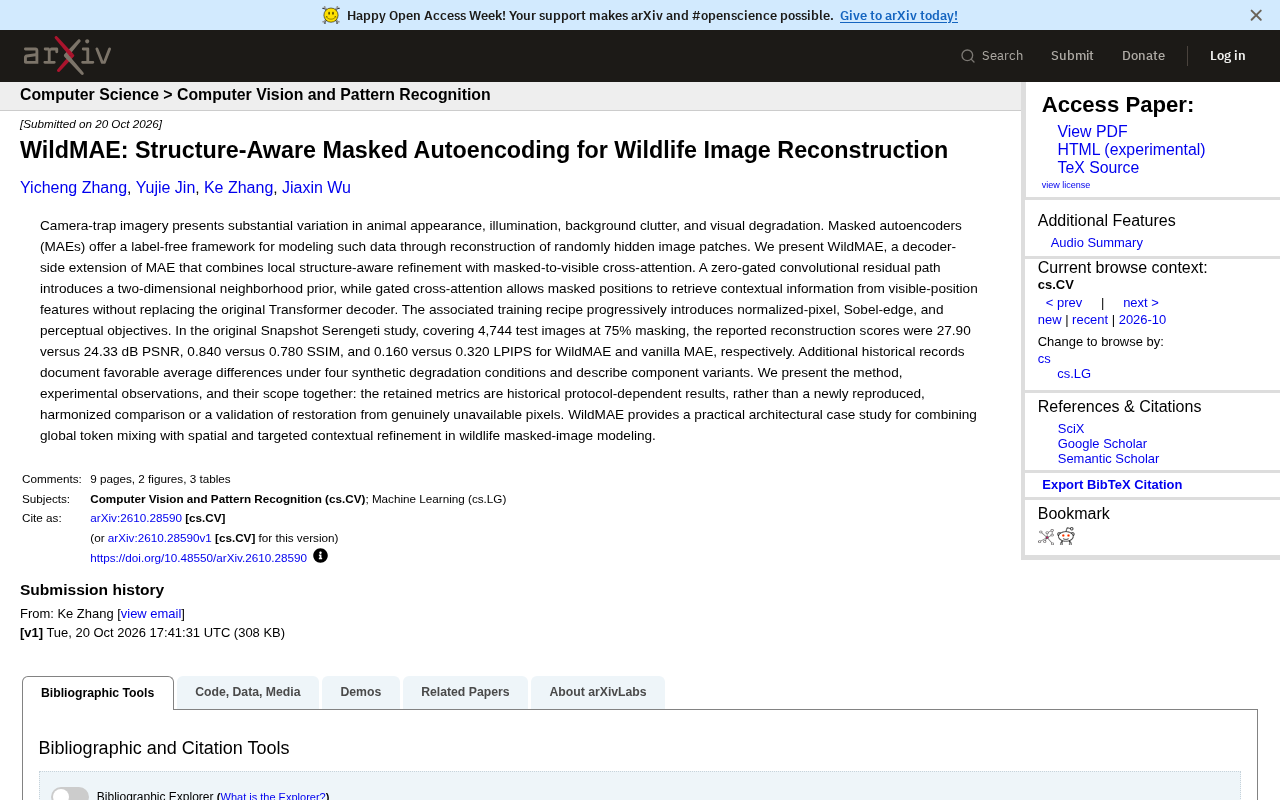
WildMAE improves the MAE decoder while keeping the encoder unchanged: a zero-gated convolutional residual path injects a 2D neighborhood prior for local structure, and gated cross-attention lets masked positions retrieve context from visible positions. Training uses progressive pixel, Sobel edge, and perceptual losses. At 75% masking on Snapshot Serengeti, PSNR rises from 24.33 to 27.90 dB, SSIM from 0.780 to 0.840, and LPIPS drops from 0.320 to 0.160. The authors note the results are protocol-dependent and do not verify recovery from truly invisible pixels.
Camera trap wildlife images often suffer from variable animal appearance, large lighting differences, cluttered backgrounds, and degraded image quality. Conventional Masked Autoencoders (MAE) learn label-free representations by reconstructing randomly masked image patches, but their reconstruction detail remains insufficient in such complex scenes. A recent study titled "WildMAE: Structure-Aware Masked Autoencoding for Wildlife Image Reconstruction" proposes a decoder-side improvement that achieves significant reconstruction metric gains at a 75% masking ratio.
Core Idea: Structure Awareness and Cross-Attention on the Decoder Side
WildMAE does not modify MAE's encoder structure; instead, it concentrates improvements on the decoder side. It introduces two parallel paths: a zero-gated convolutional residual path that injects a 2D neighborhood prior to help capture local structure (such as animal contours and texture edges), and a gated cross-attention mechanism that allows masked positions to retrieve contextual information from features at visible positions rather than relying entirely on the Transformer decoder's own global attention.
The key to this design is that it does not replace the original Transformer decoder but adds local refinement and targeted context aggregation on top of it. The zero-gated design means the convolutional path is nearly inactive early in training and is gradually opened up as training progresses, avoiding conflicts between local priors and global attention in early training.
Masked Autoencoder (MAE) is a self-supervised pretraining framework proposed by He et al. in 2022: an image is divided into regular patches, most of them (commonly 75%) are randomly masked, only the visible patches are fed into a ViT encoder, and a lightweight decoder reconstructs the masked pixels from the encoded features and mask tokens, with the reconstruction loss driving representation learning. Its asymmetric design—the encoder sees only visible patches while the decoder processes all tokens—makes pretraining far more efficient than patch-wise contrastive learning. MAE's limitation is that the decoder mainly relies on global self-attention and underuses fine-grained structural priors such as local textures and edges, which is exactly the starting point for WildMAE's decoder-side improvement.
Zero-gated is a common residual injection technique: the output of a new branch is multiplied by a learnable scalar (or vector) gate coefficient initialized to 0 and then added to the main branch. Early in training the gate is 0, the new branch has no effect on the output, and the model behaves equivalently to the original architecture; as training proceeds the gate gradually increases and the new branch smoothly participates in optimization. This design prevents the randomly initialized convolutional branch from introducing noisy gradients early on and disrupting the convergence of pretrained weights; similar ideas appear in works such as ControlNet and Flamingo.
Training Strategy: Progressive Multi-Objective Optimization
The research team designed a progressive training recipe that introduces three loss objectives in sequence: normalized pixel loss, Sobel edge loss, and perceptual loss. This transition from pixel level to structure level to semantic level lets the model first learn to restore color and brightness, then focus on edges and contours, and finally optimize overall perceptual quality.
According to the paper, this training strategy complements the decoder architecture improvements—the convolutional residual path handles local structure, cross-attention handles global context, and the progressive losses guide the two to play emphasized roles at different training stages.
Perceptual loss, proposed by Johnson et al., does not use per-pixel error; instead, it feeds the reconstructed image and the real image into a pretrained feature extraction network (usually VGG or ResNet) and compares their differences in intermediate feature maps. Because deep features encode high-level information such as texture and semantics, perceptual loss optimizes "does it look alike" rather than "how much does each pixel differ," thereby alleviating the over-smoothing and blurring caused by pixel loss. It is usually used jointly with pixel loss and adversarial loss and is a standard component of super-resolution and image restoration tasks. The LPIPS metric is computed based on similar feature distances, so introducing perceptual loss often directly improves LPIPS.
Sobel edge loss uses the Sobel operator to perform discrete difference convolution on the image in the horizontal and vertical directions to obtain gradient magnitude maps, then computes the L1 or L2 distance between the gradient maps of the reconstructed and real images. It explicitly constrains edge and contour consistency, compensating for pixel loss's insensitivity to high-frequency structure. The three-stage progressive order (pixel → edge → perceptual) corresponds to a shift in optimization focus from low-level color and brightness to mid-level structure and then to high-level semantics, avoiding multiple objectives pulling against each other early in training.
Experimental Results: Comprehensive Improvements in PSNR, SSIM, and LPIPS
On 4,744 test images from the Snapshot Serengeti dataset, reconstructed at a 75% masking ratio, WildMAE compared with the original MAE as follows:
- PSNR: 27.90 dB vs. 24.33 dB
- SSIM: 0.840 vs. 0.780
- LPIPS: 0.160 vs. 0.320 (lower is better)
All three metrics show that WildMAE outperforms the original MAE in pixel accuracy, structural similarity, and perceptual quality. In addition, the paper mentions that WildMAE also shows favorable average differences under four synthetic degradation conditions and describes the effects of different component variants.
Note that the authors explicitly state that these metrics are "results dependent on historical protocols," not a unified comparison recently reproduced, and they did not verify the ability to recover images from truly invisible pixels. This means the comparability of the results is limited by the original experimental setup, and readers should treat them as an architectural case study rather than an absolute performance benchmark.
PSNR (Peak Signal-to-Noise Ratio) is converted from mean squared error in dB; higher values indicate smaller pixel-level error, but it is insensitive to structural distortion and often inconsistent with human perception. SSIM (Structural Similarity) compares images in terms of luminance, contrast, and structure, with values from 0 to 1 (closer to 1 is better), and is closer to structural fidelity than PSNR. LPIPS (Learned Perceptual Image Patch Similarity) measures perceptual differences using feature distances from a pretrained network; lower values indicate greater perceptual similarity and correlate better with human subjective ratings. The three are complementary: PSNR reflects pixel accuracy, SSIM reflects structural consistency, and LPIPS reflects perceptual quality, so reconstruction papers typically report all three.
Snapshot Serengeti is one of the most representative public datasets in the camera trap field, consisting of hundreds of thousands of images taken over years by hundreds of cameras in Serengeti National Park, annotated with species, individual counts, and empty frames, and widely used for species classification and ecological image analysis. Its images have typical field characteristics: dramatic day-night lighting changes, variable animal scales and poses, and cluttered vegetation backgrounds, making it a suitable testbed for evaluating reconstruction model robustness.
Significance and Limitations: The Boundaries of Architectural Exploration
WildMAE's value lies in demonstrating a practical architectural pattern that combines global token mixing with spatial and targeted context refinement. For tasks such as wildlife image analysis that require handling complex backgrounds and appearance variations, this structure-aware reconstruction capability may help feature learning for downstream tasks (such as species recognition and individual re-identification).
However, the study does not claim to solve the challenge of "recovering information from completely missing pixels"—masked reconstruction is essentially inferring masked regions from visible neighborhoods, not true image inpainting. In addition, the protocol dependence of the experimental results reminds researchers to be cautious about metric differences when comparing across studies.
Overall, WildMAE provides a noteworthy technical direction for applying masked image modeling in the ecological imaging domain, and its decoder design ideas may be transferable to other vision tasks that require local structural priors.
One-line Summary
WildMAE introduces zero-gated convolutional residuals and gated cross-attention on the decoder side to improve wildlife image reconstruction quality.
Paragraph Summary
To address variable appearance, large lighting differences, and cluttered backgrounds in camera trap images, WildMAE improves the MAE decoder while keeping the encoder unchanged: it adds a zero-gated convolutional residual path to inject a 2D neighborhood prior for capturing local structure, and introduces gated cross-attention so masked positions can retrieve context from visible positions. Training uses a progressive multi-objective strategy that introduces normalized pixel loss, Sobel edge loss, and perceptual loss in sequence. On the Snapshot Serengeti dataset at 75% masking, PSNR rises from 24.33 dB to 27.90 dB, SSIM from 0.780 to 0.840, and LPIPS drops from 0.320 to 0.160. The authors state that the results are protocol-dependent, not a unified reproduction comparison, and they did not verify recovery from truly invisible pixels.
Related articles

iPhone Duo vs Z Fold 8: Which Foldable Nails Cover Screen and Form Factor Experience Better?
Based on a YouTube comparison, we analyze the iPhone Duo vs Samsung Z Fold 8 in cover screen ratio, one-handed grip, pocketability, app adaptation, multi-posture use, and keyboard input.

Why Tech Media Always Gets Accused of "Shilling"? The Verge Editor-in-Chief Responds to Bias Allegations
After The Verge's Duo review drew accusations of bias, Editor-in-Chief Nilay Patel responds: no paid reviews, no brand deals, editorial independent of sales, and details the ethics policy.

Claude Code 3x Speedup: Thanks to 1997's GZip Technology
Claude Code achieves 3x faster local sessions and 2.8x faster cloud sessions by enabling GZip compression. This article analyzes how this classic technology optimizes message transmission efficiency in AI coding tools and what it means for developers.