Willow Knowledge: Teaching Voice AI to Write in Your Own Voice

Willow Knowledge ports your writing style from ChatGPT and Claude into voice input, so dictated content sounds like you.
Willow's new Knowledge feature targets a persistent pain point in voice-to-text tools: output that's grammatically correct but lacks personal character. The core idea is to transfer the writing style and personal context users have built in ChatGPT, Claude, Gemini, and other AI platforms directly into Willow's voice input workflow — making dictated emails and Slack messages sound more like the user. Positioned as a cross-platform "style reception layer" that builds on top of LLMs rather than competing with them, the product aligns with the shift from transcription accuracy to output personalization. However, technical implementation details, privacy data handling, and real-world effectiveness all lack sufficient public information for full verification.
When AI Starts Mimicking Your Writing Style
Voice input tools are undergoing a critical evolution. Traditional speech-to-text (Scribe) tools solved the efficiency problem of "turning speech into text," but the resulting text often lacked personal character — the wording felt stiff, the tone generic, reading like anyone's email except yours. Willow's new Willow Knowledge feature is aimed squarely at closing that gap.
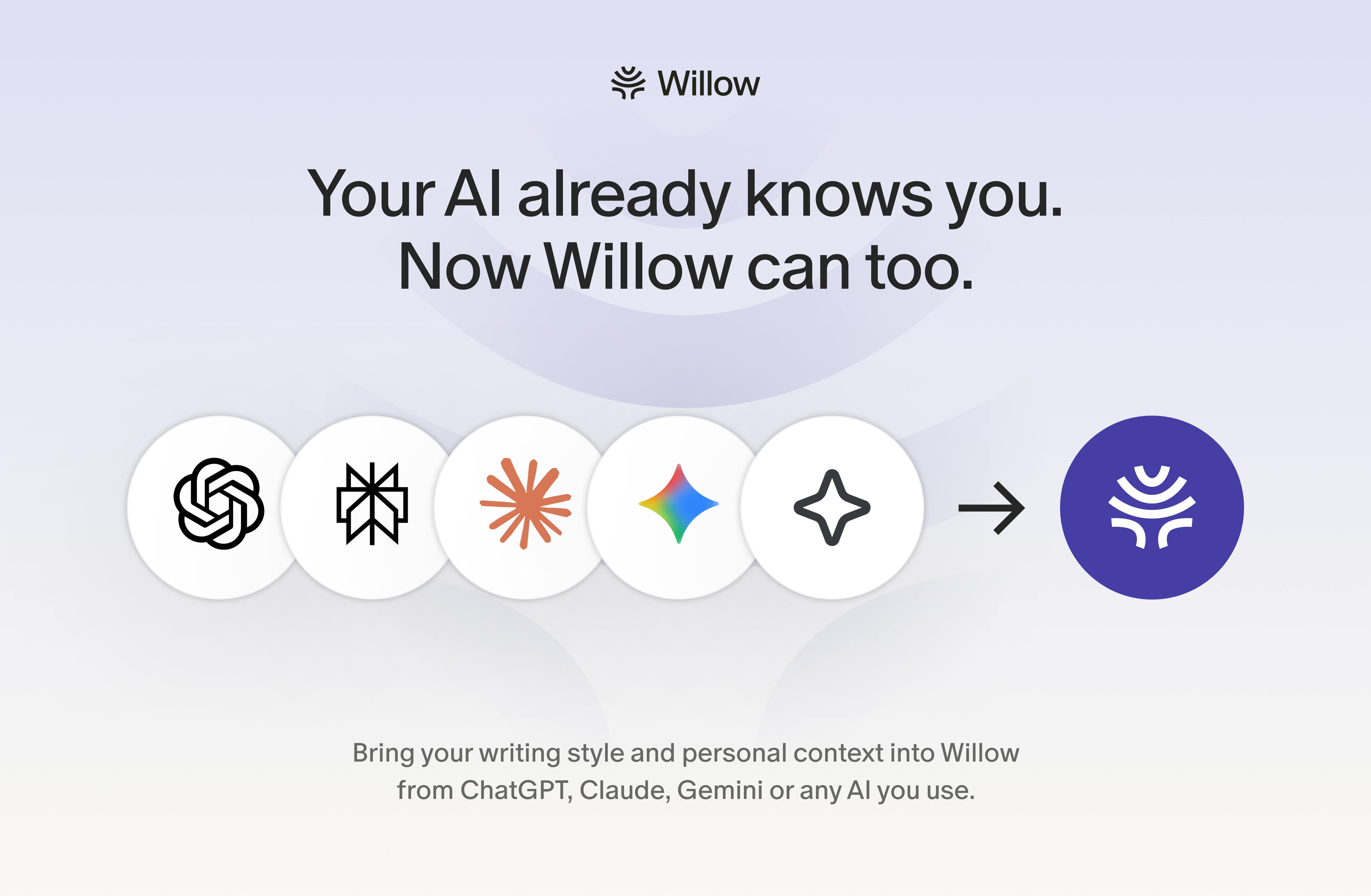
Its core pitch is straightforward: "Your AI already knows you. Now Willow can too." After launching on Product Hunt, the product earned 71 upvotes and 3 comments, landing at #12 on the day's leaderboard, categorized under productivity, writing, and artificial intelligence.
What It Actually Does
Willow Knowledge lets users transfer the writing style and personal context they've built up in ChatGPT, Claude, Gemini, or other AI tools directly into Willow. In other words, if you've already spent time training a large language model to match your tone and expression, that "persona" doesn't need to be rebuilt from scratch — it can be imported directly.
The company describes this as "giving Willow Scribe superpowers." The practical effect shows up in specific scenarios: when you dictate an email, a Slack message, or a prompt via voice, the output sounds "just like you wrote it" rather than a standardized, generic piece of text.
There's a clever insight behind this design. It acknowledges a real-world truth — a lot of users' personal language data and preferences have already accumulated inside mainstream LLM platforms. Rather than having every new tool re-collect user habits from scratch, Willow builds a "style transfer bridge" that reduces the cost of switching.
It's worth noting that ChatGPT's "Custom Instructions," Claude's "Projects" memory feature, and Gemini's personal preference settings are essentially containers that each platform uses to store users' writing preferences. The process of training these systems often takes weeks or even months of iterative effort — telling the AI whether you prefer concise or detailed responses, formal or casual tone, whether you use the Oxford comma or avoid industry jargon. These accumulated preferences have traditionally been locked within a single platform, forming a classic "data moat" that makes switching difficult. Willow Knowledge attempts to break that lock-in, but doing so requires that preference data from each platform can somehow be read or exported — a non-trivial technical and authorization challenge in practice.
Why This Direction Is Worth Watching
Competition among voice productivity tools is shifting from "transcription accuracy" to "output personalization." Accurate recognition is now a baseline expectation; what actually differentiates the experience is whether the tool can preserve the user's tone, vocabulary habits, and expressive rhythm.
For people who rely heavily on voice input — such as professionals who handle large volumes of email or communicate through team collaboration tools — tonal consistency directly affects their professional image. An email that doesn't sound like you may require repeated manual edits, negating the time savings that voice input was supposed to provide. Willow Knowledge tries to absorb those editing costs upfront.
The Product Logic Behind Portable Style
From a strategic standpoint, Willow's decision to support multiple mainstream AI platforms — ChatGPT, Claude, Gemini — rather than locking into a single ecosystem is a pragmatic one. It positions itself as a "style reception layer" that sits on top of large models rather than competing with them. This lowers the barrier to adoption: you don't need to abandon your existing AI workflow; you're simply letting voice input share the same "your style" profile.
What to Be Cautious About
The information officially disclosed so far remains at the level of feature claims. The specific technical implementation, migration method, and accuracy haven't been elaborated on. For instance, it's unclear whether "importing writing style" works by analyzing historical text samples or by connecting to each platform's memory or custom instruction features.
Migrating personal context also inevitably raises privacy and data security concerns. Moving personal writing data from one AI platform to another tool raises legitimate questions: How is the data stored? Is it used for training? Can it be fully deleted? None of these points are addressed in the available materials.
Additionally, 71 upvotes and 3 comments on Product Hunt represents moderate traction — not enough to validate real-world retention or user satisfaction. The effectiveness of personalized writing is highly subjective, and how well "sounds like you" actually works will ultimately require large-scale, long-term user feedback to verify.
In the AI personalized writing space, "style transfer" typically follows one of two mainstream technical approaches: few-shot prompting, where the user's historical writing samples are injected as examples into the prompt so the model can mimic their style; or retrieval-augmented generation (RAG), where a personal corpus is built for the user and relevant style references are dynamically retrieved at generation time. Both approaches involve tradeoffs between output consistency and privacy risk — the former is lighter to implement but limited in style fidelity, while the latter delivers better results but requires persistent server-side storage of user data. Willow has not disclosed which path it uses, and that information is critical for evaluating both product effectiveness and data security commitments.
Summary
Willow Knowledge pushes the competitive focus of voice input tools toward "personalized expression," cleverly reusing users' existing AI investment through the concept of style transfer. The direction aligns with the broader evolution of voice productivity tools, and the product positioning is grounded and pragmatic. That said, on the dimensions of technical implementation, privacy handling, and real-world experience, it still needs more public information and user validation to back up its promises. For users who regularly rely on voice input for written work, this is a new option worth keeping an eye on — but one that warrants a wait-and-see approach for now.
Related articles

Chain of Thought Isn't Just for AI: How Humans Can Use CoT to Improve Thinking Quality
Chain of Thought isn't just a prompt trick for large models. Starting from a Hacker News discussion, this article analyzes why CoT works for human thinking too, breaks down actionable ways to transfer it, and highlights the key differences between human CoT and machine CoT.
Cloudflare Teams Up with OpenAI: Closi…
Cloudflare Teams Up with OpenAI: Closing the Loop from Vulnerability Discovery to Defense with AI
Cloudflare uses OpenAI Daybreak to investigate security vulnerabilities and generate reviewable remediation plans, while developers use Codex to boost coding efficiency and quality.

Orca Multi-Agent Orchestration in Practice: A Guide to Parallel Collaboration with Claude and Codex
Orca is Stable AI's free open-source agent workbench supporting 34 agents like Claude Code and Codex in parallel. Learn its Git worktree isolation, multi-model orchestration, and mobile management.