Wine Ported to OpenBSD: New Progress for the Cross-Platform Compatibility Layer

Wine has been experimentally ported to OpenBSD by the community, faces conflicts with security mechanisms, and has not yet entered the official ports tree.
The open-source Windows compatibility layer Wine has recently seen a community-driven OpenBSD porting attempt, with discussions drawing attention on the OpenBSD mailing list and Hacker News. The main difficulty is the conflict between OpenBSD's strict security mechanisms, such as W^X memory protection and the pledge/unveil sandbox, and Wine's runtime requirements. DirectX acceleration and similar features may be limited, but basic Win32 applications are expected to run. Community reaction is mixed: supporters see it as a positive sign of ecosystem diversity, while skeptics consider OpenBSD mainly a server platform with limited practicality. Patches have been submitted but not merged into the official ports tree, so it remains early experimental work that users must compile and test themselves, and its lessons are valuable for other compatibility layer projects.
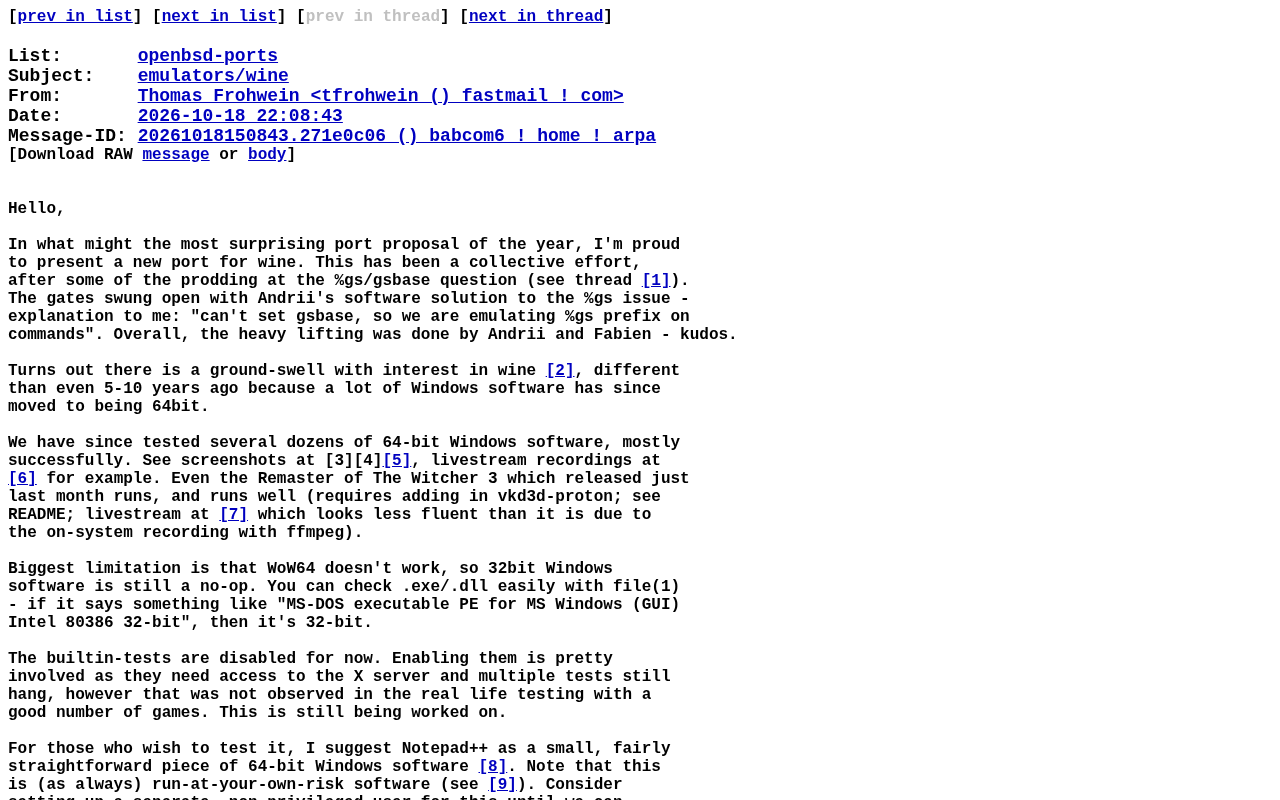
Wine is an open-source compatibility layer that allows Windows applications to run on Unix-like systems. Recently, a discussion about porting Wine to OpenBSD appeared on the OpenBSD mailing list and drew attention on Hacker News with 251 points and 58 comments. This marks an attempt by the OpenBSD community to expand software compatibility.
Porting Background and Challenges
OpenBSD is known for its strict security auditing and exacting code quality requirements. Porting a complex project like Wine to OpenBSD is no easy task, because Wine must handle a large number of Windows API calls, memory management, and system call compatibility. According to information on the mailing list, the porter needs to resolve conflicts between OpenBSD-specific security mechanisms (such as W^X and pledge/unveil) and Wine's runtime requirements.
According to comments in the Hacker News discussion, this port is not officially supported but rather community-driven experimental work. Participants mentioned that some Wine features (such as DirectX acceleration) may be limited on OpenBSD, but basic Win32 applications are expected to run.
W^X (Write XOR Execute) is a memory protection policy that OpenBSD has enforced on most architectures since version 5.8, requiring that no memory page be simultaneously writable and executable. This mechanism effectively blocks classic memory injection and shellcode execution attacks, but it creates obstacles for runtimes that need to dynamically generate and execute code. Most Wine scenarios do not rely on just-in-time compilation, but some of its components (such as the VBScript/JScript engine and certain paths of the .NET runtime) generate executable code and need to be adapted through W^X-compatible mappings of mmap or dual mapping techniques.
pledge and unveil are two sandboxing mechanisms in OpenBSD. pledge restricts the categories of system calls a process can invoke, while unveil restricts the file system paths visible to a process. As a compatibility layer, Wine needs to emulate Windows file access semantics and execute a large number of system calls, so its runtime behavior is inherently in tension with pledge's static constraints. Porters typically need to declare a broader pledge set at startup or split the process by functional module to reduce the privilege surface.
Community Reaction and Significance
The discussion on Hacker News (58 comments) reflected two viewpoints: some see this as a positive signal of OpenBSD ecosystem diversity, while others question its practicality, since OpenBSD is usually used for servers and network devices rather than desktop applications. However, according to some commenters, some OpenBSD users also need to run lightweight Windows tools, such as certain specialized software or legacy applications.
From a technical perspective, porting Wine to OpenBSD may drive improvements to OpenBSD's kernel compatibility layer and provide a reference for other similar projects (such as Linux compatibility layers). The mailing list link shows that patches for the porting work have been submitted but have not yet been merged into the official ports tree.
The OpenBSD ports tree is the project's collection of third-party software packages, maintained in a centralized model where each port is handled by a designated maintainer and must pass strict build and security checks before entering the official tree. Ports are built on the ports(7) framework and include a Makefile, a patch set, and a plist file. After patches are submitted, a port typically goes through review, testing, and maintainer adoption, so "patches submitted but not merged" means it is still in candidate status, and users can only try it by locally overriding ports or compiling manually. This is similar to how FreeBSD's ports collection and pkgsrc work, but OpenBSD has a higher bar for introducing new ports.
Implications for Developers
For developers focused on cross-platform development, this development is worth noting. The Wine porting process involves extensive system call adaptation and security trade-offs, and these lessons can be applied to other compatibility layer projects. In addition, OpenBSD's strict security model may force Wine to implement safer code paths, which in the long run also benefits Wine itself.
Currently, the port is still in an early stage, and users need to compile and test it themselves. Developers who are interested can consult the original patches and discussions on the OpenBSD mailing list.
According to information from Hacker News and the OpenBSD mailing list, this port is community experimental work and has not yet become an officially supported feature.
Linux compatibility layers (such as FreeBSD's linuxulator and NetBSD's Linux emulation) implement the Linux system call interface in the native kernel so that Linux binaries can run without modification. Wine takes a different path: it translates Win32 API calls into POSIX calls in user space rather than relying on kernel-level system call emulation. The two strategies can be combined—Wine itself can run on top of a Linux compatibility layer, or it can target native system calls directly. The lack of a mature Linux compatibility layer on OpenBSD means that porting Wine relies more on user-space adaptation than kernel support, which is one source of the technical difficulty of this work.
One-line Summary
Wine has been experimentally ported to OpenBSD by the community, faces conflicts with security mechanisms, and has not yet entered the official ports tree.
Paragraph Summary
The open-source Windows compatibility layer Wine has recently seen a community-driven OpenBSD porting attempt, and related discussions have attracted attention on the OpenBSD mailing list and Hacker News. The main difficulty of the port lies in conflicts between OpenBSD's strict security mechanisms—such as W^X memory protection and the pledge/unveil sandbox—and Wine's runtime requirements. Features such as DirectX acceleration may be limited, but basic Win32 applications are expected to run. Community reaction is mixed: supporters see it as a positive signal of ecosystem diversity, while skeptics argue that OpenBSD is mainly used in server scenarios, so its practicality is limited. Currently, patches have been submitted but not merged into the official ports tree, and the work remains early-stage and experimental, requiring users to compile and test it themselves; its lessons are valuable for other compatibility layer projects.
Related articles

Chain of Thought Isn't Just for AI: How Humans Can Use CoT to Improve Thinking Quality
Chain of Thought isn't just a prompt trick for large models. Starting from a Hacker News discussion, this article analyzes why CoT works for human thinking too, breaks down actionable ways to transfer it, and highlights the key differences between human CoT and machine CoT.
Cloudflare Teams Up with OpenAI: Closi…
Cloudflare Teams Up with OpenAI: Closing the Loop from Vulnerability Discovery to Defense with AI
Cloudflare uses OpenAI Daybreak to investigate security vulnerabilities and generate reviewable remediation plans, while developers use Codex to boost coding efficiency and quality.

Orca Multi-Agent Orchestration in Practice: A Guide to Parallel Collaboration with Claude and Codex
Orca is Stable AI's free open-source agent workbench supporting 34 agents like Claude Code and Codex in parallel. Learn its Git worktree isolation, multi-model orchestration, and mobile management.