Wireless GPU Hands-On: A Laptop Calls an RTX 5090 Over the Air

Video demos a wireless GPU prototype: an RTX 5090 in a suitcase lets a laptop call remote compute over Wi-Fi.
A YouTube video shows a "wireless GPU" device in a suitcase with an NVIDIA RTX 5090 inside, delivering compute to a laptop over Wi-Fi. The remote card appears directly as the laptop's "GPU 1" and works without special configuration. The author ran Cyberpunk over Wi-Fi and confirmed via NVIDIA-SMI that the load landed on the remote 5090. Named Wi-Sci, the solution claims to run large models and involves a 410TB memory pool, but implementation details are not disclosed. The article sees it as a radical form of compute-terminal separation, though network dependence, latency, memory-pool form, and power/cooling remain open—more a feasibility validation than a product.
A laptop with no external cables connected can still call on an RTX 5090 to run Cyberpunk and even load large models that shouldn't be able to run on that machine. This isn't science fiction—it's a "wireless GPU" prototype demonstrated in a YouTube video.

Unboxing: An RTX 5090 in a Suitcase
The video's author received a strange device packed inside a suitcase—it doesn't look like a graphics card from the outside, but inside sits an NVIDIA RTX 5090. He defines the device as a "wireless GPU": it delivers the compute power of a desktop-class graphics card to another device over a wireless network.
The idea isn't new—cloud GPUs and remote streaming have done similar things. But turning a card of the 5090's caliber into a portable wireless node, and making it appear at the system level directly as a "local GPU," makes a fundamental difference in experience.
System Recognition: It's Like the Laptop's Built-in Graphics
After booting up, the author connected with a small ASUS laptop. In addition to the laptop's original integrated/discrete GPU, the system showed an extra "GPU 1," recognized as an RTX 5090.
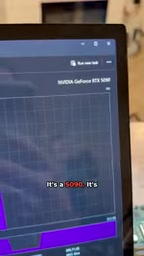
The key is the "seamlessness": no special configuration beyond installing drivers, no manually specifying a remote rendering pipeline—in Task Manager (or an equivalent tool), it's simply a graphics card of this laptop. To upper-layer applications, the boundary between local and remote GPUs is erased—this is the most valuable part of the approach, and what distinguishes it from traditional remote desktop streaming.
PCIe and the "Disguise" Mechanism of Remote GPUs
Modern operating systems and applications enumerate GPU devices through the PCIe bus, and drivers depend on this layer of abstraction. To make a remote GPU be recognized as local hardware, one typically needs to implement a virtual PCIe device at the kernel or driver layer, mapping compute instructions and memory operations from the remote side onto the local bus. This involves complex address translation, interrupt emulation, and DMA remapping. Traditional remote streaming (such as Steam Remote Play) captures frames and input at the application layer, whereas solutions like Wi-Sci attempt to deceive the operating system at the system layer, transparently redirecting all GPU calls (including CUDA, DirectX, and Vulkan) to the remote side. This requires extremely low protocol overhead and efficient remote memory access; otherwise, performance loss becomes very noticeable.
Hands-On: Running a AAA Title Over Wi-Fi
The author opened Cyberpunk directly on the laptop. The image rendered normally, and he used NVIDIA-SMI to check GPU utilization, confirming that the computation was indeed landing on the remote 5090.
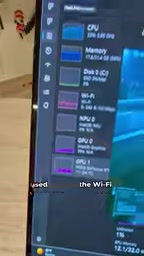
At the network level, the entire link runs over Wi-Fi rather than wired. Once the device came under load, the fans clearly spun up, and audible cooling noise could be heard—indicating that the 5090 was genuinely running under high load, not executing some lightweight placeholder task.
What's worth noting is latency. The video doesn't provide specific frame rates or latency figures, but from the author's ability to play normally, the Wi-Fi link's transmission quality has crossed the "playable" threshold. Of course, how far this is from esports-grade low latency can't be judged from a demo alone.
NVIDIA-SMI and Remote GPU Monitoring
NVIDIA-SMI is the system management interface provided by NVIDIA for monitoring GPU utilization, memory usage, temperature, and more. In a remote GPU scenario, the locally running nvidia-smi needs to be able to query the remote GPU's status, which requires the driver layer to forward query requests to the remote side and return the results. In the video, the author confirms via NVIDIA-SMI that the load lands on the remote 5090, showing that the solution achieves transparent redirection of the management interface. But this also brings challenges around security and multi-tenant isolation: if multiple clients share the same remote GPU, how do you guarantee resource isolation and QoS? The current demo involves only a single client; production environments would require further design.
Bigger Ambitions: A 410TB Memory Pool and Wi-Sci
The demo goes beyond gaming. The author mentions the solution is called Wi-Sci—Wireless Computing Infrastructure—and claims it can run large models that "shouldn't be running on that little laptop."

The figure he gives is 410TB of memory—but he specifically emphasizes "not in the way you're thinking." The implication is clear: this 410TB is most likely not the VRAM of a single machine, but some kind of memory pool aggregated across nodes. The video doesn't elaborate; the author saves the full explanation for later in the video.
If this direction holds, its significance goes beyond "remote gaming." Decoupling compute and memory from the end device means the terminal can be made extremely light while heavy workloads are centrally scheduled—another path for local large-model inference and multi-device collaborative computing.
Memory Pooling and Distributed Shared Memory
A 410TB memory pool most likely refers to aggregating the memory of multiple machines (including VRAM and main memory) over a high-speed network to form a unified virtual address space. This resembles a distributed shared memory (DSM) system, but it must address cache coherence, remote direct memory access (RDMA) latency, and bandwidth bottlenecks. Common implementations include NVLink (limited distance) or RDMA over Converged Ethernet based on InfiniBand/RoCE. However, Wi-Fi's bandwidth and latency fall far short of wired networks, so if a 410TB memory pool depended on Wi-Fi, performance would struggle to meet the demands of large-model inference. The author's emphasis on "not in the way you're thinking" may hint at more complex architectures such as tiered storage or near-memory computing rather than simple network aggregation.
A Sober View: There's Still a Gap Between Demo and Product
It must be acknowledged that this is a demo-focused video—high in information density but light on technical details. Several unresolved questions deserve attention:
- Network dependence: Wi-Fi link stability, packet loss handling, and handover capability in mobile scenarios are all prerequisites for usability.
- Latency ceiling: Being able to play games doesn't mean all interactive workloads can run; professional rendering and real-time inference are more latency-sensitive.
- The true form of 410TB: How the memory pool is organized, what the bandwidth is, and how coherence is guaranteed—the video explains none of this.
- Power and cooling: For a suitcase-form device, mobility and power supply are unavoidable engineering problems.
From a technology-trend perspective, "separating compute from the terminal" is being attempted repeatedly. Wireless GPU pushes this concept into a more radical form: rather than turning the terminal into a thin client, it makes remote compute disguise itself as local hardware within the system. If this approach matures into an engineered product, both the form factor and pricing structure of end devices could be redefined.
But at this stage, it's more a polished feasibility validation than a deliverable product. The line in the video—"you'll have to watch the full video to learn more"—itself indicates that key information has yet to be fully disclosed.
(This article is based on content from a YouTube video; all cited figures come from the video's original statements and have not been independently verified.)
The Difference Between Thin Clients and Hardware Virtualization
Traditional thin clients (such as VDI) run the entire desktop session on the server side, with the client only receiving a stream of frames and all peripherals and GPU acceleration on the remote side. Wi-Sci's approach, by contrast, makes the remote GPU "disguise" itself as local hardware: applications still run on the local CPU, and only GPU compute is offloaded to the remote side. This is closer to the "remote GPU" mode in GPU virtualization (as in some NVIDIA GRID implementations), but the latter typically relies on low-latency networks within a data center. Wireless GPU extends this mode to Wi-Fi, with the challenge being network jitter and bandwidth fluctuation. In addition, data synchronization between local applications and the remote GPU (such as texture uploads and framebuffer readbacks) generates substantial round-trip traffic—a severe test for Wi-Fi.
One-line Summary
A video demonstrates a wireless GPU prototype: an RTX 5090 inside a suitcase lets a laptop seamlessly call on remote compute over Wi-Fi.
Paragraph Summary
A YouTube video shows a "wireless GPU" device packed in a suitcase, with an NVIDIA RTX 5090 inside, delivering compute to a laptop over Wi-Fi. The remote graphics card appears at the system level directly as the laptop's "GPU 1" and can be used by applications without special configuration. The author tested running Cyberpunk over the Wi-Fi link and used NVIDIA-SMI to confirm the load landed on the remote 5090. The solution is named Wi-Sci (Wireless Computing Infrastructure) and is claimed to run large models and involve a 410TB memory pool, but the specific implementation is not detailed in the source material. The article views this as a radical form of separating compute from the terminal, but network dependence, latency, the nature of the memory pool, and power/cooling remain unresolved—currently more a feasibility validation than a deliverable product.
Related articles

AI Weekly: Claude Code Backdoor Incident and AI Giants' Capital Game
AI security this week: Cursor marketplace seeded with a Claude Code backdoor affecting Mac and Windows developers. Meanwhile, Amazon AI capex hits $75.9B, Google AI search revenue lags traditional search, Anthropic launches Ultra subscription, and OpenAI commits to robots.txt training signals while publicly defending fair use.

Malicious Claude Code Extension Infiltrates Cursor: Version 2.1.313 Self-Check and Cleanup Guide
A malicious Claude Code build 2.1.313 appeared in the Cursor extension marketplace for about 11 hours, affecting up to 5,000 users. StepSecurity disclosed that it stole system information, git email, and environment variable names, and attempted to implant SSH keys and reverse tunnels. This article covers the incident, malicious behavior, and complete self-check and cleanup steps.

15 Essential Prompts for Vibe Coding: Keep AI from Wrecking Your Code
Vibe Coding often tempts AI to break your code. These 15 prompts—from PRD, architecture, and database to testing and debugging—chain each output as the source of truth, turning AI coding from casual chat into a controllable engineering process.