Wondering: An AI Learning Tool That Lets You Learn Anything Like Playing Duolingo

Wondering uses AI to create personalized, gamified micro-courses for learning any topic.
Wondering is an AI-driven learning app that ranked #2 on Product Hunt, positioning itself as "Duolingo for learning anything." It uses large language models to decompose complex topics into personalized, bite-sized lessons combining visuals, podcast audio, and interactive exercises. While it addresses the lifelong learning market's need for efficient, accessible education, it faces challenges around AI hallucination and maintaining depth.
An AI App Targeting "Learning Anything"
Duolingo reshaped language learning with gamification and bite-sized lessons, helping hundreds of millions of users build the habit of opening an app to learn every day. Now, a new product that recently ranked #2 on Product Hunt — Wondering — is attempting to replicate this successful learning paradigm for "any knowledge." Its slogan says it all: "Duolingo for learning anything."
The product has garnered 165 upvotes and 19 comments on Product Hunt, categorized under Productivity, Education, and Audio. Based on its performance, it clearly taps into a massive and genuine need: people want to master complex knowledge in a more relaxed and efficient way.
What Wondering Actually Is: AI-Driven Personalized Learning Paths
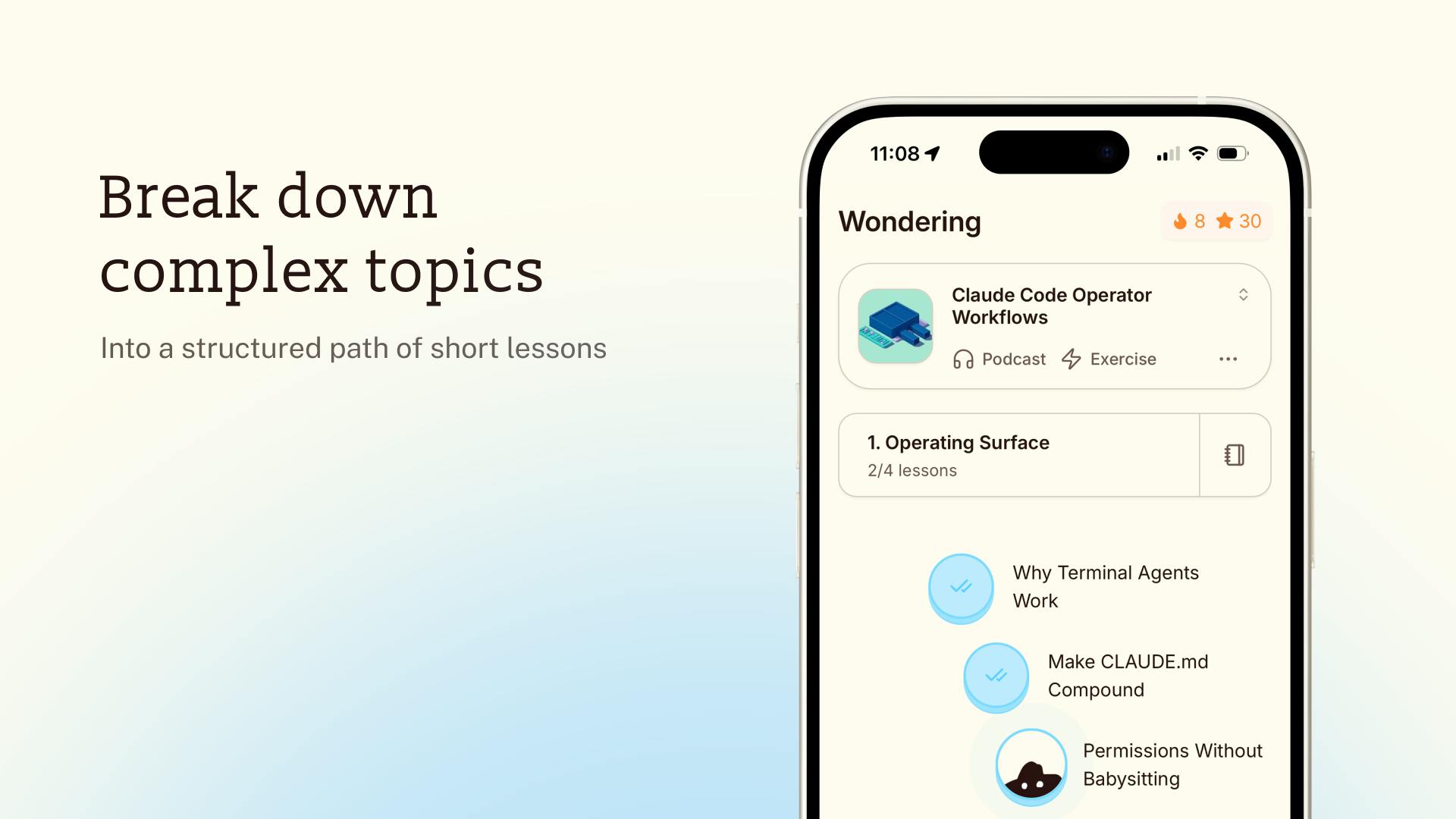
According to official descriptions, Wondering's core philosophy is breaking down complex topics into knowledge "you can remember and actually apply." The user flow is straightforward: you tell it what you want to learn, and it generates a personalized learning path composed of a series of short lessons.
These lessons aren't monotonous walls of text — they blend multiple media formats:
- Visual content: Diagrams to help understand abstract concepts
- Podcast audio: Perfect for listening during commutes or walks
- Interactive exercises: Reinforcing memory through practice rather than passive consumption
This multimodal content fusion isn't just about stacking formats — it's backed by solid cognitive science. Richard Mayer's multimedia learning theory shows that when text and images are presented together following design principles like "spatial contiguity" and "temporal contiguity," learning outcomes significantly outperform single-medium approaches. On the technical side, the podcast audio likely uses text-to-speech (TTS) technology from providers like ElevenLabs or OpenAI to generate natural, human-like voices, while diagrams may be created using structured chart generation tools or text-to-image models. This multimodal synergy essentially leverages "dual coding theory" from cognitive science — information encoded simultaneously through verbal and visual channels produces far better memory retention than single-channel input.
More crucially, the product positions itself as "a thoughtful tutor beside you." It proactively identifies the most important core ideas within a topic and lets you explore at your own pace. This stands in stark contrast to the one-size-fits-all linear structure of traditional online courses.
How Wondering Compares to Duolingo
Duolingo's success stems from a complete set of behavioral incentive mechanisms: instant feedback, achievement systems, streak tracking, and more. The theoretical foundation of this gamification system comes from operant conditioning in behavioral psychology and B.J. Fogg's behavior model — making behavior easy (bite-sized lessons), motivated (game rewards), and triggered (push notifications). Duolingo is particularly adept at leveraging "loss aversion" psychology (fear of breaking a streak) and "variable rewards" (random encouraging animations and achievement badges) to drive users back day after day, resulting in over 34 million DAU.
Wondering borrows the "bite-sized lessons + interactive exercises" shell, but it targets open-ended knowledge domains rather than the highly structured field of language learning.
This creates a fundamental difference: language learning has clear grammar rules and vocabulary boundaries, making it easy to design standardized exercises. "Any knowledge," however, spans everything from quantum mechanics to macroeconomics, with vastly different knowledge structures. Whether Wondering can truly "break down any complex topic" largely depends on the content generation and knowledge organization capabilities of its underlying large model.
The Technical Logic Behind It: How Large Models Generate Personalized Courses
While the team hasn't disclosed technical details, the product's form makes it easy to infer that Wondering is essentially a personalized learning content generation engine powered by large language models.
Large language models (LLMs) like GPT-4 and Claude are built on the Transformer architecture, acquiring broad world knowledge and reasoning capabilities through massive text pretraining. In educational contexts, the core value of LLMs lies not just in possessing knowledge, but in dynamically adjusting content difficulty based on the user's cognitive level — this is essentially the technological realization of Vygotsky's "Zone of Proximal Development" theory: learning materials should be slightly above the learner's current level, neither boring nor frustrating.
The value isn't in "having" knowledge — the internet is already overflowing with it — but in how knowledge is organized and presented. When a user inputs a learning goal, the AI needs to accomplish several things:
-
Knowledge decomposition: Breaking a broad topic into progressive small units. This step involves a core challenge of Knowledge Graph construction — accurately identifying dependency relationships (prerequisite relationships) between concepts. For example, learning calculus requires first mastering the concept of limits. In traditional instructional design, these dependencies are manually annotated by domain experts; when AI automates this, it must avoid situations where learners are asked to "run before they can walk." Additionally, Bloom's Taxonomy of Educational Objectives divides learning into six levels — remembering, understanding, applying, analyzing, evaluating, and creating — and excellent learning paths need to progress gradually through these levels.
-
Multimodal generation: Creating text, diagrams, audio, and other formats for the same knowledge point
-
Key insight extraction: Filtering out the "most important ideas" from massive amounts of information
-
Interaction design: Automatically generating exercises to test and reinforce learning outcomes. This likely employs spaced repetition algorithms — based on Ebbinghaus's forgetting curve, scheduling reviews just as memory is about to decay, achieving maximum retention with minimum time investment.
This is one of the most imaginative application directions for generative AI in education. In the past, creating a high-quality course required instructional design teams spending months; AI now makes instant, personalized course generation possible.
Opportunities and Challenges Worth Watching
Opportunity: A Core Need in the Lifelong Learning Market
In an era of rapidly iterating knowledge, people are no longer satisfied with one-time formal education — they need to continuously learn new skills and understand new concepts. The global online learning market exceeded $350 billion in 2023 and is projected to surpass $1 trillion by 2030. The growth drivers include: accelerating technological change (emerging technologies like AI and blockchain requiring practitioners to continuously update skills), the proliferation of remote work, and the rise of new credentialing approaches like micro-credentials.
However, traditional MOOC (Massive Open Online Course) platforms like Coursera and edX have long seen completion rates hovering between 5-15%, exposing the fundamental limitations of the linear long-course model. Users don't lack the desire to learn — existing product formats simply don't fit real learning behaviors: fragmented time, personalized starting points, and shifting interests.
AI learning tools like Wondering target precisely this growing "lifelong learning" market. They lower the barrier to learning to its minimum — no need to enroll in expensive courses, no need to plow through thick textbooks, just ask a curious question to get started. This offers a completely new approach to the persistent problem of low MOOC completion rates.
Challenge: Accuracy and Depth of AI-Generated Content
However, AI-generated learning content faces inherent skepticism. Large models suffer from "hallucination" problems, potentially generating knowledge that sounds plausible but is factually incorrect. The root cause of hallucinations is that LLMs are statistical next-token predictors rather than fact-database retrieval systems — they learn language patterns, not truth itself. For professional fields requiring rigor (such as medicine, law, and engineering), the cost of misinformation is extremely high.
The industry currently mitigates hallucinations through several approaches: Retrieval-Augmented Generation (RAG) has models retrieve relevant documents from reliable knowledge bases before generating answers; citation tracking requires models to annotate information sources for user verification; confidence assessment flags content where the model is uncertain. For an educational product like Wondering, finding the balance between "instant generation" and "content reliability" will be key to earning professional users' trust.
Additionally, whether the AI's extracted "most important ideas" are truly accurate and whether they oversimplify complex issues are things users should remain vigilant about.
True deep learning often requires facing difficulty and experiencing cognitive struggle. Whether an overly "pleasurable" learning experience might keep learning at a superficial level is a question these products need to answer over the long term. The "desirable difficulty" theory in cognitive science points out that moderate cognitive challenges — such as active recall, interleaved practice, and spaced learning — though making the learning process feel more effortful, produce more durable memories and deeper understanding. How to balance "lowering barriers" with "maintaining desirable difficulty" is a design philosophy question facing all AI education products.
Takeaway
Wondering represents a typical direction for generative AI landing in education: using personalization, multimodality, and gamification to lower the barrier to learning any knowledge. Its impressive ranking on Product Hunt demonstrates strong market expectations for the "AI tutor" concept.
For users eager to learn efficiently, it's worth trying — but maintain a clear head: AI is an excellent learning aid, but it cannot replace deep thinking itself. Treating it as an on-demand introductory tutor is perhaps the most appropriate way to use it.
Related articles

JobRunner MCP Server: AI Agents Can Now Fix Failed Java Jobs
JobRunner launches an open-source MCP server enabling AI agents to view cluster status, diagnose failures, and recover Java jobs—incident response from any cloud coding environment or existing agent.

MLAI Digital Launches 9 Security Agents: MCP Server Safeguards the Full Lifecycle of Agentic AI
MLAI Digital launches Security MCP Server with nine built-in specialized security agents covering vulnerability discovery, attack simulation, prompt injection detection, API and infrastructure assessment, and accelerated remediation—embedding security validation across the full Agentic AI lifecycle from development to production.

Running Isaac Lab on H100 GPUs: Exploring Better Approaches
Exploring optimization methods for running Isaac Lab on NVIDIA H100 GPUs, including MIG configuration, mixed precision, TensorRT acceleration, and community experience to improve robotics simulation and reinforcement learning efficiency.