Word Embedding Learning Roadmap: A Complete Guide from word2vec to Transformer Embeddings

A complete learning roadmap from word2vec to Transformer embeddings for NLP beginners.
This article provides a structured learning path for understanding word embeddings, starting with why classic methods like word2vec shouldn't be skipped, the value of implementing them from scratch, the math prerequisites needed, and progressing through GloVe to Transformer-based contextual embeddings like BERT and GPT, with concrete resource recommendations at each stage.
A CS Student's Confusion: How to Truly Understand Word Embeddings?
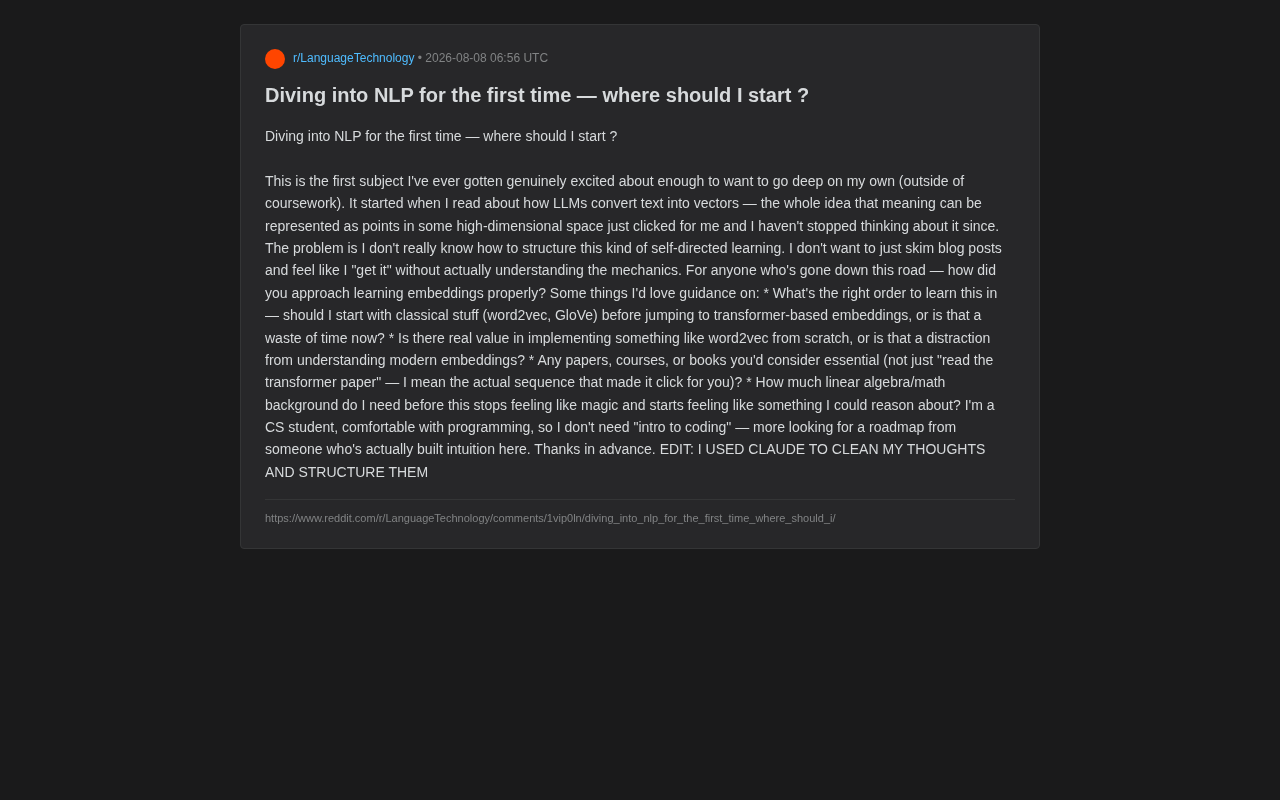
Recently, I came across a very representative question on Reddit. A computer science student had, for the first time, developed a genuine interest in a topic—not because of course requirements, but because a concept had truly struck them. That concept was: how Large Language Models (LLMs) convert text into vectors.
In their own words: "Meaning can be represented as points in high-dimensional space"—this idea was a revelation, and they couldn't stop thinking about it.
This is actually a common "entry point" for many people stepping into the NLP field. Word embeddings are fascinating because they transform an abstract philosophical question—"what is meaning?"—into a concrete object that can be handled with math and code. From Plato's discussion of "Forms" to Wittgenstein's "meaning is use," philosophers debated for thousands of years about questions that now find an operable mathematical expression within the framework of word vectors. But after the initial excitement comes real confusion: Faced with a sea of blogs, papers, and courses, where should a self-learner actually start to truly understand the mechanisms rather than just scratching the surface?
This article attempts to systematically answer this question, providing a learning path from intuition to mechanism, from classical to modern.
Learning Order: Start with Classic word2vec or Jump Straight to Transformers?
The original poster's core question was: "Should I learn word2vec, GloVe, and other classic methods first, or jump directly to Transformer-based embeddings? Would learning the classics be a waste of time?"
Why You Shouldn't Skip Classic Word Embedding Methods
The answer is clear: Don't skip word2vec. The reason isn't that it still has great practical value today, but that it's the purest, cleanest entry point for understanding the concept of "embeddings."
The core idea behind word2vec (especially Skip-gram and CBOW) is extremely simple yet profound:
- Distributional Hypothesis: A word's meaning is determined by the words that frequently appear around it ("You shall know a word by the company it keeps"). This hypothesis can be traced back to linguist J.R. Firth's famous assertion in 1957. In computational linguistics, this idea evolved from Latent Semantic Analysis (LSA, which obtains low-dimensional representations through singular value decomposition of word-document co-occurrence matrices) to neural network language models. word2vec's breakthrough was replacing matrix factorization with shallow neural networks, dramatically improving training efficiency and making it possible to train on billions of words of text.
- By predicting context (or using context to predict a center word), the model is forced to map semantically similar words to nearby vector positions.
When you understand how the classic analogy "king - man + woman ≈ queen" naturally emerges from training, you've truly built an intuition for semantic spaces. This analogy works because semantic relationships are encoded as translation directions in vector space—the "male to female" direction remains consistent across different word pairs. Here, cosine similarity (computing the cosine of the angle between two vectors) is more suitable than Euclidean distance for measuring semantic similarity, because the direction of word vectors reflects semantics better than their magnitude: high-frequency words tend to have larger vector norms, but this doesn't mean they're semantically more "important." Cosine similarity eliminates the effect of magnitude differences through normalization, making semantic comparisons purer. This intuition is the foundation for understanding all subsequent complex models.
The Essential Difference Between Static and Contextual Word Vectors
Once you understand word2vec, you can clearly see its limitations and understand why Transformer embeddings were needed:
- Static word vectors: word2vec gives each word a fixed vector regardless of what sentence it appears in. The word "bank" shares the same vector in "river bank" and "bank account." This means polysemy is unsolvable in static embeddings—the model can only "average" all senses into a single vector.
- Context-aware embeddings: BERT, GPT, and other Transformer-based embeddings are "context-dependent"—the same word gets different vector representations in different sentences. BERT uses a bidirectional encoder architecture, pre-trained through Masked Language Modeling (MLM)—randomly masking 15% of tokens and predicting them, allowing each position's representation to incorporate both left and right context information. GPT uses a unidirectional (autoregressive) decoder architecture that can only see left context, trained by predicting the next token. Both produce dynamic embeddings, but the difference in information flow direction determines their respective strengths: BERT is better suited for understanding tasks (classification, QA), while GPT excels at generation tasks.
This evolution from "static" to "dynamic" is one of the most important threads in NLP over the past decade. Skipping word2vec to go directly to Transformers means losing the critical reference point for understanding "why attention mechanisms are needed."
The Value of Implementing word2vec from Scratch
The poster asked very practically: "Is implementing word2vec from scratch actually valuable, or would it distract from understanding modern embeddings?"
Strongly recommended: implement it at least once. This is absolutely not a distraction—it's the crucial step that transforms "I think I understand" into "I actually understand."
Implementing word2vec from scratch forces you to confront several core issues that library functions typically hide:
- How do you construct training pairs (center word–context word)? Specifically, you need to implement a sliding window that traverses the corpus, extracting context words within the window size for each center word, and organizing them into training pairs.
- What computational bottleneck does Negative Sampling actually solve? The original word2vec requires computing softmax normalization over the entire vocabulary (typically hundreds of thousands of words), with computational complexity of O(V). Negative sampling converts the problem into binary classification: for each positive sample (a real center word–context word pair), k negative samples (typically 5-20) are randomly drawn, and only these k+1 word vectors need updating. The sampling probability typically follows a distribution proportional to word frequency raised to the 3/4 power—this empirical design balances sampling opportunities between high-frequency and low-frequency words, preventing extremely common words (like "the" and "a") from dominating training.
- What are the embedding matrix and output matrix respectively, and how do gradients flow?
- How does the loss function mathematically formalize the goal of "semantic similarity"?
Once you've hand-written all of this, how gradient descent step by step sculpts a meaningful vector space transforms from "magic" into "a process I can reason about." This is exactly the transformation the poster most desires—from magic to something I could reason about.
For modern Transformer embeddings, you don't need to reproduce an entire GPT from scratch, but it's strongly recommended to hand-write the forward pass of Self-Attention at least once. The core of self-attention is using three linear projection matrices (Query, Key, Value) to let each position in a sequence directly attend to all other positions. The specific computation is Attention(Q,K,V) = softmax(QK^T/√d_k)V, where √d_k is a scaling factor that prevents dot product values from becoming too large and pushing softmax into saturation regions with vanishing gradients. Multi-Head Attention splits the embedding dimension into multiple subspaces, letting different heads learn different types of semantic relationship patterns (such as syntactic dependencies, coreference relations, semantic associations, etc.). This mechanism enables the model to process the entire sequence in parallel, breaking through the sequential computation bottleneck of Recurrent Neural Networks (RNNs). Understanding how the Q, K, V matrices compute attention weights can also bring a qualitative leap in understanding.
How Much Linear Algebra Do You Need to Learn Word Embeddings?
"How much linear algebra/math background do I need for all of this to stop feeling like magic?"
The good news: The math threshold for getting started is lower than you might think. You don't need to become a mathematician, but you need solid intuition for the following concepts:
Essential Core Mathematical Concepts
- Vectors and vector spaces: Vector addition and subtraction, dot products (which directly correspond to semantic similarity), cosine similarity. In the context of word embeddings, a 300-dimensional vector is not an abstract mathematical object—each of its dimensions may implicitly encode some semantic property (though individual dimensions are usually not interpretable). Understanding what "distance" and "direction" mean in high-dimensional spaces is the foundation for building embedding intuition.
- Matrix multiplication: Embedding lookup is essentially a matrix operation (multiplying a one-hot vector by the embedding matrix is equivalent to a table lookup), and attention mechanisms are also combinations of extensive matrix multiplications. Understanding the geometric meaning of matrix multiplication as linear transformations—rotation, scaling, projection—helps you intuitively grasp what neural network layers are "doing."
- Gradients and partial derivatives: Understanding how backpropagation updates weights. You don't need to hand-derive every step, but you should understand that "the gradient points in the direction of steepest loss decrease." The chain rule is the mathematical foundation of backpropagation, and the computational graph is its programming abstraction.
- Probability basics: Softmax (converting an arbitrary real-valued vector into a probability distribution), cross-entropy loss (measuring the difference between predicted and true distributions)—these are core to classification and prediction tasks. Understanding the basic idea of maximum likelihood estimation helps you understand why we choose cross-entropy over other loss functions.
Recommended Math Refresher Resources
If these concepts aren't solid yet, it's recommended to spend one to two weeks going through 3Blue1Brown's "Essence of Linear Algebra" video series. It uses visualization to clearly explain the geometric intuition behind vectors and matrix transformations—the best resource for building the understanding that "math is not a symbol game but spatial operations." Additionally, the same series' "Essence of Calculus" and "Neural Networks" videos are also worth watching, covering gradient descent and backpropagation intuition in the same visual style.
An Actionable NLP Word Embedding Learning Roadmap
Overall, for CS students like the original poster who have programming experience, here's a suggested path:
Phase 1: Build Vector Space Intuition (1-2 weeks)
- Watch 3Blue1Brown's linear algebra series to build geometric intuition.
- Read introductory materials on the distributional semantics hypothesis to understand the core idea of "meaning as position." Start with the vector semantics chapter from Jurafsky and Martin's Speech and Language Processing textbook, which is freely available online and continuously updated.
Phase 2: Master Classic Word Embedding Methods (2-3 weeks)
- Carefully read the original word2vec paper (Mikolov et al., 2013), focusing on Skip-gram and negative sampling. Read it alongside Xin Rong's "word2vec Parameter Learning Explained" technical note, which provides a detailed breakdown of the gradient derivation process.
- Implement a simplified word2vec from scratch using NumPy or PyTorch, train it on a small corpus, and visualize the word vectors. Use t-SNE or PCA to reduce high-dimensional vectors to 2D for visualization, directly observing whether semantically similar words cluster together.
- Learn about GloVe's approach and compare its similarities and differences with word2vec (global co-occurrence statistics vs. local window prediction). GloVe (Global Vectors) was proposed by Pennington et al. in 2014, with the core insight that word vectors should be able to explain the ratio of global co-occurrence probabilities between word pairs. Interestingly, subsequent research (Levy & Goldberg, 2014) proved that word2vec and GloVe are mathematically equivalent—they both implicitly factorize a transformed word co-occurrence matrix.
Phase 3: Moving to Transformer Contextual Embeddings (3-4 weeks)
- Read "Attention is All You Need" (Vaswani et al., 2017), but pair it with Jay Alammar's "The Illustrated Transformer." The Transformer architecture proposed in the original paper fundamentally changed the NLP research paradigm, with its core innovation being the complete abandonment of recurrent structures, capturing long-range dependencies in sequences using only attention mechanisms and positional encoding.
- Hand-write the forward pass of self-attention once. Try implementing single-head attention in no more than 50 lines of Python, input a small matrix, and step-by-step verify the dimensions of Q, K, V and the distribution of attention weights.
- Study BERT's contextual embedding philosophy and understand the leap from static to dynamic. Further explore how BERT's pre-train then fine-tune paradigm created NLP's "ImageNet moment," and how the subsequent GPT series pushed this approach to the extreme.
Recommended Systematic Learning Resources
- Course: Stanford CS224n (NLP with Deep Learning) is the widely recognized gold standard, with extremely well-designed assignments. Assignment 2 requires implementing word2vec from scratch, Assignment 3 involves dependency parsing, and Assignments 4-5 cover Seq2Seq and Transformers. All course videos, lecture notes, and assignments are freely available.
- Illustrated blogs: Jay Alammar's Illustrated series explains complex models extremely intuitively. Especially recommended are "The Illustrated Word2Vec," "The Illustrated Transformer," and "The Illustrated BERT."
- Hands-on tutorials: Andrej Karpathy's "nanoGPT" and related videos, building from scratch and understanding every line of code. His recent "Let's build GPT from scratch" video (approximately 2 hours) is the best hands-on guide from self-attention to a complete GPT.
Conclusion: Protect That Initial Excitement
The most touching thing about the original poster was the statement: "This is the first time I've truly felt excited about a topic." On the path of self-learning, the scarcest thing is never resources—it's sustained intrinsic motivation.
True understanding doesn't come from the illusion of "I get it" after quickly skimming a few blog posts. It comes from implementing things yourself, debugging repeatedly, and deriving gradients on paper. When abstract high-dimensional spaces become concrete objects in your hands that you can debug, visualize, and reason about—that moment of "magic becoming science" is the greatest reward of this journey.
It's worth remembering that the researchers doing groundbreaking work in this field today—from Mikolov to the Vaswani team—all started from similar curiosity and confusion. Understanding word vectors isn't just learning a technique; it's learning a way of thinking: how to formalize vague human intuitions into precise mathematical structures, then use computation to verify and extend them.
Key Takeaways
Related articles

Chain of Thought Isn't Just for AI: How Humans Can Use CoT to Improve Thinking Quality
Chain of Thought isn't just a prompt trick for large models. Starting from a Hacker News discussion, this article analyzes why CoT works for human thinking too, breaks down actionable ways to transfer it, and highlights the key differences between human CoT and machine CoT.
Cloudflare Teams Up with OpenAI: Closi…
Cloudflare Teams Up with OpenAI: Closing the Loop from Vulnerability Discovery to Defense with AI
Cloudflare uses OpenAI Daybreak to investigate security vulnerabilities and generate reviewable remediation plans, while developers use Codex to boost coding efficiency and quality.

Orca Multi-Agent Orchestration in Practice: A Guide to Parallel Collaboration with Claude and Codex
Orca is Stable AI's free open-source agent workbench supporting 34 agents like Claude Code and Codex in parallel. Learn its Git worktree isolation, multi-model orchestration, and mobile management.