Words More Efficient Than Phonemes? Information Rate Study Reveals Optimal Encoding Units

960-hour corpus experiment shows words and slightly longer units have the lowest information rate and highest encoding efficiency under limited modeling budgets.
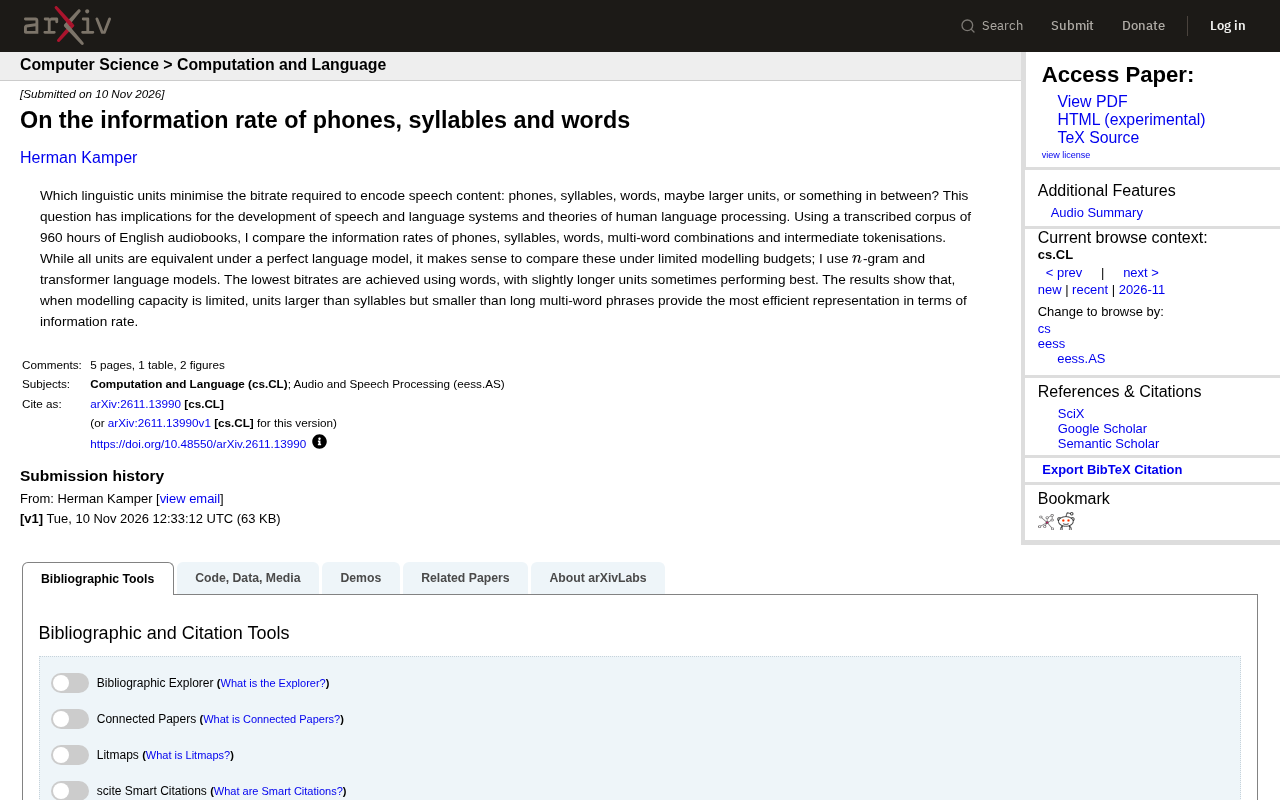
The study addresses the fundamental question of which linguistic unit requires the lowest information rate to encode speech content. Using 960 hours of transcribed English audiobooks, it systematically compares phonemes, syllables, words, multi-word combinations, and intermediate-granularity units under limited modeling budgets. N-gram and Transformer models simulate shallow and deep modeling capacity, with information rate measured by cross-entropy or compression rate. Results show word-level units have the lowest information rate, slightly longer units sometimes perform better, while phonemes and syllables have higher rates due to long sequences, and long phrases suffer from data sparsity. The study emphasizes that under an ideal infinite model all units are equivalent, and optimal granularity depends on modeling capacity.
In speech encoding and language processing, a fundamental question has long remained unresolved: what kind of linguistic unit should be used to represent speech content so that the required information rate is lowest? Phonemes, syllables, words, or larger combinations? This question concerns not only the design of language systems but also our understanding of human language processing mechanisms.
A recent study based on 960 hours of English audiobook corpus compared the information rates of different units under a limited modeling budget and provided a clear answer: words and slightly longer units perform best in encoding efficiency, while syllables and multi-word phrases are relatively inferior.
Research Background: Why Focus on Information Rate?
Information rate measures the number of bits required to encode the content of a unit. Under an ideal language model, the information rates of all units are equivalent—because a perfect model can losslessly compress sequences of any granularity. But real language models have limited capacity, and the efficiency differences among units under a finite budget become prominent.
This study uses the transcribed corpus of 960 hours of English audiobooks to systematically compare the information rates of phonemes, syllables, words, multi-word combinations, and intermediate-granularity units. The authors employ two types of language models, n-gram and Transformer, to simulate limited modeling capacity and thereby evaluate the actual encoding efficiency of each unit.
Information Rate in information theory generally refers to the average amount of information carried per symbol (or per unit time), often measured by Shannon entropy. In language sequence modeling, it is equivalent to the model's average surprisal per unit, in bits. If a segment of speech content is regarded as a message to be transmitted, a lower information rate means that fewer bits are needed to reconstruct that content losslessly (under the model assumptions), indicating higher encoding efficiency.
It is important to distinguish that the information rate under an ideal infinite-capacity model is unit-independent. This is because any granularity sequence can be perfectly compressed to its empirical entropy, and different granularities are merely different segmentations of the same underlying message, with total information conserved. What truly creates differences is the limited modeling budget: when model parameters, training data, or context windows are constrained, different unit sequences differ in learnability and sparsity, leading to divergence in actual cross-entropy. Therefore, "lowest information rate" in this article should be understood as the empirical encoding cost under a given model capacity and corpus size, not an absolute information-theoretic lower bound.
Core Finding: Words Are the Optimal Balance Point
Experimental results show that under a limited modeling budget, word-level units have the lowest information rate, that is, the fewest bits are required to encode the same content. Units slightly longer than words (such as common multi-word combinations) sometimes perform better, but overall words and adjacent granularities occupy the efficiency peak.
In contrast, although phonemes and syllables have fewer unit types and flexible combinations, their sequences are longer and models struggle to capture long-range dependencies, resulting in higher information rates. Long multi-word phrases, due to data sparsity and difficulty in model estimation, show reduced efficiency.
This conclusion echoes the view in linguistic theory that "words are the core units of language processing" and provides empirical evidence for the design of speech encoding systems: when resources are limited, modeling with words as basic units may be more efficient.
Method Details: Fair Comparison Under a Limited Budget
The key to the study lies in the setting of a "limited modeling budget." The authors did not pursue an ideal model with infinite capacity but used two types of actual models, n-gram and Transformer, representing shallow statistical learning and deep neural learning, respectively. By controlling model capacity, they simulated resource constraints in real application scenarios.
The corpus size reaches 960 hours, covering rich English audiobook content, ensuring statistical reliability. Unit types include phonemes, syllables, words, multi-word combinations, and intermediate tokenisations between words and phrases. Information rate is calculated through metrics such as cross-entropy or compression rate, ensuring comparability across different units.
n-gram language models are based on the Markov assumption, estimating the probability of the next unit using the conditional frequencies of the previous n−1 units. They are essentially shallow statistical counting, with weak ability to capture long-range dependencies, and face severe data sparsity problems (requiring smoothing or backoff). Transformer language models, on the other hand, model dependencies at arbitrary distances through self-attention mechanisms, with adjustable parameter counts and context windows, representing deep neural learning. The two types of models correspond to two extremes: "low capacity, strong local statistics" and "high capacity, learnable long-range structure." Comparing them together can test whether the conclusions are robust to the modeling approach.
When comparing across units, attention must also be paid to the trade-off between sequence length and vocabulary size: phonemes have small vocabularies but long sequences, while words have large vocabularies but short sequences. Information rate must be normalized "per original content unit" (e.g., bits per character or per second of speech) to fairly compare different segmentations. Intermediate-granularity tokenisation (such as subwords or combinations between words and phrases) is precisely a compromise introduced to alleviate the contradiction between vocabulary sparsity and overly long sequences.
Implications for Language Systems and Cognition
This study has direct reference value for speech recognition, text compression, and language model design. For example, when building lightweight speech encoders, choosing word-level units may save more bits than phoneme-level. At the same time, it also suggests that human language processing may tend to use words as pivots, because words provide the optimal information rate balance under limited cognitive resources.
However, the authors also point out that under a perfect model all units are equivalent, meaning that unit choice is not absolute but depends on modeling capacity. As model capacity increases, the optimal unit may drift toward finer or coarser granularities. Future work can explore information rate comparisons in more languages and modalities.
"Words are the core units of language processing" has long been supported by evidence in psycholinguistics: lexical recognition studies show that words are the main interface for accessing semantics, while phonemes and syllables mainly serve sublexical acoustic-phonetic encoding functions. The information rate perspective provides a new quantitative explanation for this view—under limited cognitive resources (analogous to limited model capacity), using words as pivots can achieve a better balance between sequence length and combinatorial sparsity.
However, this explanation requires caution regarding the meaning of "equivalence under a perfect model": it shows that the optimal granularity is not an inherent property of language itself but a function of modeling constraints. As model capacity and data volume increase, the optimal unit may drift toward finer granularity (fully exploiting subword regularities) or coarser granularity (exploiting long-range semantics). This is consistent with the experience in neural language models that subword tokenisation is widely superior to pure word-level or pure character-level, and also suggests that the unit choice in speech encoding systems should be dynamically adjusted with available computing power and data scale.
Conclusion
With a solid corpus and clear experimental design, this study answers a fundamental question about language information rate: under limited modeling capacity, words and slightly longer units are the most effective representations for encoding speech content. This finding not only deepens our understanding of the efficiency of language units but also provides quantitative evidence for related technical applications.
Related articles

From 0 to 1: Vibe Coding an AI Knowledge Base — A Practical Retrospective and Tech Stack Breakdown
A retrospective on building the AI knowledge base OilBook from scratch with Vibe Coding: Next.js+Neon stack, Oil Dev Skill workflow, Stripe paywall security, interview-style writing, AI-flavor control, and Vercel deployment.

GLM-5.4 Hands-On: Native Vision Meets a New Vibe Coding Workflow
Hands-on with Zhipu GLM-5.4: native vision tested across a 3D product demo, pure-code video generation, and remote-control Vibe Coding, compared with GPT-6.2 and Gemini Neon.

AI and Humans Claim to Prove the Riemann Hypothesis: Machine-Verified, Yet Nobody Can Understand It
Anthropic mathematician and AI Claude claim to prove the Riemann Hypothesis with 17 million lines of Lean code, machine-verified but unreadable by humans. This article analyzes the event, the zero proportion record from 41.6% to 67.2%, and the gap between machine verification and human understanding.